

Chapecó: the farm capital that barely farms
The capital of western Santa Catarina barely plants anything — it processes. The region's grain and livestock turn into protein, which is why industry is worth 28% of the economy and farming, just 2%.


They call Chapecó the farm capital of western Santa Catarina — and they’re right, but for the wrong reason. The city barely plants a thing: agriculture accounts for only 2% of the value it generates. What Chapecó does isn’t harvest; it’s transform. The grain and livestock of the entire region come in here and leave as packaged protein, ready for Brazil and the world. That’s why industry weighs 28% of the economy — fourteen times more than the fields.
It’s that inversion that makes Chapecó a case study in territorial intelligence: here, agribusiness isn’t a farm, it’s a factory.
Wealth
The grain that becomes protein
Chapecó has 254,000 inhabitants and a GDP of R$ 17.6 billion — around R$ 69,000 per person, higher than that of many a state capital. But the shape of this economy is the opposite of what the agribusiness legend promises:
Chapecó’s industry has a name and a smell: it’s the animal-protein chain — slaughterhouses, packing plants, cooperatives, and the army of warehouses, loading docks and refrigerated trucks that ship out chicken, pork and their byproducts year-round. The region’s farming doesn’t stay in the field; it gets pulled into the city, processed and shipped back out. Mid-sized commerce, the universities (Unochapecó, Uceff) and a strong private healthcare network round out a hub that serves the entire West — one that moves R$ 7.3 billion in credit and R$ 1.35 billion a month in Pix, with an average income of R$ 4,136 per head of household, nearly double the national average. A rare kind of vulnerability: only 4,000 families on Bolsa Família.
A city on four wheels
If Sinop drives a pickup, Chapecó drives a car. The fleet counts 133,000 cars — against 27,000 pickups — the portrait of an industrial, urban city of southern colonization, where the passenger car is the rule and the pickup the exception of whoever still works a smallholding. No surprise, then, that one of the sites Chapecó residents visit most is Webmotors: buying, trading and comparing cars is a local sport. The city has big-city traffic in a mid-sized body — wide avenues, a fleet growing faster than the asphalt, and public transit playing catch-up.

Who lives here
Chapecó’s family profile is young and productive, like that of any frontier of work. The dominant group is married couples with young children (22.8%, above the national average), and young couples without children weigh 10.7% — half again above the country’s average. The elderly are rare (2.8%, nearly a third of the national average). These are people who came, or whose parents came, to work — and stayed.
There is, however, an identity that doesn’t show up in the income figures: pride in being from the West. Chapecó thinks of itself as a place that “produces wealth for the state” and “owes nothing to anyone” — with a certain initial wariness toward outsiders that dissolves with familiarity. The city lives in layers: the impersonal, fast-moving downtown, and the neighborhoods where everyone still knows whose child is whose.
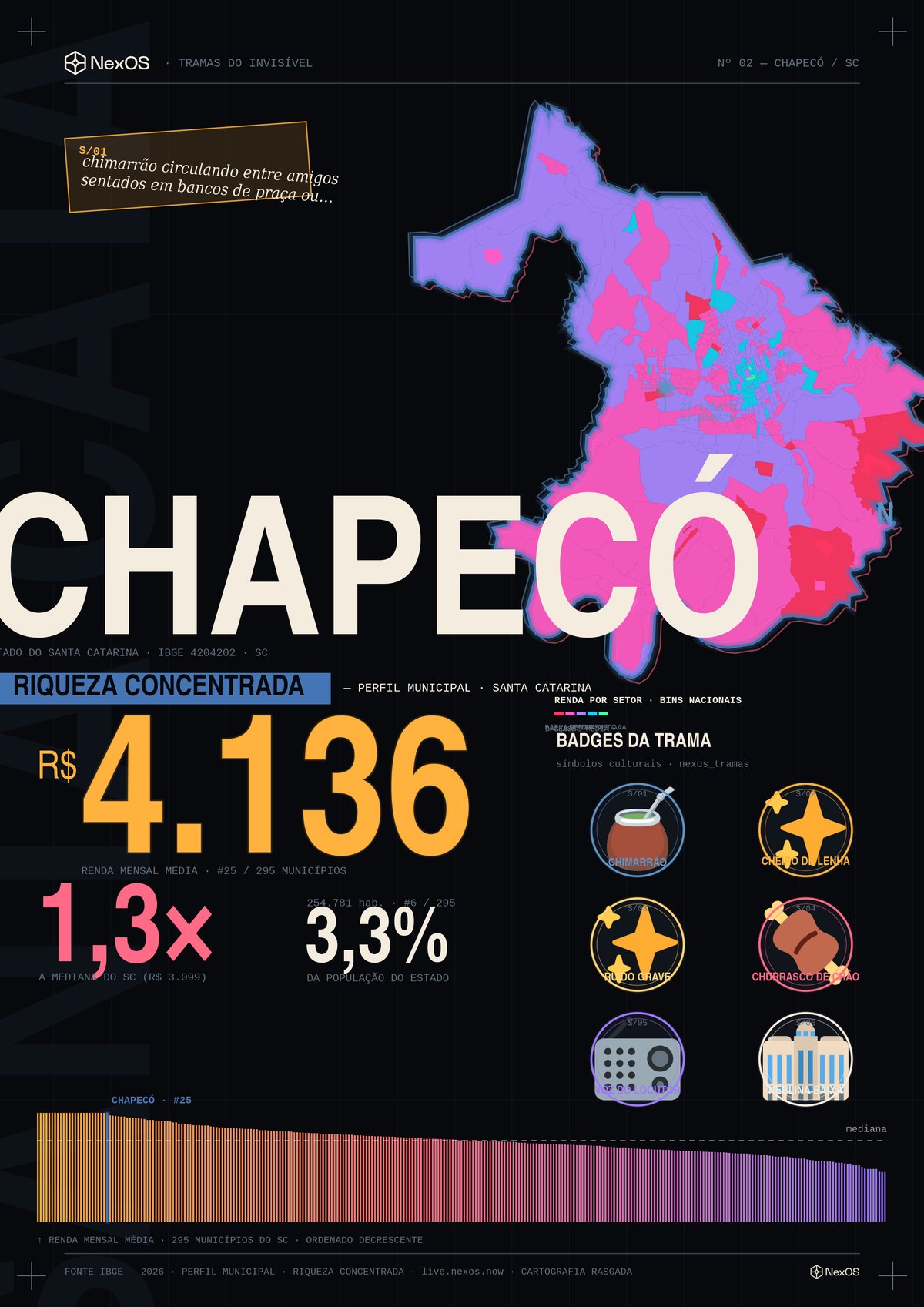
Create your city's poster, for free, at live.nexos.now/poster.

What the city feels
Chapecó’s imagination is one of cold and smoke. The chimarrão steaming in gloved hands on winter mornings, the low fog covering the buildings, the smell of barbecue on weekends, the lights of industrial warehouses burning before dawn, marking the factory shift. And three passions that surface even in what the city consumes on its phones: football — Chapecoense is a religion, and Sofascore is among the most intensely used apps in town — faith — among the most-accessed domains is a Bible app, in a West of traditional Catholicism and rising evangelicalism — and the border: Chapecó residents look up shopping in Paraguay like someone planning their next trip. Football, faith and the open road: the soul of the West across three screens.
The media map nobody buys from outside
Chapecó is a complete media hub — radio, TV, digital and one of the largest cinema networks in interior Santa Catarina — all of it local and buyable:
| Layer | Who commands Chapecó’s attention |
|---|---|
| Radio | Rádio Oeste Capital 93.3 FM leads; behind it, Rádio Chapecó 100.1, Nativa 105.7 and the community station Efapi 105.1 |
| TV | Televisão Chapecó S/A and the regional programming of TV O Estado |
| Local digital | clicrdc.com.br is the leader, followed by diregional.com.br, chapecoonline.com.br and folhadesbravador.com.br |
| Cinema | 5 complexes, ~16 screens and 3,200 seats (Arcoplex, Grupo Cine, Multicine…), with up to 24,000 moviegoers/month |
And don’t mistake “interior” for a news desert: Chapecó is the opposite — an oasis. There are 11 radio stations and 9 active local sites, and the digital leader alone, clicRDC, delivers 1.12 million pageviews a month — the audience of a capital-city portal. All of it local, measured and buyable in a single move through the Alright Network, NexOS’s curation of the largest local and regional media inventory in Brazil:

There’s still a third layer — what Chapecó residents consume on their phones. Cross-referencing the programmatic inventory, you can read the city by access intensity per theme. And one passion dominates all the others:
Chapecoense is a religion, and the data confirms it: football is the city’s most intense category (Sofascore, ogol, scores365), ahead of everything. But what comes next maps the entire West — games among a young, connected public, music and radio (CifraClub at the top), the faith of a Bible app, and the pair that defines the local economy: cars (Webmotors) and the border (shopping in Paraguay). Looking outlet by outlet, by access intensity per user:
The sound of radio in the back of the shop, the Chapecoense match on Sunday, a new car looked up on the phone — Chapecó’s media isn’t nostalgia: it’s the real channel, with a real audience, on sale to any agency in Brazil. Which has simply never looked.
How Chapecó wants to be spoken to
Here communication works when it sounds like a chat with the neighbor over the front gate: direct, sincere, with one foot in everyday life. “A gente,” “pessoal do Oeste,” “guri,” “guria,” “capaz” turn up without strain. The right tone mixes respect and closeness — talking about price, years of service, practical benefit, recognizing that the resident already works plenty and dislikes runaround. The city’s triggers are clear: pride in producing, respect for hard work in the packing plant, in the field or in town, the cold and the chimarrão as part of the day, the care for those who come in from the interior to be treated or to study.
Chapecó is a crossroads that thinks big while being mid-sized. Everything converges here — the grain, the cattle, the student, the patient, the truck. And maybe that’s why it only wants to be spoken to the way it speaks: eye to eye, without exaggeration, in the manner of someone who transforms what others plant and already knows exactly what it’s worth.
Explore Chapecó’s X-ray on NexOS · City hall: chapeco.sc.gov.br · IBGE profile: cidades.ibge.gov.br/brasil/sc/chapeco. See also Sinop, MT — the other end of the same frontier — and the family archetypes.
This piece is part of the Tramas series — territorial intelligence as method. Data cross-referenced by NexOS: IBGE (GDP, 2022 Census), Central Bank (Pix and credit), CadÚnico/Bolsa Família, DETRAN (vehicle fleet), ANCINE (cinema), ANATEL and a curated local media inventory. Profile and classification: the Tramas do Invisível methodology.

Americana, Brazil: nostalgic for the old street, but with fewer multigenerational households than the national average
Americana's Trama profile talks about surnames that repeat across neighborhoods and neighbors who know each other by sight, but NexOS's family archetype data shows only 12.09% of households are multigenerational.

São Carlos, Brazil: behind the tech-hub label, industry pulls 46.7% of BNDES financing, well ahead of trade and services
R$273.7 million in BNDES financing (910 operations) makes industry, led by machinery, the biggest borrower of development credit in a city that sells itself as a university hub.