

Sinop, Brazil: the R$11bn farm city where farming is only 12% of the economy
The unofficial capital of northern Mato Grosso posts metropolis numbers — credit 164% above the national average, 25,000 pickup trucks, local media with a real audience. But the soy that built it has already turned into something else: services, clinics and colleges.


Ask any media planner what Sinop is and the answer comes back fast: soy. It’s the right answer, and an incomplete one. Sinop is the unofficial capital of northern Mato Grosso, a city that grew up pressed against the agricultural frontier and still carries the feel of a place built by people who came from far away “for a while” and ended up putting down roots. But open up the city’s measured economy and the soy isn’t where the legend promises. Agribusiness accounts for just 12% of the value Sinop generates. More than half is services.
That’s the paradox that makes Sinop a case study in territorial intelligence: the harvest makes the money, but it’s the pavement that spends it.
Wealth
The soy that became a service
Sinop has 196,000 residents and a GDP of R$ 11.7 billion — around R$ 60,000 a head, a big-city figure in a town that still looks like the frontier. It plants on a vast scale: 178,000 hectares of soy, worth nearly R$ 1 billion on their own last harvest, plus 149,000 hectares of corn and a herd that tops a million head between poultry and cattle. But the picture of what this economy actually produces dismantles the cliché:
The field looks small because it had already transformed itself before it could be counted. Sinop’s soy doesn’t stay soy: it becomes a dealership, an accounting office, an agronomy consultancy, a clinic, a college, a wholesaler. Agribusiness is the invisible engine — it dictates the flow of money without ever needing to show up on the storefront. When the harvest is good, it isn’t the fields that swell: it’s the clinic that fills up, the college that enrolls more freshmen, the dealerships that empty their lots.
And credit tells the story the GDP hides. The average Sinop resident carries R$ 30,800 in credit per capita — 164% above the Brazilian average. This is not the debt of hardship: it’s the working capital of people financing tractors, silos and trucks. Pix completes the portrait — R$ 8,400 per resident per month, 137% above the national average — and in a single month 132,000 of the city’s 142,000 adults paid for something by tap. Sinop transacts in full, in real time.
The fleet that gives the game away
If Sinop’s wealth doesn’t parade, it drives a pickup. The city has 25,469 pickup trucks in its fleet — one for every eight residents — and the model list reads almost like an agribusiness manifesto: after the popular Fiat Strada (6,026) come the Toyota Hilux (3,986), the Chevrolet S10 (3,254), the Saveiro, the Ford Ranger (1,352) and the Fiat Toro. Behind them, nearly 6,500 heavy trucks, with the Volvo FH leading the grain convoy toward the port.
This isn’t just logistics — it’s social code. In the city’s silent hierarchy, the size of your pickup says as much as the neighborhood you live in or the college you attend. The truck is, at once, a work tool and a calling card. It’s the kind of reading no national panel survey can see: an agricultural-urban fleet that reveals, beyond any doubt, what drives the local economy and how money from the fields chooses to show itself — on wheels, with four-wheel drive.

The ones who came to stay
Sinop’s wealth is young, and the family archetypes prove it. The dominant group is married couples with small children — 23.5% of households, nearly 20% above the Brazilian average. Right behind them, young childless couples make up 11%, more than half above the national average (+53%). And the elderly all but vanish: households of married elderly couples are 55% less frequent than the national average.
The explanation lies in the origin. Sinop wasn’t born on a riverbank: it was born on a drawing board, out of a directed colonization that brought entire families up from the South to clear the forest and raise a gridded city in the middle of the frontier. Hence the air of a permanent work-in-progress — and the class-B income (R$ 4,044 per head of household, 93% above the national average), with income-tax filings running at more than double the national rate. The counter-proof of that concentration is a rare vulnerability: only 6.6% of families receive Bolsa Família, four times fewer than the Brazilian average. Sinop is not a city that needs income transfers. It’s a city waiting for an offer worthy of the money already circulating through it.
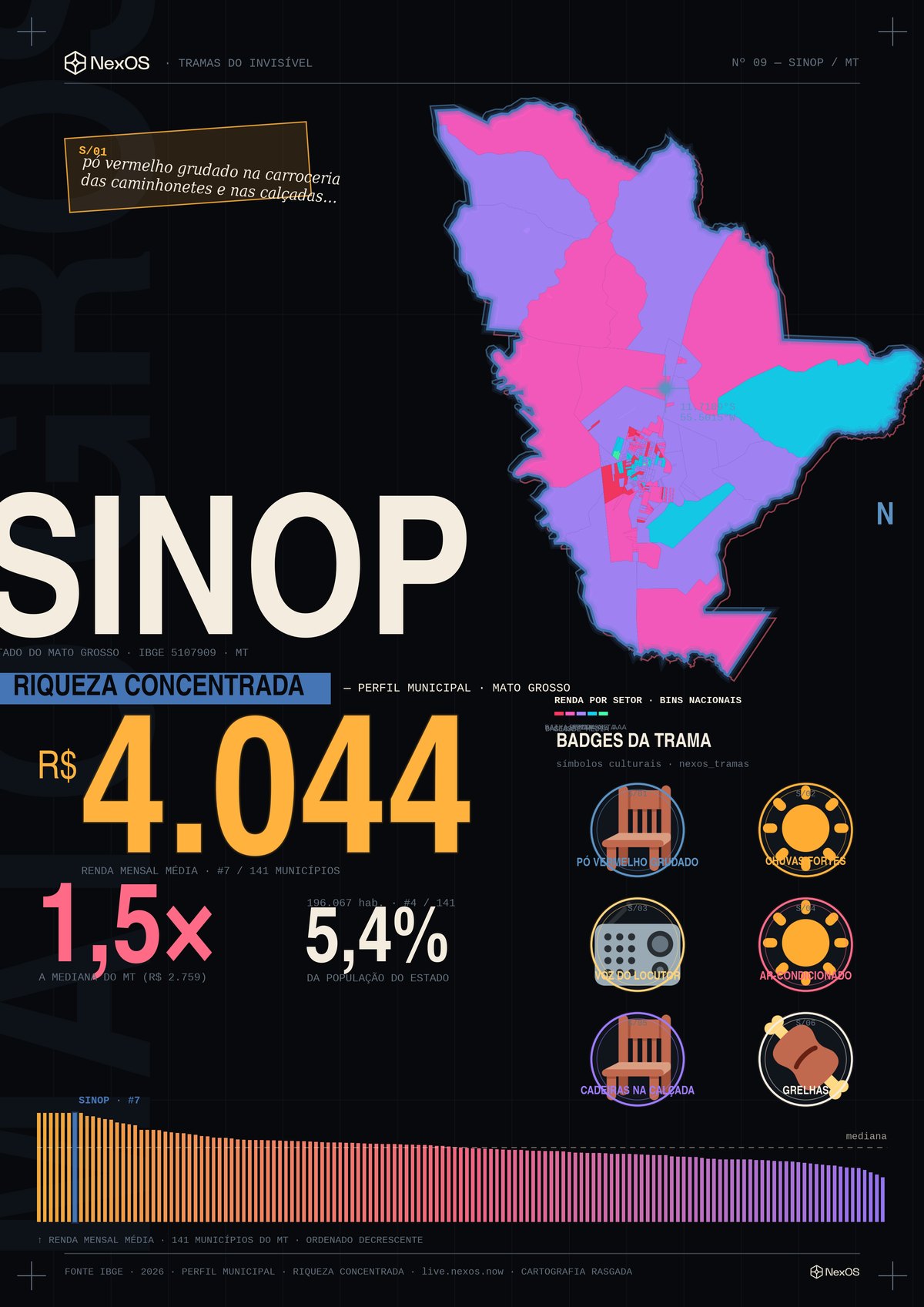
Create your city's poster, free, at live.nexos.now/poster.
The invisible city
Beneath the glass-fronted buildings, Sinop is stitched together by a mesh no map shows. The people who really keep information moving aren’t the media — they’re the motorcycle-taxi driver, the barber, the gym owner, the university sports-club leader. They’re the ones who know who’s building, who just opened a shop, where the trouble was the night before. The small neighborhood shopkeeper extends credit on trust, points you to a job opening, and stitches the newcomer to the old-timer. It’s a network of personal ties that decides, in practice, what becomes a topic and what becomes an opportunity.
This mesh is also one of care. When someone falls ill, neighbors organize a ride to the clinic; groups of mothers swap recommendations for pediatricians and medicines; the church puts together the food basket and the visit. In the face of an accident on the highway — and the highway, here, kills — within hours an online fundraiser appears, a raffle, an event at the society-football arena to collect money. It’s a pragmatic solidarity, moved by bonds, not by institutions.
And all of it pulses to the clock of the harvest. Time in Sinop isn’t measured only in months: it’s measured in planting and reaping. In the harvest windows, truck traffic climbs, repair shops and auto-parts stores fill up, and part of the workforce vanishes from the city. At the start and end of each semester, waves of university students fill and empty the bus station, the shared houses, the bars. At year’s end the city takes a deep breath: families head back “to the homeland” in the South while relatives from the interior arrive to “stroll the mall” and tie up loose ends. Anyone who wants to speak to Sinop has to know which season of the agricultural year the city is in — because its mood, its wallet and its attention all change with it.
There’s tension in this machinery, and it’s recent. The rising value of the center pushes lower-income families out to subdivisions where infrastructure arrives slowly; the urge to “stop renting” before it becomes impossible drives hurried lot purchases. The fleet grows faster than the streets, and the pickup fights for room with the pedestrian and the cyclist. And there’s a memory that won’t heal: the felling of the forest, the smoke from the burns, the accidents in the truck traffic — ghosts of a city that changed its environment too fast and is still arguing over the price of it, in wall graffiti and student collectives.

The wealth that didn't become a right
There’s a crack in the portrait — and it, too, is data. On the Social Progress Index, Sinop scores like a rich city wherever the subject is infrastructure: housing 94, access to information 88, nutrition and basic medical care 78. And it collapses wherever the subject is social mobility: personal rights in critical condition (27 out of 100), low social inclusion (40), low access to higher education (43). It’s the signature of a hub that has solved the basics — house, connection, consumption — but hasn’t yet turned wealth into distributed opportunity. For a brand, an agency or a government, that contrast isn’t a detail: it’s where the agenda of the next ten years lives.
The media map nobody buys from the outside
Here’s what no global platform shows: Sinop is a complete media hub, without a single news desert — and the infrastructure is local, measured and buyable. There are 6 stations based here, 2 broadcast TVs, 10 local sites, and a digital audience concentrated in outlets from the territory itself.
| Layer | Who commands Sinop’s attention |
|---|---|
| Radio | Meridional 98.9 FM leads comfortably — 16,000 listeners and 99% coverage; behind it, Jovem Pan 93.1 and Band 102.9 |
| TV | TV Centro América Sinop (Globo) covers 100% of the territory, followed by Real TV, Record News and SBT Sinop |
| Local digital | sonoticias.com.br is a giant — 420,000 pageviews/month, almost four times the runner-up (gcnoticias.com.br, 111,000) |
All of it is local, measured and buyable in a single move through the Alright Network, the curation NexOS makes of the largest inventory of local and regional media in Brazil:

To this add a screen that agribusiness frequents more than you’d expect: the cinema. Sinop has two complexes — the Moviecom, in the Carandá Shopping mall, and the independent Cine Center — adding up to 7 screens and 874 seats, drawing between 12,000 and 19,000 moviegoers a month. In 35-degree heat, the mall’s air-conditioned screening room is less cinema and more meeting point: it’s the “living room” of Sinop’s middle class, its parking lot packed with pickups. Cinema and DOOH media here isn’t a big-city luxury — it’s where the family goes on a Saturday.
And there’s the layer the interior stereotype denies: addressable digital. Run the inventory through the NexOS filter (679 healthy domains, versus the seven-thousand-plus of the open exchange) and consumption is deeply local — with a signature no state capital has:
Music, games and football the people of Sinop consume like every other Brazilian. What sets the city apart is Notícias Agrícolas among its most intense domains — the farmer who opens the phone to check the grain price before the soy turns into a service — right behind CifraClub, where people learn to play the sertanejo that plays on Meridional. Outlet by outlet, by access intensity per user:
Radio on the way out to the fields, the TV newscast at lunch, sonoticias.com.br on WhatsApp in the afternoon, streaming and CTV at night. Sinop’s media is neither nostalgia nor only a global platform — it’s an ecosystem of radio, TV, local portal, cinema and programmatic that exists, is measurable, and is for sale to any agency in Brazil. One that simply never looked.
How Sinop wants to be spoken to
Whoever speaks to Sinop speaks the way you’d talk in a shop doorway: direct, down to earth, no runaround. “We know how hard the days are around here.” Humor about the heat and the dust works — as long as it doesn’t curdle into mockery of people who work hard. And there’s a courtesy the city demands without saying it: the “us” that sticks here is inclusive, because half the city arrived not long ago and the other half already feels of the land.
The places where the city gathers are well known — the Carandá Shopping, the bus station, the airport, the society-football arenas, the parks at dusk, the neighborhood gyms. But being present in Sinop isn’t about occupying those spots: it’s about understanding that each one is a node in a network that decides, by word of mouth, what deserves attention. In the end, the city of the harvest and the pavement is exactly that: a place where wealth doesn’t parade, it circulates. Where R$ 1.8 billion a month passes from hand to hand without anyone looking rich, because the money here comes from work — and work, in Sinop, is far too serious to become a façade. Anyone who wants to speak to this city first has to understand that it already knows what it’s worth. It’s just waiting for someone to look.
Explore the X-ray of Sinop on NexOS · City hall: sinop.mt.gov.br · IBGE profile: cidades.ibge.gov.br/brasil/mt/sinop. See also our profile of Chapecó and the 4-layer method.
This piece is part of the Tramas series — territorial intelligence as method. Data cross-referenced by NexOS: IBGE (GDP, PAM, 2022 Census), Central Bank (Pix and credit), Federal Revenue Service (personal income tax), CadÚnico/Bolsa Família, DETRAN (vehicle fleet), ANCINE (cinema), ANATEL and curated local media inventory, IPS Brazil. Symbolic profile, invisible networks and classification: Tramas do Invisível methodology.

Americana, Brazil: nostalgic for the old street, but with fewer multigenerational households than the national average
Americana's Trama profile talks about surnames that repeat across neighborhoods and neighbors who know each other by sight, but NexOS's family archetype data shows only 12.09% of households are multigenerational.

São Carlos, Brazil: behind the tech-hub label, industry pulls 46.7% of BNDES financing, well ahead of trade and services
R$273.7 million in BNDES financing (910 operations) makes industry, led by machinery, the biggest borrower of development credit in a city that sells itself as a university hub.