

Dourados, Brazil: R$20bn in wealth and almost no new jobs
Income and credit in the country's top 2%, job creation at rock bottom (among the 2% with the least job creation in Brazil), and the largest urban Indigenous reserve in the country invisible in the numbers.


Dourados generates more than R$20 billion a year — nearly R$84,000 per inhabitant, a rich-city number. The income of those who file taxes is among the top 2% in Brazil. Credit per person, the same: top 2%. By the money coming in, this is one of the most prosperous cities in the country.
And yet it barely creates jobs. In net formal hires per inhabitant, Dourados is among the 2% with the least job creation in Brazil — among the worst municipalities in the country on this measure. It’s the riddle of the red earth: so much wealth, and stalled. The money arrives, irrigates, raises values — but it doesn’t turn into signed work cards at the rate the size of the economy would promise.
job creation
Wealth
The wealth that comes in and doesn't circulate
Dourados has 242,000 inhabitants and the vocation everyone already knows by heart: agribusiness. Soy, corn, sugarcane — and their money. But unlike Sinop, where grain is almost everything, here agribusiness accounts for 10% of the value the city generates; the rest is the urban machinery that agribusiness pays for. Services account for 56% — clinics, colleges, wholesale, repair shops —, industry for 18% and public administration for 16%.
The paradox of Dourados isn’t in the composition — it’s in the distance between two numbers. On one side, the average income of those who file taxes and credit per inhabitant break through the national ceiling: top 2% in Brazil in both. The formal payroll, also in the top 2% of the country. On the other, net job creation per inhabitant plunges to among the 2% with the least job creation in Brazil. The city piles up income at the top and closes jobs at the bottom — an economy that grows rich without spreading it.
The NexOS read classifies Dourados as Concentrated Wealth, and the adjective is literal: the city’s concentration index is among the 15% most unequal in the country. The red earth produces a great deal, but what it produces stays in few hands. It’s soy that becomes credit, credit that becomes a clinic, a clinic that becomes a gated community on the edge of town — a short, rich, closed circuit that turns quickly among those already inside and barely opens a door to those outside.
The city that sees itself
The visible Dourados is prosperous and has plenty to be proud of. It’s a regional health hub — entire corridors of medical and dental clinics draw patients from all over southern Mato Grosso do Sul. It’s a real university town, with UFGD and UEMS sustaining a student economy of shared houses, snack bars, stationery shops and prep courses. It’s a wholesale hub, with Atacadão working as the lung of regional retail, and it has the gym-and-aesthetics middle class that shows up in any city that made money on commodities.
The profile of those who live here confirms the urban, productive portrait: average income of the head of household around R$3,500, and a working-frontier family structure — married couples with children, young couples, people who came from Paraná, from the state’s interior, from the South and Southeast and stayed. The mixed accents, the surnames of every origin, tell the story of a city that grew fast out of farms, sawmills and roads, and became an obligatory crossing point for the region. It’s the Dourados that’s in the data, in the symbols, on the radio — the one that recognizes itself in the mirror.
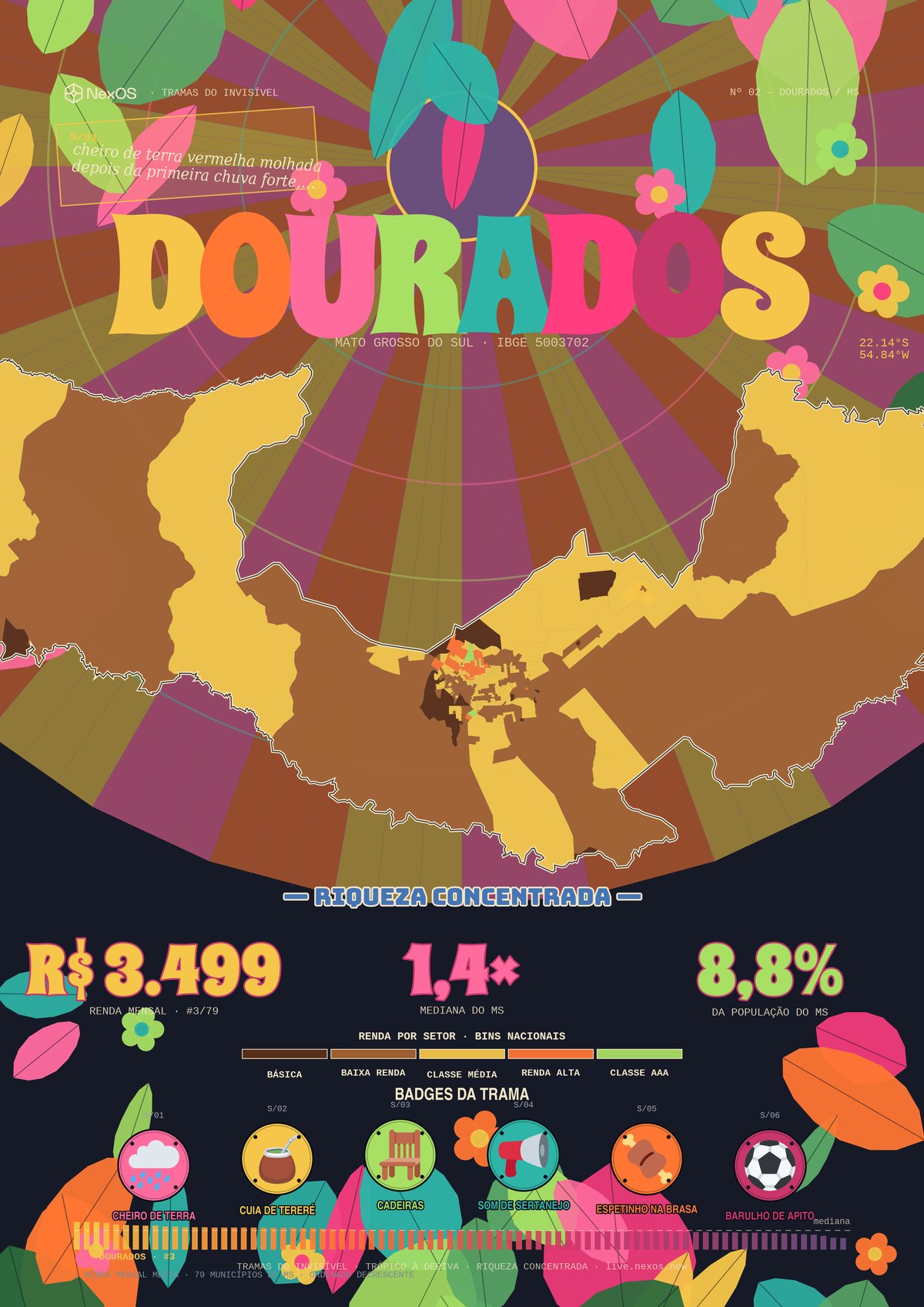
Create your city's poster, for free, at live.nexos.now/poster.

The city that doesn't make the count
There is, however, another Dourados — and it barely appears in anything we measure here. The municipality is home to the Dourados Indigenous Reserve, one of the largest and densest urban reserves in Brazil, where thousands of Guarani, Kaiowá and Terena families live pressed against the fabric of the city. It’s the largest urban Indigenous population in the country — and, in the indicators that portray Dourados as one of the richest in Brazil, it is practically invisible.
Not by chance. The average income that tops the ranking is the average of those who file taxes, hold accounts, take out credit — it frames precisely those inside the circuit. Job creation among the country’s worst 2% and concentration among the 15% most unequal suggest the reverse: an economy that grows without incorporating. And when the very narrative the city tells about itself touches the subject, it does so quietly. In the accounts that circulate in Dourados, the “land conflicts in the rural surroundings” come up discussed “carefully,” alongside “a sense that not all the region’s voices are always heard with the same attention.” The erasure isn’t only statistical; it’s in the tone.
It is not for a territorial intelligence page to speak for the Guarani, Kaiowá and Terena — they have their own voice, and this is not its place. It is, however, to point out what the data does: it builds a Dourados of top-2% income and erases the part of the city that would most need to be told. The red earth that gives the city its emblem its name — “Crossroads of the Red Earth” — is the same that enriches some on top-2% credit and is contested by others. It’s the same earth. It’s just not the same account.
This tension doesn’t resolve in a paragraph, nor should it. It stays — a city that is, at once, one of the portraits of Brazilian agribusiness prosperity and one of the portraits of everything that agribusiness leaves out of the frame.

The media map no outsider buys
For a city this size, Dourados is a complete media hub — radio, TV, digital — and not a news desert. There are 17 radio stations, 2 TV channels and 10 local sites active, all open to buy:
| Layer | Who commands Dourados’s attention |
|---|---|
| Radio | Rádio 94 FM leads; behind it, Jota FM 101.3, Cidade 101.9, the public 91.7, the university 96.3 and the community 104.9 |
| TV | Local regional channels, strong on image-building |
| Local digital | douradosnews.com.br, folhadedourados.com.br and douradosagora.com.br on breaking news; agron.com.br on agribusiness |
The digital leader is Dourados News; in agribusiness, the affinity portal is Notícias Agrícolas, which the region’s producer consumes heavily. All local, measured and buyable in a single shot through the Alright Network, the curation NexOS makes of the largest local and regional media inventory in Brazil:

There’s still a third layer — what the Dourados resident consumes on their phone. Cross-referencing the curated programmatic inventory and reading by access intensity per category, the city draws itself:
Looking outlet by outlet, by access intensity per user, the portrait sharpens: connected young people on games, the passion for music, football, faith — and, a Dourados hallmark, agribusiness rising on the producer’s phone:
Tereré passing hand to hand on the sidewalk, car-stereo sertanejo on Friday night, a meat skewer on the corner, the radio playing low at the corner-store counter — Dourados’s media is the real channel of a city that talks out loud. All measured, all local, all for sale to any agency in Brazil. Which simply never looked.
The question that remains
Dourados is one of the richest ends of Brazilian agribusiness — the other end is Sinop, in Mato Grosso, where grain is almost the entire economy. But if Sinop tells itself by what it plants, Dourados tells itself by what it hides. Here the angle isn’t sectoral; it’s human. A city can have income in the top 2% of the country, credit in the top 2%, and still be, at the same time, a place that barely creates jobs and keeps the largest urban Indigenous population in Brazil on the margin.
The red earth sticks to the tire and to the sole of every sneaker of everyone who lives here. It enriches, it raises values, it gives the city’s emblem its name. The question the statistics don’t answer — and that this page leaves open — is the simplest and the most uncomfortable: whose is the red earth?
Explore the x-ray of Dourados on NexOS · City hall: dourados.ms.gov.br · IBGE profile: cidades.ibge.gov.br/brasil/ms/dourados. See also Sinop, MT — the other end of the same agribusiness — and the family archetypes of Brazil.
This piece is part of the Tramas series — territorial intelligence as method. Data cross-referenced by NexOS: IBGE (GDP, 2022 Census), Central Bank (Pix and credit), Federal Revenue Service (personal income tax), RAIS/CAGED (formal employment), CadÚnico/Bolsa Família and curated local media inventory. Profile and classification: Tramas do Invisível methodology. The Indigenous theme is treated as a structural absence in the data — it is not for this page to speak for the Guarani, Kaiowá and Terena peoples.

Americana, Brazil: nostalgic for the old street, but with fewer multigenerational households than the national average
Americana's Trama profile talks about surnames that repeat across neighborhoods and neighbors who know each other by sight, but NexOS's family archetype data shows only 12.09% of households are multigenerational.

São Carlos, Brazil: behind the tech-hub label, industry pulls 46.7% of BNDES financing, well ahead of trade and services
R$273.7 million in BNDES financing (910 operations) makes industry, led by machinery, the biggest borrower of development credit in a city that sells itself as a university hub.