

Feagro 2026: 80,000 people and 4 local radio stations for your media plan
Latin America's largest Jersey cattle show moves R$ 200 million in Braço do Norte (SC) — a town that media tools treat as empty, but that has a weekly newspaper since 1997, four radio stations and a programmatic media oasis. How a national brand talks to this community.


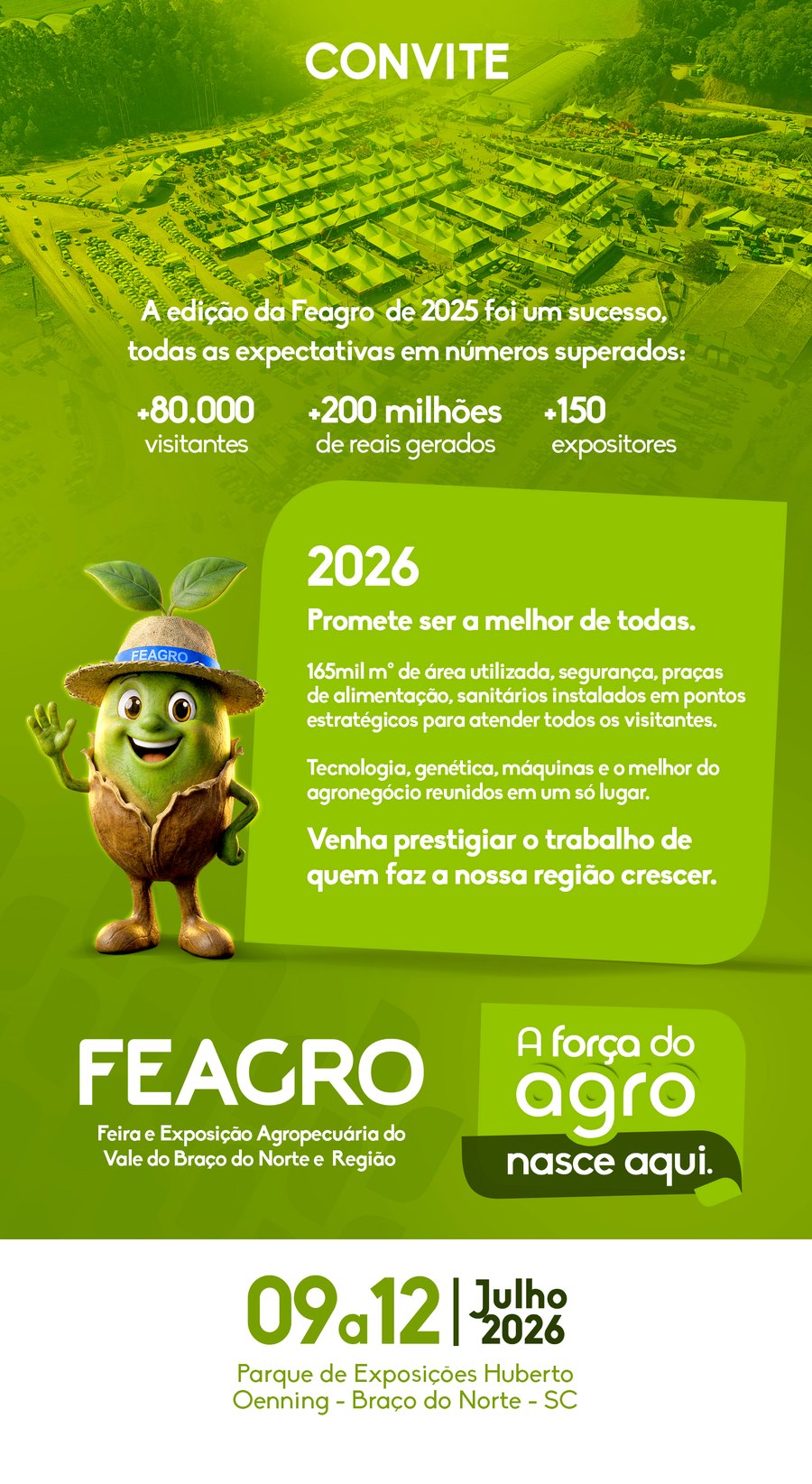
On the second Sunday of July, around three in the afternoon, two 25-kilo piglets will be released onto a 30-meter track in the dairy-cattle pavilion, and the crowd will roar as if it were a penalty kick in a cup final. It’s the piglet race at Feagro, and it sums up what this fair is: an entire town of 34,000 people that, over four days, takes in more than twice its own population and turns cattle genetics, a swine auction and a sertanejo concert into the same party.
Now imagine you’re an animal-nutrition brand, a genetics company or a cooperative, and you want to reach the 80,000 people who walk through. You open the usual media tools, type in Braço do Norte — and they tell you it’s nearly a void: no local TV station, no major national portal. But the automated map is wrong. There’s a printed newspaper that has circulated for almost thirty years, four radio stations and a digital inventory larger than the town itself. The question — how do you talk to this community? — has an answer. It just isn’t where the algorithm looks. And that’s exactly what makes Feagro one of the most interesting cases of territorial intelligence in southern Brazil.
2026
The fair that fits the whole town inside
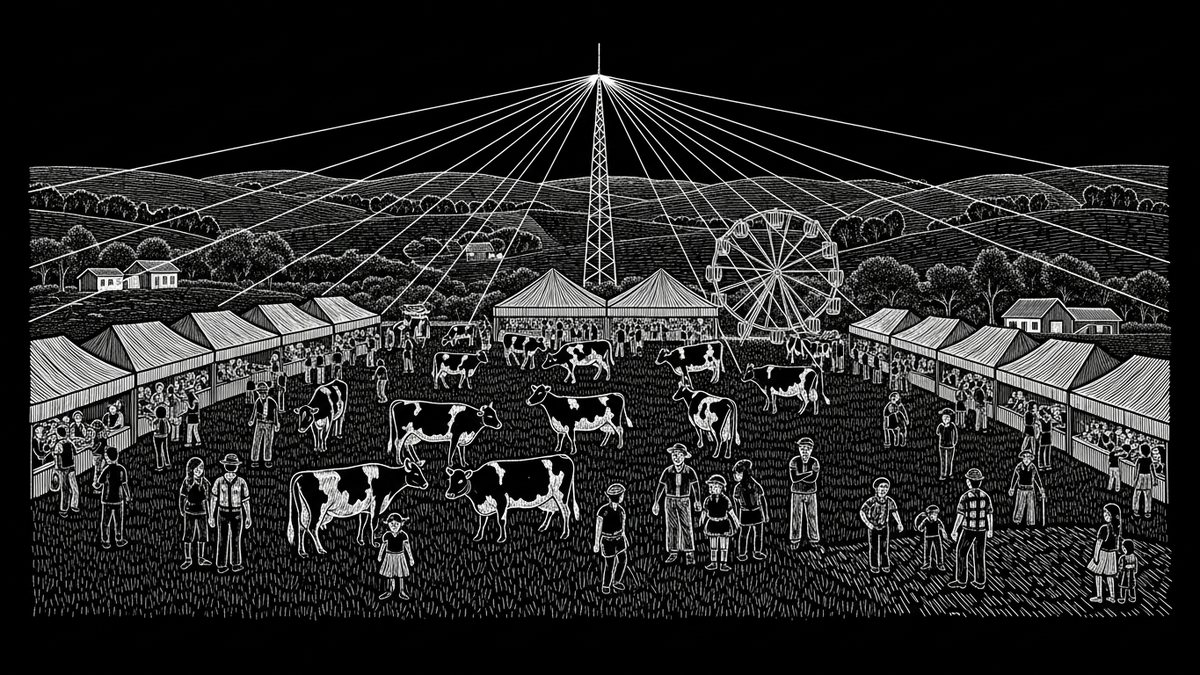
Feagro — full name Feira e Exposição Agropecuária do Vale de Braço do Norte e Região — is Latin America’s largest Jersey cattle show by number of animals. But reducing it to the Jersey would miss the point. Unlike a vertical fair built around a single chain, Feagro is a diverse local exposition: the flagship is the dairy cow, but orbiting it are beef cattle, swine farming, fish farming, family agribusiness, machinery, a gaúcho-tradition rodeo, the 1st Santa Catarina Cachaça Contest, live music, a petting farm and an amusement park. It’s the fair that fits the whole town inside — and that nature changes everything, including who the audience is (more on that below).
Take that piglet race to understand the spirit. On closing Sunday, after an official weigh-in, up to sixteen pairs of piglets weighing 20 to 25 kilos race down a 30-meter track. The owner releases the animal at the start and, from then on, can no longer touch it — only shout, clap, make noise so the animal runs the right way. Whoever crosses first takes R$ 1,500, a trophy and the year’s glory. It’s silly, it’s brilliant, and it’s exactly the kind of attraction that makes a whole family cross the valley to spend Sunday at the fair. Alongside it run the cattle judging, the genetics auctions, the technical field days, the rodeo, the cachaça contest and the evening shows. Feagro stacks serious business and popular festival on the same grounds — and that mix is where the 80,000-strong crowd comes from.
The history explains the pride of the house. Braço do Norte has a rarity among countryside fairs: the park came before the event. The grounds of the Parque de Exposições Huberto Oenning — the Expovale, on Estrada Geral Uruguaia — were bought by the municipality in 1993 with the explicit vision of building an exposition park there. Feagro itself was only born in 2004, when the region had already been breeding Jersey for a decade. The accumulated prestige earned, in 2017, the title of National Capital of Jersey Cattle, granted by federal law. After two years halted by the pandemic, the fair returned in 2022 — and grew to the record 2025 edition: 80,000 visitors, R$ 200 million in business, more than 150 exhibitors and 400 animals.
It’s worth noting what that reveals: Feagro is organized by a local committee, not an outsourced events operator. It’s a community event — with tributes to deceased organizers, governance by the town itself, and sponsorship that comes almost entirely from the region’s cooperative ecosystem (with Sicoob Credivale as the anchor). It’s not a fair that landed in the town; it’s a fair that the town built. The 2026 edition, the 20th, promises to break records, with 165,000 m² of used area and around 150 exhibiting companies — under the motto “the strength of agro is born here.” (Anyone wanting the schedule and stand map will find it all on the official site and the @feagrovale Instagram.)
And these aren’t just neighborhood booths. Among the 150-plus exhibitors, Feagro gathers national and regional heavyweights — from the world’s largest farm-machinery maker to the cooperatives that finance the region and the genetics brands that drive the Jersey ring:
Why the Jersey, and why now
The Jersey isn’t Brazil’s most common cow — it’s the most efficient. A small-framed dairy breed, it produces milk with high fat and protein content while eating less. At a moment when dairy farming faces tight margins, the fair’s conversation isn’t about volume, it’s about efficiency per liter — the chain’s real economic way out. Braço do Norte became a national and international reference precisely by mastering this genetics.
But Braço do Norte’s agro isn’t only milk. The town is Santa Catarina’s 10th-largest swine herd — 175,000 head, the only municipality in the South to make the state top 10. Jersey milk and integrated swine share the same territory, feed the same cooperative dairies and processing plants, and bring to the fair two technical audiences that make big purchases: semen, breeding stock, feed, integration contracts.
That efficiency has an owner: the cooperative chain. The region’s milk and swine supply local dairies and plants, and it’s the cooperative system — with Sicoob Credivale up front — that funds much of the fair and finances the producer. When a rancher decides to change the herd’s genetics or close an integration contract, the decision runs through the cooperative as much as through the brand. That’s why Feagro is, before a stage, a trading floor: in July 2026, with the sector coming out of a depressed price cycle, the producer arrives with calculator in hand, comparing feed conversion and cost per breeding female. Talking to him requires understanding that the counterpart isn’t only the individual — it’s the productive cell: producer, family and cooperative, deciding together. It’s time to close, not just to show.

Who walks the fair
Here’s the first clue to the answer to the opening question. Feagro’s audience isn’t an anonymous mass — it’s a well-defined portrait through the NexOS archetypes. Crunching Braço do Norte’s data, three profiles concentrate more than half the crowd (53%): the stable agribusiness family, the patrimonial producer (owner of land, herd and a cooperative share) and the young successor taking over management. It’s a homogeneous, formalized audience with productive assets — average household-head income of R$ 3,133, with only 6.8% of homes relying on income transfers. This isn’t a place of vulnerability; it’s a place of decision-makers with buying power for technical inputs. And the money moves fast: Braço do Norte handles R$ 493 million per month in Pix received, with nearly 21,000 people on the receiving end — practically the entire adult population. The agro’s capital doesn’t sit idle in the bank (local deposits total just R$ 6.8 million); it circulates, becoming crops, barns and machines.
And since the fair draws the whole family — the 80,000 crowd is 2.4 times the population — whoever walks Feagro isn’t only the producer: it’s the wife who co-decides the investment, the son who’ll inherit the farm, the neighbor who came from the next town. Talking to this place is talking to the productive economy of an entire valley, gathered in one spot for four days.
These three profiles become, in practice, three activation targets. The farm decision-maker — the integrated swine producer and the land-owning rancher — signs off on semen, breeding stock and feed; you reach him by radio in the rural time slot and by geo on the farm itself. The agribusiness family — those who co-decide and attend the fair together — respond to light display and digital audio. And the young successor, the son digitizing the property’s management, lives on the phone: streaming audio, short video, mobile. Three people, three paths — and all of them crossing the same Feagro gate. The question is: through which channel do you reach each one?

How a national brand talks to the community of Braço do Norte
This is where reading the territory separates from reading only the spreadsheet. The automated media tools look at Braço do Norte and see little: no local TV station, no national portal. But they’re wrong — because there is, yes, local press. The Folha do Vale has circulated since 1997, every Friday, in print and online, covering the valley (Braço do Norte, Gravatal, Rio Fortuna, Grão-Pará and São Ludgero). It’s a community newspaper, subscriber-based — the kind the inventory bots don’t catalog, but exactly where the producer reads the name of the neighbor who won at Feagro. It exists, it’s read, and it moves the place; it just doesn’t show up for those who look at the territory from afar.
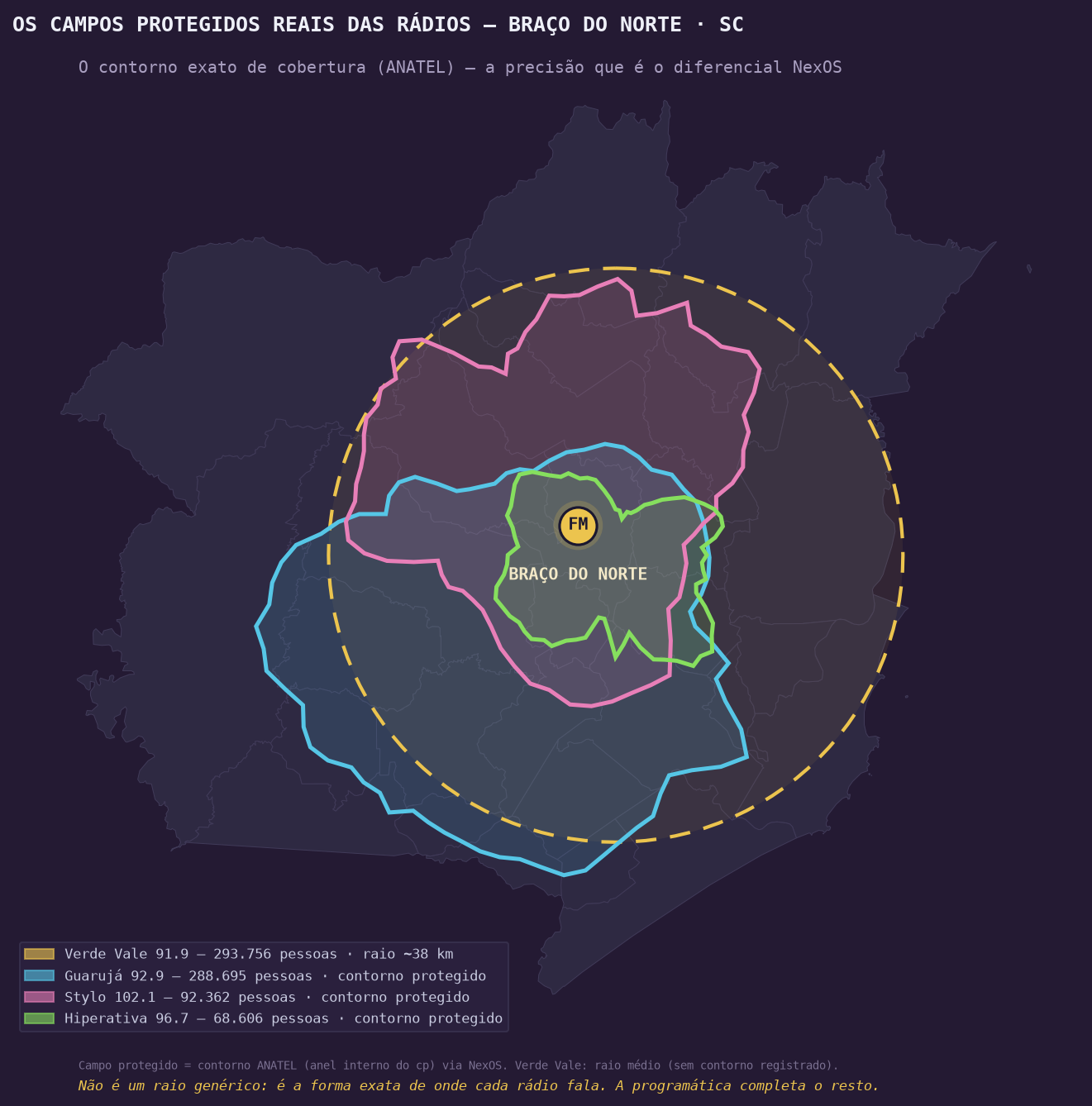
Alongside the newspaper, radio is the medium with the highest daily penetration. There are four stations, and the streaming audience shows who’s in charge:
And there’s a third layer, digital. Programmatic demand in Braço do Norte is huge: the town concentrates 24% of all the programmatic media of its immediate region — while holding only 10% of the population. That’s an over-indexing of 2.3 times: the place buys and absorbs digital-media auction volume far above its size. There’s inventory to spare, cheap, waiting to be used.
And here’s the precision that becomes the differentiator. We don’t say “reaches X municipalities” — we say people: each station’s exact coverage field, measured in people. Verde Vale 91.9 reaches 293,756 people; Guarujá 92.9, 288,695; Stylo 102.1, 92,362; Hiperativa 96.7, 68,606. They’re irregular, real shapes — not a generic round radius — covering the valley and its surroundings. Where the signal doesn’t reach, programmatic carries the message to the rest of the micro-region the 80,000 come from.
For statewide scale, there’s also ndmais — Santa Catarina’s largest news portal, with strong consumption inside Braço do Norte. Where Folha do Vale gives local belonging, ndmais gives statewide reach with the feel of regional news, buyable via contextual deal. And the purchase-intent signals are in the consumption data: whoever checks Climatempo every day and searches for machinery and animals on OLX is exactly the producer — gold inventory for those who know how to read the territory.
Put the pieces together and a national brand’s plan draws itself in three reinforcing layers. The first is the local press — Folha do Vale —, which delivers what no algorithm gives: belonging, the seal of one of their own, read by the community that makes the purchase. The second is radio, the spoken backbone: the channel that moves people to the Park and talks to whoever’s on the tractor, in the barn or on the road. The third is geographic programmatic: with inventory to spare at 2.3× the town’s weight, you can precisely fence the Huberto Oenning Park and the surrounding farms and extend the message across the whole micro-region at low cost. Newspaper to belong, radio to speak, programmatic to scale — with ndmais adding statewide context. None of these layers shows up if you search for “Braço do Norte’s media” in an automated system: you have to read the territory.
There’s even a technical constraint the data hands you for free: the place has low creative-format capacity — without robust fiber backhaul, heavy video stalls and burns budget. Whoever knows the territory arrives already aware: audio and light display, not 4K film. It’s the kind of detail that separates a plan that works from one that wastes budget on buffering — and that only appears when you read the municipality before opening the platform.
All of this — the newspaper, the radios, ndmais, the geo programmatic — is what NexOS organizes and makes buyable in one stroke through the Alright Network, the curation of the largest local and regional media inventory in Brazil. The recommendation is direct: plugging Folha do Vale and Rádio Verde Vale 91.9 into the Alright Network turns a place the market treated as invisible into mapped, buyable local inventory.

This is where the method comes in. The NexOS Planner methodology starts from a simple rule — territory first, platform second. For a genetics or nutrition brand that wants to reach the producer around Feagro, the plan draws itself from the data: Folha do Vale for the local seal, Rádio Verde Vale as the backbone (drive-to-fair, rural time slot), ndmais via contextual deal for statewide reach, and geo programmatic fencing the Huberto Oenning Park and the rural grid — all measured by consumption intensity (how many times each person returns to an outlet), never by empty “impressions.” You don’t report “we delivered 15 million impressions”; you report that you talked to the right swine producer.
And the plan has an address, a time and an accent — because NexOS reads that in the territory. The brand shows up in the morning, between 8 and 11, when the countryside comes down to handle the bank and the farm-supply store on the main avenue; it sponsors the futsal championship and the community festival, with the ad read out on local radio; it runs a sound car on the eve of a big date; it offers coffee at the gas station in the early hours, where the milk truck stops. On digital, it speaks at night (7–10 p.m.), when the day’s work is done — in WhatsApp groups of cooperatives, teams and churches, and on geolocated Facebook. And the language is that of a farm-store counter chat: direct, plain, no foreign jargon, anchored in the pride of those who work hard. The brand doesn’t interrupt the fair — it sponsors the local pride.
The Valley of Lit Lamps
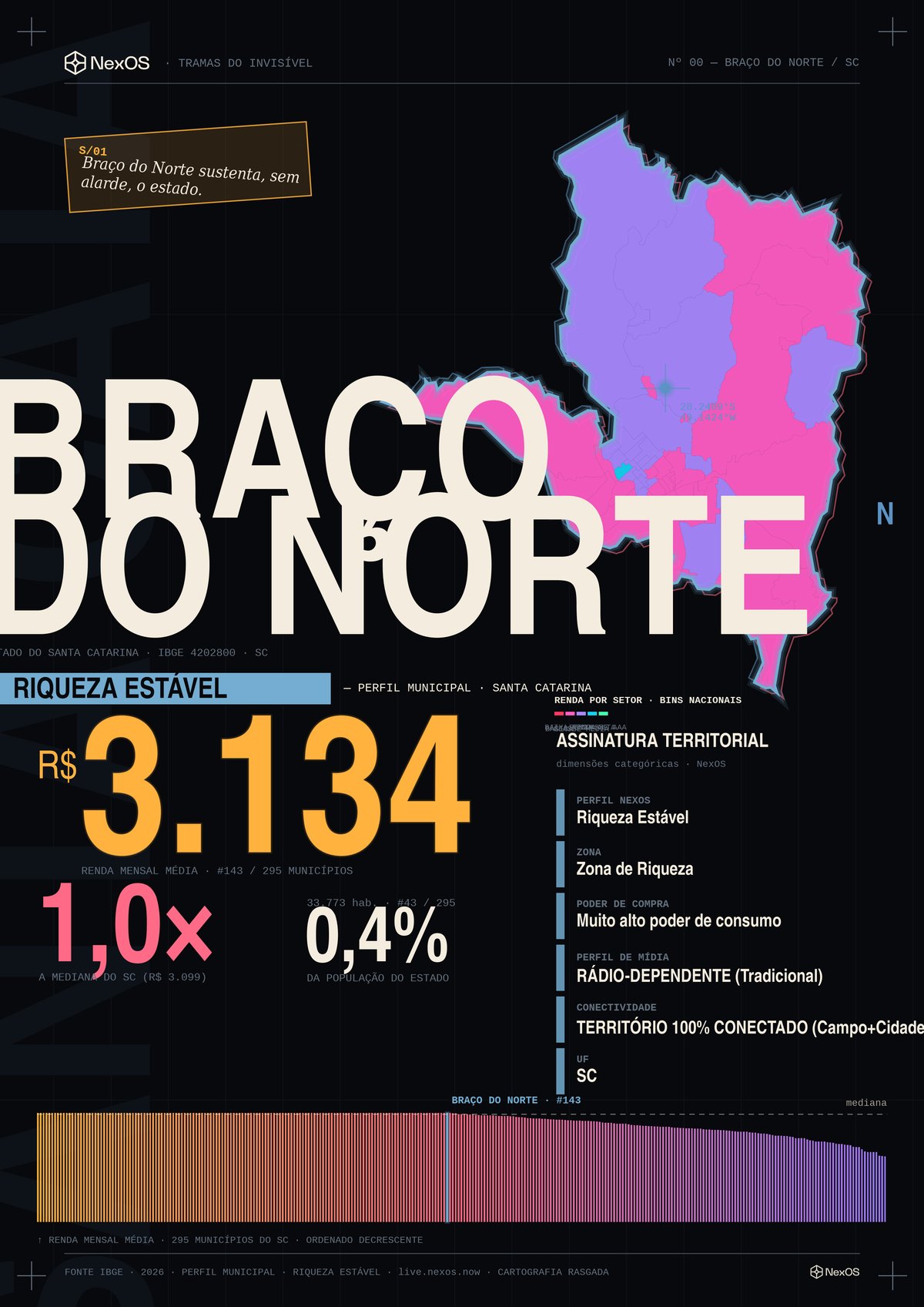
NexOS territorial intelligence has a name for Braço do Norte: Vale das Luzes Acesas — the Valley of Lit Lamps. At night, the lights of the houses scattered across the hills, the lit barns and poultry sheds draw a valley dotted with little lantern-farms — a town that never fully goes dark, because the work in the fields and the agro-industry never stops. It’s a child of German, Italian and gaúcho settlement: diversified family property, a shed with chimarrão and the radio tuned to gaúcho music, the church square as a meeting point, low fog on cold mornings. And it’s a town of stable wealth — industry already accounts for nearly a third of the economy, and the agro it celebrates in the ring became, on the books, also dairy, plant and service. Feagro is the moment when this lit valley gathers in one place to do business, show genetics, eat at the family-farming pavilion and cheer at a piglet race.
And here’s the lesson NexOS pursues in every territory: what the automated map calls empty is, on the ground, a valley informed by a newspaper almost thirty years old, four radio stations and a digital signal no system catalogs. Like the house lights on the hills at night, everything is on — it just doesn’t show for those who look from afar. Invisible is not nonexistent. In Braço do Norte you can, yes, talk to 80,000 people — as long as you read the place before opening the spreadsheet. And whoever reads it arrives at Feagro with the plan ready, while the competitor still believes there’s no one there to talk to.
Sources: Feagro / official site and @feagrovale; Chamber of Deputies (National Capital of Jersey Cattle title); Folha do Vale (newspaper of the Braço do Norte Valley, since 1997 — Adjori/SC). Media, audience, archetype, Pix (Central Bank) and symbolic-layer data (“Vale das Luzes Acesas” — NexOS municipal Trama): NexOS/Tramas (BigQuery); radio coverage derived from the ANATEL base. Territorial mesh: IBGE 2022. Media metric: intensity = bid requests ÷ cookies. Sector production and rankings are public data (IBGE/Embrapa).

Mickey Mouse, R$ 100 million and 250,000 people at Expo Rio Verde 2026
Mickey Mouse is a rodeo bull valued at R$ 1.2 million — and the star of a fair in a city of 225,000 people that receives R$ 4.8 billion in Pix a month. Welcome to the Harvest City: how a brand talks to the agribusiness powerhouse of Southwest Goiás.

FENAGEN 2026: in the city of sweets, the champion bull is chosen by genetics — not by looks
Pelotas is the land of sweets, of charque and of the cold off the lagoon. In the first days of July it becomes the capital of data-driven beef genetics — where the bull stops winning on beauty and starts winning on a spreadsheet. Welcome to FENAGEN, and to what it reveals about a city reinventing its own calling.