

FENAGEN 2026: in the city of sweets, the champion bull is chosen by genetics — not by looks
Pelotas is the land of sweets, of charque and of the cold off the lagoon. In the first days of July it becomes the capital of data-driven beef genetics — where the bull stops winning on beauty and starts winning on a spreadsheet. Welcome to FENAGEN, and to what it reveals about a city reinventing its own calling.


For more than a century, choosing the best bull at a show was, deep down, a beauty contest: the judge walked the ring, looked at the frame, the topline, the stance, and pointed to the most handsome. In Pelotas, over the first four days of July, that logic is being turned inside out. At FENAGEN — the National Genetics Fair — what decides which animal is champion is no longer just the eye: it’s the data. The bull enters the ring with a résumé — performance indexes, health, predictability — and beauty no longer rules alone.
And there’s a delicious geographic irony to it. Because this revolution of spreadsheets and DNA is happening in Pelotas — the city Brazil knows for its sweets, for the charque of the old salting houses and for the damp cold that rolls off the lagoon. The Trama that NexOS generates for the municipality calls it, in fact, the “City of Sweet Cold”: the warm smell of burning sugar in the kitchens mixed with the cutting wind, the historic townhouses, the chimarrão on the park benches. It’s this city — old-looking and tender — that has become, for four days, the capital of data-driven beef genetics.
2026
What Promebo is (and why it changes everything)
FENAGEN wasn’t born from a marketing plan. It was created to celebrate 50 years of Promebo — the Beef Cattle Improvement Program — and became a fixture on the Rio Grande do Sul agribusiness calendar after the buzz of its first editions. Promebo is, in one sentence, the system that turns cattle into comparable data: weight, gain, carcass, fertility, all measured over decades so a producer can choose a sire knowing what he’ll harvest — instead of hoping it works out.
The fair is organized by the ANC, keeper of the Herd-Book Collares, one of the oldest genealogical registries in the country. And the words of its leaders make the stakes clear. At the opening, ANC president Joaquin Villegas summed up the idea:
“The forum is born with a very clear purpose: to show, objectively, how evaluated genetics can come off the paper, off the numbers and the summaries, to directly impact production inside the farms.”
In other words: take genetics out of theory and into the corral. ANC’s superintendent, animal scientist Silvia Freitas, adds the ambition that sets the tone for 2026 — to demystify genetic improvement and present it as a tool accessible to farms of any size:
“FENAGEN was born to simplify the understanding of genetic improvement. It’s an event to qualify small, medium and large producers.”
It’s not rhetoric. At the 5th Promebo in Practice Forum, the demonstration brought together 112 heifers from five farms, weighing between 180 and 400 kilos — different management realities, the same principle: genetics has to respond to the diversity of Brazilian cattle-raising, not to an ideal show-ring model.
A services city, not a cattle-money city
Here it’s worth undoing a misunderstanding. Pelotas is not an agriculturally rich city in cash-flow terms. With 325,000 residents, its economy runs on services — universities, healthcare, street commerce, wholesale-retail, plenty of thin-margin informal work. In Pix, the municipality received R$ 2.8 billion in May 2026 — a respectable number, but modest next to agribusiness powerhouses like Rio Verde (which receives R$ 4.8 billion). The agro-industrial heritage — rice, peaches, the memory of the salting houses — sits in the background, not in the shop window.
That’s exactly why FENAGEN is a story of reinventing a calling, not of showing off wealth. The organizers’ stated goal is ambitious: to consolidate the Zona Sul of Rio Grande do Sul as a hub radiating livestock technology. The city of sweets doesn’t want to compete on head of cattle; it wants to compete on knowledge about cattle. And there’s a concrete clue that this is serious — just look at who foots the bill.
Notice what this list has — and what it doesn’t. There’s no beer brand as master sponsor, no automaker selling a pickup. There’s Neogen (animal DNA testing), Alta, Progen and ABS Pecplan (genetics and semen), Ouro Fino and JA (animal health), alongside the breed associations (Angus, Hereford & Braford, Brangus) and Embrapa. FENAGEN is bankrolled by the genomics industry. At a fair whose main product is information about the animal, the sponsors are themselves data companies. The thesis proves itself.


How a brand talks to Pelotas
If FENAGEN proves that Pelotas wants to be a livestock-tech hub, the next question is practical: how do you talk to this city? And here, again, the “interior = weak media” reflex doesn’t apply. Pelotas is a complete media hub. For the university and better-informed crowd, Rádio Universidade 1160 AM is the soundtrack of lab and office. For agribusiness and technical decisions, the portal revistacultivar.com.br — based in the city — is a national reference. For regional daily life, jornaltradicao.com.br provides the ballast.

And the tone weighs as much as the channel. In Pelotas, communication works when it’s direct, no frills, with dry humor and respect for the intelligence of people who make it through the month on a tight budget. “Bah,” “tri,” “capaz,” “guri” come naturally — but what convinces isn’t the accent, it’s the concreteness: talking about the cold, the mate that warms the hands, the bill that has to be paid. It’s a market that values whoever shows up with data in hand and talks as an equal — exactly the spirit of the fair.

From sweet to data
There’s something beautiful about a city known for delicacy — the fine sweets, the townhouses, the long chimarrão — embracing the hardest science of cattle-raising. FENAGEN doesn’t ask Pelotas to stop being the City of Sweet Cold; it adds a layer. In the first days of July, between a warm stove and the wind off the lagoon, the city hosts the elite of southern cattle and discusses, without romanticism, how data picks the champion.
For anyone who reads the territory, the lesson goes beyond the bull. Pelotas shows that a calling isn’t a frozen fate: an economy of services and sweets can, on purpose, build a new place on the map — that of a market that thinks about Brazilian cattle-raising through data. And a brand that wants to be there has to understand both languages: the old affection and the new spreadsheet. At FENAGEN, for four days, the two talk in the same ring — and, for the first time in a long time, the last word on the champion belongs to genetics.
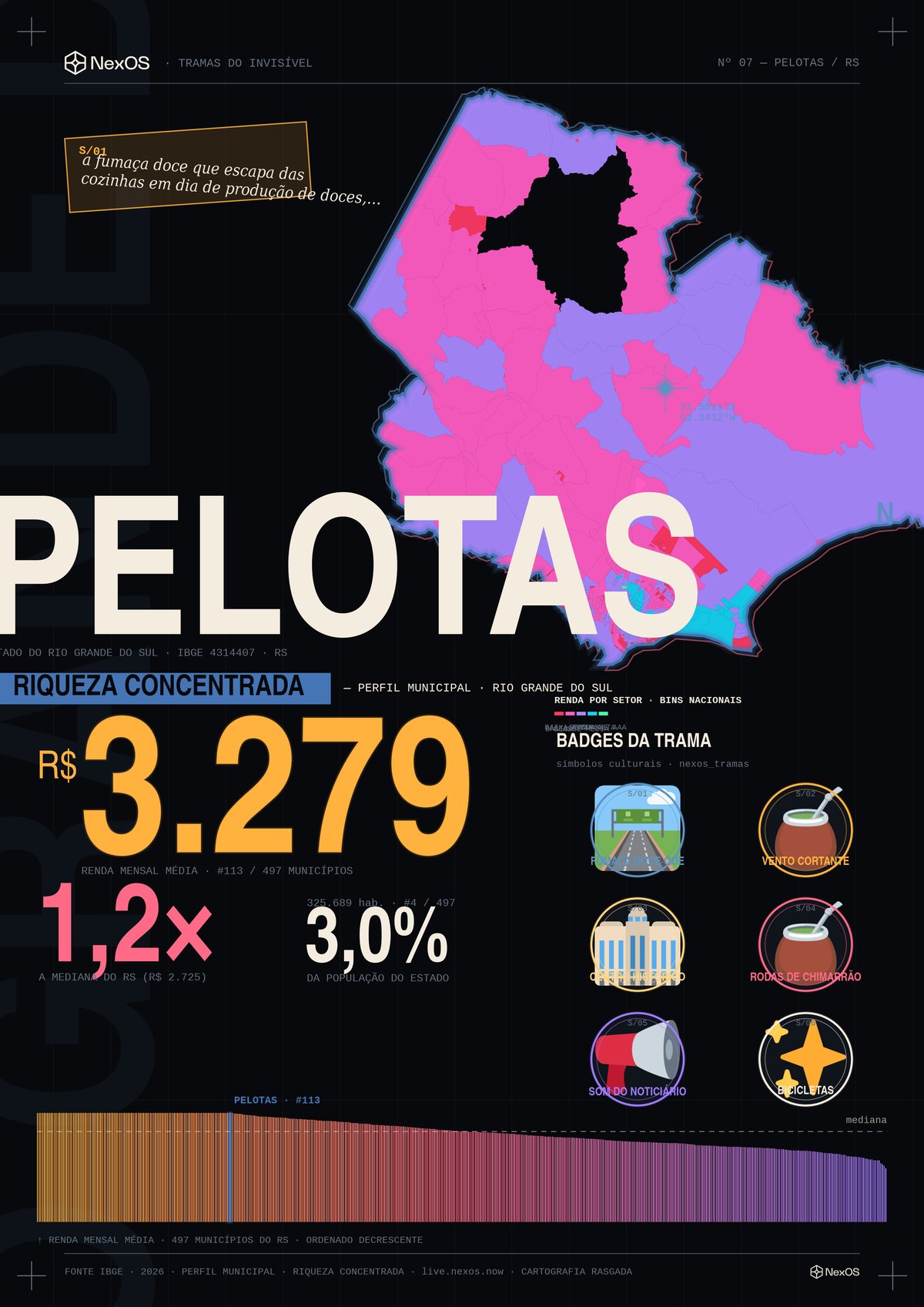
Create your city's poster, for free, at live.nexos.now/poster.

Mickey Mouse, R$ 100 million and 250,000 people at Expo Rio Verde 2026
Mickey Mouse is a rodeo bull valued at R$ 1.2 million — and the star of a fair in a city of 225,000 people that receives R$ 4.8 billion in Pix a month. Welcome to the Harvest City: how a brand talks to the agribusiness powerhouse of Southwest Goiás.

MilkShow 2026: in Patos de Minas, the local portal beats Globo in your media plan
The largest dairy fair in Central Brazil happens in a town that is the opposite of a media void: a complete hub, where the town's own portal (patoshoje.com.br) has more audience intensity than globo.com. How a national brand talks to the dairy community — without overpaying for the wrong address.