

Imperatriz, Brazil: where the card reader and welfare share the same sidewalk
Top 10% in Brazil for Pix and credit, living alongside a third of households on Bolsa Família. The 'gateway to the Amazon' runs on commerce, not soy.


In Imperatriz, the card reader and Bolsa Família share the same sidewalk. On the very plastic chair where a street vendor swipes the card of someone buying a phone in installments sits the family that gets its welfare payment at the end of the month. The city ranks in the top 10% in Brazil for Pix and for credit per capita — and, at the same time, 34% of its households depend on Bolsa Família, Brazil’s Bolsa Família cash-transfer program. These are not two cities in different neighborhoods: it is the same feverish economy on two floors, seen from the same hot street corner.
It is this contradiction that makes Imperatriz a case study in territorial intelligence. Maranhão’s second-largest city is nicknamed the “gateway to the Amazon” on highway BR-010 — and the legend promises timber, gold mining, pulp, soy. But what moves Imperatriz is neither the forest nor the farm: it is the counter. Agriculture accounts for 0.84% of the value the city generates. What it does is sell, finance and serve — for itself and for a handful of neighboring towns that drive up the highway to shop.
The same sidewalk, two floors
The figure that unsettles is not the high credit or the high poverty on their own — it is the two together, in the same city. Imperatriz has 272,000 inhabitants and a GDP of R$ 9.5 billion, with the average income of the head of household at R$ 2,547. In the NexOS comparison with Brazil’s cities, it sits on the upper floor of the country in almost everything that measures money moving — and on the lower floor when the subject is income left over:
Formal payroll in the top 2% in Brazil. Credit and Pix in the top 10% in Brazil. But the Social Progress Index on its “Opportunity” dimension is stuck at 47 of 100 — below the national average. In plain terms: a lot of money comes in, but it does not turn into schooling, mobility or safety at the same rate. This is the signature of the informal Northeast — an abundance of regional spending and social dependence living on the same block. NexOS classifies Imperatriz as “Emerging”: Pix and declared income at the top end among the informal, with a positive jobs balance. People who spend a lot for what they earn — because earning is uncertain, and the card reader never asks about tomorrow.
The upper floor: the city that pays in installments
Imperatriz is the economic capital of western Maranhão, and it earns that title at retail. The cash-and-carry stores — Atacadão São João, large distributors — supply a clientele that comes from neighboring towns to buy in bulk and resell. Imperial Shopping and the main strip move fashion, electronics and food, sustained by an army of street vendors selling everything on the sidewalk. Private universities such as Ceuma and UniFacimp Wyden fill the city with rent, snack bars, photocopies and student transport. Clinics and medical centers draw patients from far away, warming up the hotels and restaurants around them.
All of this runs on cards and on Pix. The city processes roughly R$ 18,600 in credit per capita and a Pix intensity among the top 10% in the country — not because it is rich, but because everything here is a transaction: the fridge is bought in installments, the market is paid by QR code, what hasn’t arrived yet is borrowed against. Services account for 62% of the economy, public administration for another 18.6%, industry for 18.4% — and agriculture, that relic of the Amazon legend, for less than 1%. Suzano’s pulp does pass along the BR-010 that cuts through the city, but it passes by truck, leaving no value added at the counter. Imperatriz is not the gateway to the forest. It is the gateway to commerce.

The lower floor: the city that receives
And beneath that same sidewalk, the other floor. There are 29,000 families on Bolsa Família — 34% of all households — receiving about R$ 20 million a month, an average benefit of R$ 687. The CadÚnico social registry holds 65,000 registered families: more than half the city has been through, or is going through, some form of welfare registration. This is no hidden pocket on the outskirts; it is structural, spread out, part of the same economy that makes the card reader beep.
The cash transfer is not the opposite of Imperatriz’s spending — it is its fuel. Much of that top-10%-in-Brazil Pix and that credit on the main strip begins the day the benefit lands. The money enters at the bottom and rises through the city: it becomes the market run at the cash-and-carry, the installment at the furniture store, the phone top-up, the street barbecue. That is why the average income looks modest (R$ 2,547) while the turnover looks high: what is missing in individual income, the city makes up in speed of circulation. It is an economy that does not accumulate — it spends while it has.
What ties the two floors together
The thread that stitches the upper floor to the lower one is who lives here. Imperatriz’s family portrait is not the young frontier of childless couples — it is the full house of the Northeast. The most common group is married couples with young children (20.8%), followed closely by multigenerational families — three or more generations under one roof (19.0%), one of the hallmarks of the informal Northeast, where grandmother, mother and grandchild share the roof and the income. Then come couples with teenage children (16.5%) and, in a weight that tells the story of vulnerability, single mothers and fathers with children (8.4%).
It is a city of large, young, tight-knit families, where one person’s income supports many and the spending of many fits onto a single card. That is why the contradiction is no paradox: the multigenerational household on the lower floor and the credit on the upper floor are the same family, in the same home, in the same month.
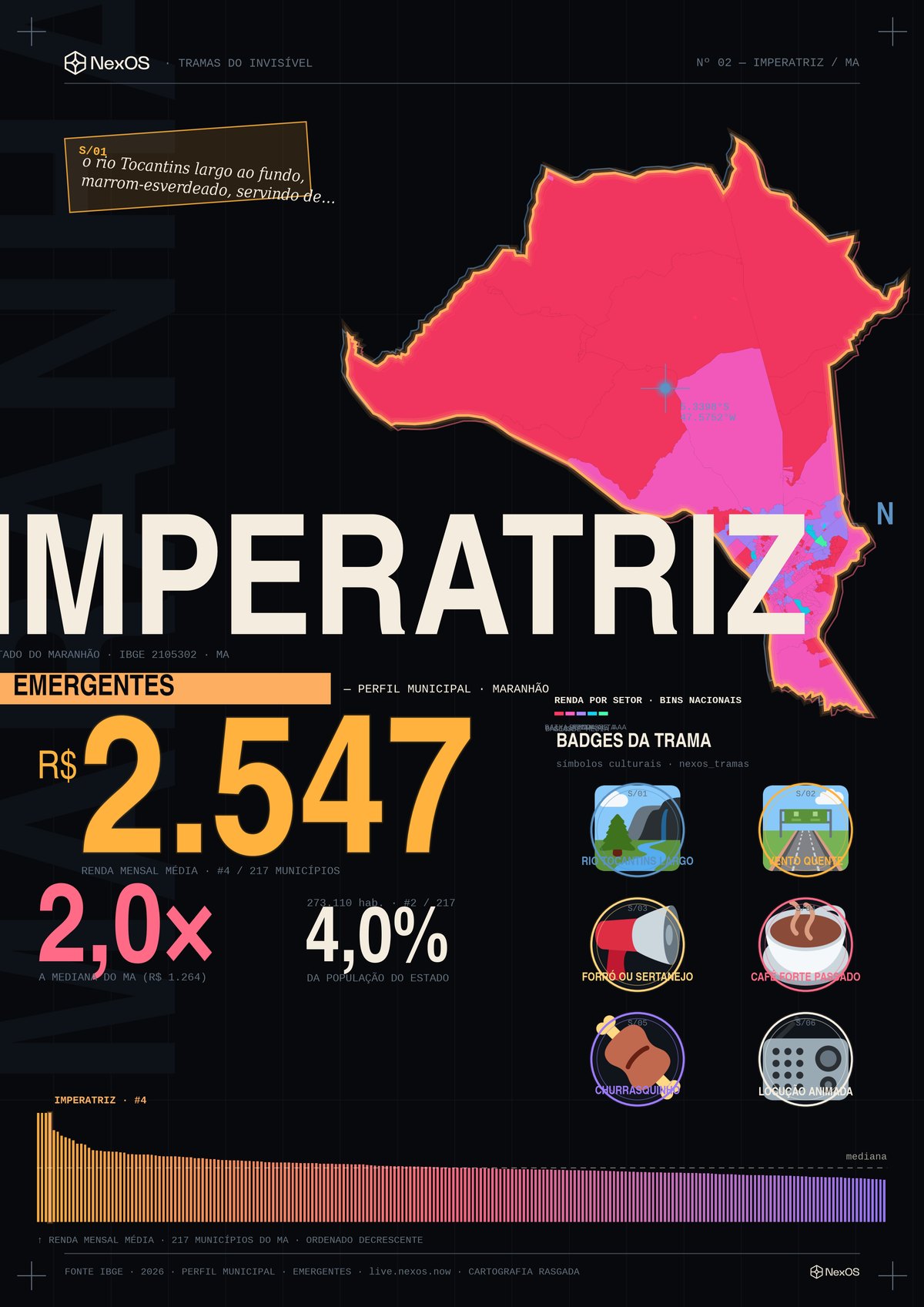
Create your city's poster, for free, at live.nexos.now/poster.

What the city feels
The imagery of Imperatriz is heat at ground level. The hot wind off the Tocantins river rising in late afternoon, the orange sky reflected in the water, the hammock strung across the living room for an after-lunch nap, the water jug and the fan as household furniture. The smell of street barbecue, charcoal and grease on the busy corners. Plastic chairs on the sidewalk, people talking and watching the parade of motorbikes. The sound systems blasting forró, piseiro and reggae on weekends. The churches full at night, keyboard and voice spilling through open windows. And, stuck to the lampposts, the other symbol of the city: signs for courses, colleges and civil-service exams, promising a better future — because in Imperatriz a job is the dream, and study is the door.
That imagery shows up, intact, in what the city consumes on its phones. Cross-referencing the programmatic inventory, you can read Imperatriz by access intensity — not by the volume of people, but by the relative strength of each habit:
What stands out is vagas.com.br among the most intense domains: in a city of informal economy and mobility, looking for work is a mass habit. Outlet by outlet:
Football at the top, as in nearly all of Brazil. But what comes right behind tells the story of the city: study (Toda Matéria, with almost the weight of football), language (an English app among the most intense), faith (the offline Bible and the Catholic rosary) and, closing it out, the job search on Vagas.com. Music, school, church and the hunt for work — exactly the signs stuck to the lampposts, now on the screen. It is the lower floor wanting to move up, read through the phone.
The media map nobody buys from afar
Imperatriz is a complete media hub — TV, radio and digital — and, contrary to what people imagine of inland Maranhão, it is far from being a news desert. There are 17 radio stations, 6 TV channels and 10 local sites active, all utterly commonplace in daily life and, together, a buyable inventory that no outside agency tends to see:
| Layer | Who commands Imperatriz’s attention |
|---|---|
| Radio | Rádio Mirante 95.1 FM leads with ~98% coverage of the city; behind it, Rádio Top 88.9 and Difusora 89.3 |
| TV | Six stations headquartered here, from Mirante (regional affiliate) to public and legislative TV |
| Local digital | imperatriznoticias.ufma.br and oprogressonet.com set the city’s agenda |
Radio here is no nostalgia: it is the soundtrack of commerce. Mirante 95.1 plays in the back of the store, in the moto-taxi cab, at the cash-and-carry counter, reaching almost the entire population. It is the real channel, with a real audience, available in a single buy through the Alright Network — the curation NexOS makes of the largest local and regional media inventory in Brazil:

How Imperatriz wants to be spoken to
Here communication works when it reaches ground level — the plastic chair, not the distant billboard. People in Imperatriz recognize whoever talks about price, installments and practical benefit, no beating around the bush, in the manner of those who already work too hard and have little patience for waffle. The city’s triggers are clear: pride in being the capital of western Maranhão, the heat that brings everyone together on the sidewalk, the faith that fills the churches at night, and the bet on study and the civil-service exam as the door to the upper floor. They talk about forró and football, but they decide on what helps the big family make it to the end of the month.
The “Hot Gateway of the Tocantins” was never the gateway to the forest. It is the gateway to commerce and credit — hot because the economy boils at the counter, not in the bush. And it lives, with ease, the contradiction the rest of the country finds impossible: the card reader and Bolsa Família, on the same sidewalk, in the same family, counting the same money go by.
Explore the X-ray of Imperatriz on NexOS · City hall: imperatriz.ma.gov.br · IBGE profile: cidades.ibge.gov.br/brasil/ma/imperatriz. See also Chapecó, SC — the other end of the map, where industry weighs heavy and Bolsa Família is minimal — and the family archetypes of Brazil.
This piece is part of the Tramas series — territorial intelligence as method. Data cross-referenced by NexOS: IBGE (GDP, 2022 Census), the Central Bank (Pix and credit), CadÚnico/Bolsa Família, RAIS, SPI and curated local media inventory. Profile and classification: the Tramas do Invisível methodology.

Americana, Brazil: nostalgic for the old street, but with fewer multigenerational households than the national average
Americana's Trama profile talks about surnames that repeat across neighborhoods and neighbors who know each other by sight, but NexOS's family archetype data shows only 12.09% of households are multigenerational.

São Carlos, Brazil: behind the tech-hub label, industry pulls 46.7% of BNDES financing, well ahead of trade and services
R$273.7 million in BNDES financing (910 operations) makes industry, led by machinery, the biggest borrower of development credit in a city that sells itself as a university hub.