

MilkShow 2026: in Patos de Minas, the local portal beats Globo in your media plan
The largest dairy fair in Central Brazil happens in a town that is the opposite of a media void: a complete hub, where the town's own portal (patoshoje.com.br) has more audience intensity than globo.com. How a national brand talks to the dairy community — without overpaying for the wrong address.


Every morning, before six, a milk truck crosses the fog of the dirt roads that descend into Patos de Minas, in the Alto Paranaíba of Minas Gerais. It carries the output of one of the three largest dairy basins in Brazil — and, from July 7 to 11, it will pass right beside the Exposition Park, where 170,000 m² become Central Brazil’s largest dairy fair: MilkShow, in its 23rd edition, under the theme “Do Campo à Indústria: Conectando a Força do Leite” (From Field to Industry: Connecting the Power of Milk).
Now imagine you’re a genetics, animal-nutrition or animal-health brand, and you want to reach the dairy producer who’ll walk through. The market’s reflex is to buy the usual: globo.com, g1, the big national portals. And here’s where Patos de Minas plays a trick — because, inside the town, the local portal beats Globo. patoshoje.com.br has more audience intensity than globo.com. Whoever follows the reflex overpays for the wrong address. Whoever reads the territory speaks cheaper and deeper.
2026
HUB
The fair that became the milk revolution
MilkShow was born as the Semana da Coopatos and grew into the largest dairy-chain fair in Central Brazil. It’s not a mass fair of rodeo and amusement park — it’s a technical, dense, chain fair: judging, genetics auctions, field days, lectures and business. In 2025, there were about 3,000 visitors a day and more than R$ 30 million in business — plus the debut of ExpoMilk, the judging and exhibition of Girolando cattle, the breed that sustains Brazilian tropical milk.
For 2026, the fair promises its “broadest and most integrated” edition, opened by commentator Caio Coppolla, under the theme “Do Campo à Indústria: Conectando a Força do Leite.” It’s organized by Coopatos — the cooperative that sets the tone for everything here — alongside Supra Sementes and Cemil, with Diamond sponsorship from Terrena and support from the city hall, the Rural Syndicate and SEBRAE. What ties it all together is a chain: whoever produces milk in Patos de Minas produces inside a cooperative ecosystem that finances, collects, processes and sells. The fair is the showcase of that ecosystem.

And these aren’t neighborhood booths. Among the exhibitors, MilkShow gathers national and global heavyweights — from the genetics that decides the herd to the animal health that protects it and the credit that finances it:
Why milk, and why now
Minas is Brazil’s largest dairy state, and the Alto Paranaíba is one of its hearts. But the 2026 conversation isn’t about volume — it’s about margin. The dairy producer lives squeezed between feed cost and the price paid per liter, and the way out isn’t to produce more: it’s to produce better. That’s why the fair revolves around genetics, animal health and nutrition — everything that raises productivity per cow and milk quality. The “revolution” in the theme isn’t rhetoric: it’s the passage from a backyard dairy to a dairy of data, breeding and cooperative scale.
And there’s a detail Patos de Minas reveals in its bank account: the milk money circulates, and fast. The town moves R$ 2.6 billion per month in Pix received, with nearly 110,000 people on the receiving end. This isn’t a subsistence economy — it’s an agro-industrial and services hub where capital moves at high speed. Whoever arrives to sell genetics or nutrition arrives in a market with real buying power.

Who walks the fair
MilkShow’s audience isn’t a rodeo crowd — it’s the technical dairy chain: the decision-making producer, the vet, the animal scientist, the cooperative manager, the agronomy student from Unipam. The Trama that NexOS generated for Patos de Minas calls the town “Encruzilhada da Roça Moderna” (Crossroads of the Modern Countryside): the intersection between a rich corn-and-milk countryside and a mid-sized city that modernizes with colleges, strong commerce and sertanejo nightlife. It’s people who still smell of wood-stove and dawn milk trucks, but who decide purchases by phone and follow the milk market in real time.
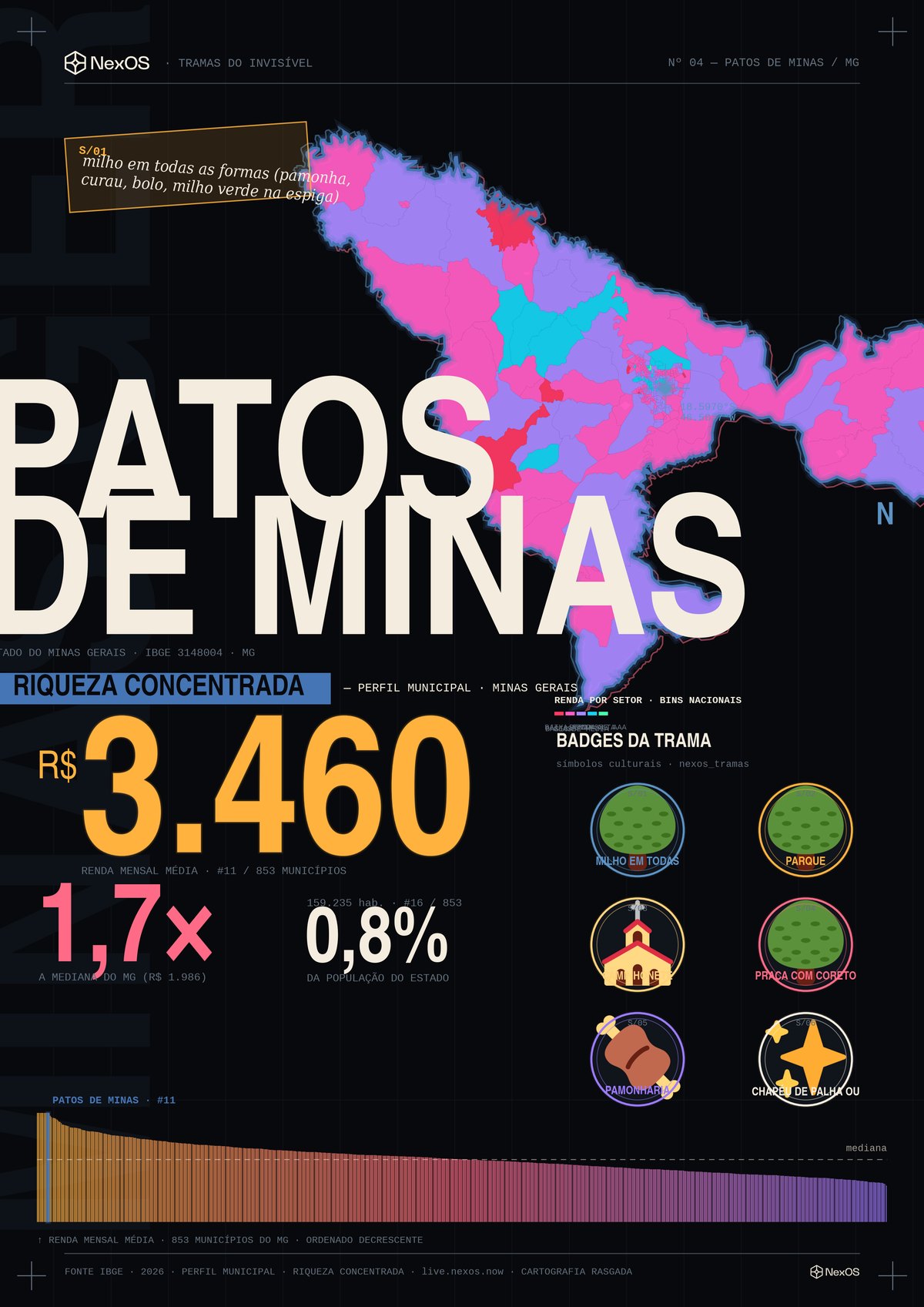
Create your city's poster, for free, at live.nexos.now/poster.

How a national brand talks to the dairy community
Here’s the point that separates reading the territory from reading only the spreadsheet — and it’s the opposite of what you see in small towns. Patos de Minas isn’t a media desert; it’s a complete media hub: local TV, 7 radio stations and 10 news sites. And the digital leader is homegrown: patoshoje.com.br delivers 1.6 million pageviews a month and is plugged into programmatic media. A national brand’s reflex is to buy globo.com and be done. But look at what the data says about intensity — how many auction requests each person generates on a domain, i.e., how much the local audience “lives” there:
On the radio side, the picture is the same: a well-served market, with strong stations whose protected field (the exact ANATEL coverage contour) covers the town and the dairy surroundings. And here’s the precision that becomes the differentiator — we don’t say “reaches X municipalities,” we say people: Jovem Pan 103.3 reaches 184,000 people; FM Liberdade 101.1, 182,000; Rádio Clube 99.7, 159,000; Nossa FM 105.9, 149,000. They’re irregular, real shapes, not a generic radius:
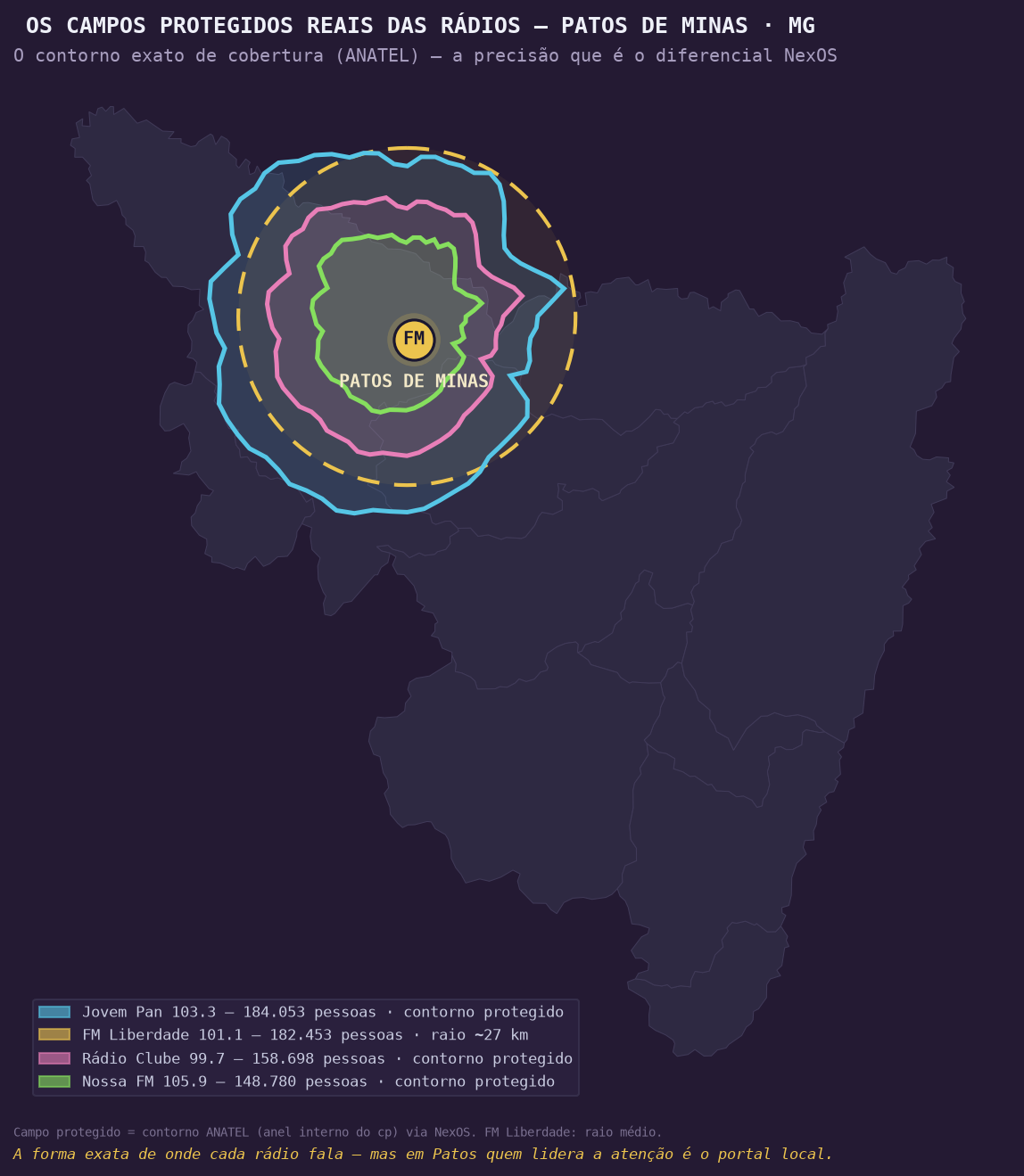
Put the pieces together and a national brand’s plan to reach the dairy chain inverts relative to the reflex. The base isn’t the national portal — it’s the local hub: patoshoje for belonging and intensity, radio (sertanejo and morning news, when the producer is milking or on the road) for spoken reach, and geo programmatic fencing the Exposition Park and the rural grid. The national comes in as coverage backup, not as the backbone. All measured by consumption intensity, never by empty “impressions” — because what matters isn’t how many screens you lit up, it’s whether you talked to the right dairy producer.
And the plan has an address, a time and an accent — because NexOS reads that in the territory’s Trama. The brand shows up early, between 6:30 and 9, in the bakeries and markets where the countryside starts its day; in the afternoon (5–7:30 p.m.) in the squares and supermarkets; and on Thursday-to-Saturday nights in the bars and around the Park when there’s an event. It sponsors small sertanejo shows, school and church June festivals, and activates the university student houses of Unipam with the right language. And the tone is that of a Minas bakery-counter chat: direct, with light humor, valuing faith, family, one’s word — no cold institutional speech. The brand doesn’t interrupt the fair: it joins the town’s conversation.
All of this — the local portal, the radios, the geo programmatic — is what NexOS organizes and makes buyable in one stroke through the Alright Network, the curation of the largest local and regional media inventory in Brazil.

This is where the method comes in. The NexOS Planner methodology starts from a simple rule — territory first, platform second. In a market like Patos de Minas, “territory first” means discovering, before you spend, that the local portal earns more attention than the national one — and building the plan on that, not on the reflex. It’s the difference between buying media and buying belonging.
Encruzilhada da Roça Moderna
NexOS territorial intelligence has a name for Patos de Minas: Encruzilhada da Roça Moderna — the Crossroads of the Modern Countryside. It’s the town of corn in every form (pamonha, curau, corn on the cob), of the pickup parked outside the bar and the church, of the bandstand square full at dusk, of the June-festival bunting saved and reused year after year — but also of full colleges, strong commerce and sertanejo nightlife. A countryside that went high-tech without ceasing to be countryside: the producer decides genetics on a spreadsheet, but still has coffee at the bakery and follows the milk price on the morning radio.
And it’s that dual nature that makes MilkShow a case of territorial intelligence: a cutting-edge technical fair, in a town that is a complete media hub, in a valley where the milk money moves in billions. What the market’s reflex doesn’t see is that, here, the closest is the strongest — the town’s portal beats Globo, the morning radio talks to whoever’s milking, and the cooperative is at once the bank, the factory and the town square. In Patos de Minas, talking to the dairy chain isn’t a matter of budget — it’s a matter of reading the place before opening the spreadsheet. And whoever reads it arrives at MilkShow with the right plan, while the competitor still overpays for the wrong address.
Sources: MilkShow / Coopatos — official site and coopatos.com.br; 2025 edition via Feed&Food. Media, audience, intensity, Pix (Central Bank) and symbolic-layer data (“Encruzilhada da Roça Moderna” — NexOS municipal Trama): NexOS/Tramas (BigQuery); radio coverage derived from the ANATEL base. Territorial mesh: IBGE 2022. Media metric: intensity = bid requests ÷ cookies. Sector production and rankings are public data (IBGE/Embrapa).

Mickey Mouse, R$ 100 million and 250,000 people at Expo Rio Verde 2026
Mickey Mouse is a rodeo bull valued at R$ 1.2 million — and the star of a fair in a city of 225,000 people that receives R$ 4.8 billion in Pix a month. Welcome to the Harvest City: how a brand talks to the agribusiness powerhouse of Southwest Goiás.

FENAGEN 2026: in the city of sweets, the champion bull is chosen by genetics — not by looks
Pelotas is the land of sweets, of charque and of the cold off the lagoon. In the first days of July it becomes the capital of data-driven beef genetics — where the bull stops winning on beauty and starts winning on a spreadsheet. Welcome to FENAGEN, and to what it reveals about a city reinventing its own calling.