

Mossoró, Brazil: the oil-and-salt capital that lives on the public payroll
Elite income at the top (top 1% in Brazil), but what holds up the GDP is services and the public payroll — farming is just 2.7%.


They call Mossoró the capital of oil and salt — and the imagery doesn’t lie: there are onshore fields pumping all around, a geometric salt flat reflecting the noon sun, irrigated fruit farming coming down from the Açu and the Apodi. But open up the economy’s ledger and the oil vanishes. What pays Mossoró’s GDP isn’t the well or the salt flat: it’s the paycheck. Services and the public payroll add up to 79% of the value the city generates. Farming — the backcountry crop that gives the sertão its name — is just 2.7%.
It’s the inversion that makes Mossoró a case for territorial intelligence: the “commodities city” is, in the real ledger, a city of white coats, wholesale-club counters and a payslip at the end of the month.
Wealth
The salt flat that doesn't show up in the ledger
Mossoró has 264,000 residents and a GDP of R$ 10.3 billion — about R$ 39k per person, a median per capita figure (just above the national average) for a city this size. But the shape of that economy belies the legend of the productive sertão:
The industry that’s left (18.6%) is, in good part, exactly the oil and salt of the imagery — mineral extraction, processing, energy. But it loses by a wide margin to what moves daily life: clinics, labs, wholesale clubs, colleges, retail and, above all, public administration — nearly a quarter of the entire economy. Add up services and the government payroll and you have 79% of Mossoró. The sertão doesn’t live off the land; it lives off serving, treating, teaching and paying salaries.
Where the money goes
Here’s the outlier the stereotype hides. Mossoró has an income elite of capital: monthly income per filer is in the top 1% in Brazil (R$ 6,800) and the formal payroll mass is in the top 2% in Brazil. It’s rich-city income — doctors, university professors, career civil servants, regional-chain managers. Except that this elite is surrounded by a median base: GDP per resident sits just above the national average, job creation (CAGED) is below average, and 35% of households are on Bolsa Família (at the national average). NexOS classifies the city as “Stable Wealth” — a Statewide Oasis: a hub that concentrates income at the top while the majority lives on a far more modest economy.
| Indicator | Mossoró | Reading |
|---|---|---|
| Income per filer | top 1% in Brazil | national top — a paycheck elite |
| Formal payroll mass | top 2% in Brazil | high payroll, dense formal employment |
| GDP per capita | just above the national average | median — the wealth isn’t everyone’s |
| Job creation (CAGED) | below the national average | an economy not growing in jobs |
| Households on Bolsa Família | 35% (at the national average) | a vulnerable base lives alongside the elite |
Concentration is the story. Mossoró’s historic “resistance” — the city that stood up to the cangaço, that abolished slavery before the Lei Áurea, that prides itself on owing nothing to anyone — has become, in today’s economy, the resistance of a middle class of civil servants and self-employed professionals. It isn’t the salt worker or the oil worker of folklore who holds the city up: it’s the payslip of the public service and the private practice.

Who lives here
Mossoró’s family profile is that of a hub drawing people from across the region to live, study and work. The dominant group is the multigenerational one — households with three generations under one roof (18.5%), well above the national average, a portrait of a Northeast where grandmother, daughter and grandson share the same yard. Right behind come the married couples with young children (19.4%) and those with teenage children (16.4%) — a city still young, in its child-raising years.
Average income per respondent — R$ 2,634 — sits well below the income per filer (top 1% in Brazil). The distance between the two numbers is the city’s own portrait: a formal elite that files income tax at the national top, and a majority of multigenerational and single-mother households living on a far tighter economy. It’s the concentration that defines Mossoró — not the average, but the distance between the top and the floor.
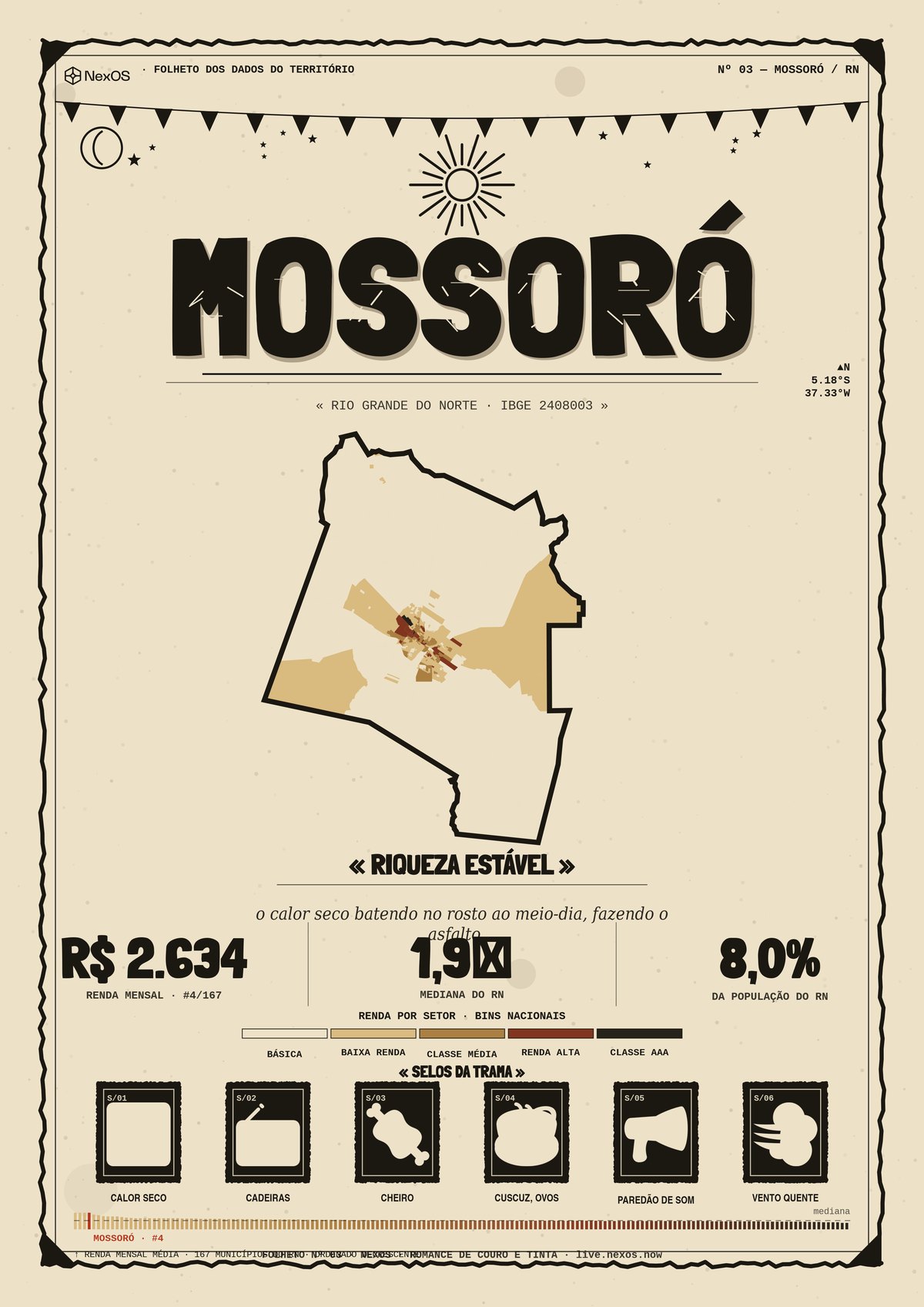
Create your city's poster, for free, at live.nexos.now/poster.

What the city feels like
Mossoró’s imagery is one of dry heat and open sky. The asphalt shimmering at noon, the fine dust rising on the less-paved streets, the plastic chair on the sidewalk at dusk with loose conversation and the warm wind coming up the street. It’s a land of strong drip coffee with cuscuz before getting on the motorbike, of white coats crossing the avenue — the sign of a health-hub city —, of forró and piseiro pouring out of improvised sound walls on the weekend, of skewer barbecue near the squares. And it is, above all, the city that turns the festival into a manifesto: the “Mossoró Cidade Junina” fills the Estação das Artes with stages, barbecue smoke and people arriving from all over.
The city’s symbol is “Sertão in Resistance” — and the resistance here isn’t postcard aesthetics: it’s method. Mossoró resists by building its own hub, holding up the whole region that depends on it to get treated, study and shop. The sertão doesn’t wait for the rain; it sets up a clinic, opens a wholesale club and puts the sound wall on the street. To resist, in Mossoró, has become the verb of those who make do.
The media map nobody buys from outside
Mossoró is not a news desert — it’s the opposite: a complete media hub, with TV, radio and digital, all local and buyable. There are 14 radio stations and 10 local sites active. And the digital audience is big-city: the lead site, Fim da Linha, delivers 1.84 million pageviews per month — and the second, Diário do Brasil, another 1.39 million. On the radio, the voice that echoes at the corner-store counter is that of Rádio Resistência 93.7 FM — the city’s own name turned into a dial. All local, measured and buyable in one shot through the Alright Network, NexOS’s curation of the largest local and regional media inventory in Brazil:

There’s also a third layer — what the Mossoró resident consumes on the phone. Cross-referencing the programmatic inventory, you can read the city by access intensity per topic:
The health-and-education hub city gives itself away on the phone: what Mossoró accesses with the most intensity are language and study apps (SpeakMaster, Tuda Sala de Aula, Toda Matéria) — the university axis, with Anhanguera and the UFERSA campus, injecting prep courses, internships and college-entrance prep into the routine. Right behind come games and short video from a young, connected audience, the music (CifraClub, Spotify, letras.mus.br) of the forró and piseiro that play on the street, the football and the faith of a Bible app. Looking outlet by outlet, by access intensity per user:
Prep course on the phone, game on the weekend, forró on the sound wall, Bible in the pocket — Mossoró’s media isn’t nostalgia: it’s the real channel, with big-city portal audience, for sale to any agency in Brazil. One that simply never looked toward the Oeste Potiguar.
The paycheck and the salt flat
Mossoró is a city that learned to sustain itself without depending on the rain or the well. Oil and salt remain on the horizon — the pink salt flat reflecting the dusk is a landscape that exists only here. But the economy that pays the bills is another: it’s the white coat, the wholesale-club counter, the university campus and, at the center of it all, the paycheck that lands at the end of the month. The “commodities city” is, in fact, a services capital disguised as a productive sertão.
And maybe that’s exactly what “Sertão in Resistance” is: not the folklore of the conquered drought, but a city that turned its own survival into method — and carries a whole region on its shoulders, while the rest of Brazil still imagines it living on oil and salt. Whoever looks at the map sees commodity. Whoever looks at the data sees a payslip. The difference between the two Mossorós is everything.
Explore Mossoró’s X-ray on NexOS · City hall: mossoro.rn.gov.br · IBGE profile: cidades.ibge.gov.br/brasil/rn/mossoro. See also Sinop, MT — the city where farming actually moves the GDP — and the family archetypes.
This piece is part of the Tramas series — territorial intelligence as method. Data cross-referenced by NexOS: IBGE (GDP 2021, 2022 Census), Receita Federal and RAIS (income and payroll mass), Banco Central (Pix and credit), CadÚnico/Bolsa Família, CAGED (employment), ANATEL and curated local media inventory. Profile and classification: Tramas do Invisível methodology.

Americana, Brazil: nostalgic for the old street, but with fewer multigenerational households than the national average
Americana's Trama profile talks about surnames that repeat across neighborhoods and neighbors who know each other by sight, but NexOS's family archetype data shows only 12.09% of households are multigenerational.

São Carlos, Brazil: behind the tech-hub label, industry pulls 46.7% of BNDES financing, well ahead of trade and services
R$273.7 million in BNDES financing (910 operations) makes industry, led by machinery, the biggest borrower of development credit in a city that sells itself as a university hub.