

Parauapebas, Brazil: the R$26 billion iron-ore city that has almost no elderly
In the Serra dos Carajás, a R$26.4 billion economy runs on iron ore shipped out by rail: 84% of the wealth is mining. And there's an even rarer mark: only 1.6% of adults are elderly, one of the lowest rates in Brazil. Whoever arrives, arrives young; the money moves through Pix and motorcycles, not real estate.


Say “Parauapebas” and the image that comes up hasn’t changed in forty years: ore trains, Vale, the Serra dos Carajás, a city that exists because there’s iron under the forest. That part is true — and bigger than it looks: 84% of everything the city’s economy generates is mining. But there’s a second truth hiding behind the first one, and no commodity report shows it: Parauapebas is one of the cities with the fewest elderly people in all of Brazil. Only 1.6% of the adult population is 60 or older, married or living alone in that age bracket — a share that puts the municipality among the 1% of Brazilian cities (with more than 20,000 residents) with the lowest proportion of elderly people in the country. Nobody grows old in Parauapebas. Whoever arrives, arrives young, works the mine’s contract cycle, and decides — year after year — whether to stay or move on.
That’s why the name the city’s own Trama already reveals fits exactly: Crossroads of Iron and Forest. Parauapebas isn’t a destination, it’s a passage. The ore passes through in rail cars. The worker passes through on contract cycles. The money passes through Pix, not into brick and mortar. And the forest next door keeps receding.
Wealth
The iron that holds everything up
Parauapebas has nearly 268,000 residents and a GDP of R$26.4 billion. The breakdown of value added leaves no doubt about who pays the bills:
No other large Brazilian city has an industrial share this dominant. It’s the Carajás mine and everything that lives around it — contractors, transport, collective catering, housing rented out to workers from elsewhere — that carries the rest. And the “rest” grows around it like a satellite: commerce is strong and spread out, from corner stores to the Atacadão Macre wholesale market, which functions as the pantry for entire households and lunchbox businesses. Malls and shopping galleries are packed with small entrepreneurs selling to people who earn relatively well but live under the constant fear of a mining-contract downturn — the city’s own economic profile records this as a structural trait, not a footnote. Gyms, private clinics and private colleges are growing alongside it: the drive to move up professionally is real, even as heavy manual labor is still the floor many families stand on.
A city of passage: whoever arrives, arrives young
Here’s the data the mineral’s spec sheet doesn’t usually show, and it’s the heart of this story. Check the distribution of family archetypes — the 13 ways of living the Census reveals — and Parauapebas breaks from any average Brazilian city:
Parauapebas’s share of elderly residents — married or living alone — is four times lower than the national average. We ranked it against every city in Brazil: among the 1,243 Brazilian municipalities with more than 20,000 residents, only 16 have an equal or lower elderly share. At the same time, young families with small children make up more than a quarter of the entire adult population — well above the national average. The reading is simple and blunt: nobody grows old here, they start over. The city’s own historical memory holds this as identity: whoever “caught Parauapebas at the start” — during the opening of the Carajás frontier, the railway, the first shacks — carries that story as a badge of belonging, told over bar tables and family lunches. It’s a city that still sees itself as new, even after four decades of existence.
And it’s people from every corner of Brazil: from Maranhão, Ceará, the Pará and Tocantins interior, everyone trying to put down roots fast in a place that grows fast. In the older neighborhoods, the community is already tight — everyone knows who works for which contractor, who’s “at Vale” and who’s at a subcontractor. In the new subdivisions, contact shifts to WhatsApp groups instead of sidewalk chats, and solidarity shows up strongest exactly at moments of crisis — flooding, illness, unemployment — with raffles, online fundraisers and church support holding up families that don’t have a network yet.

Two wheels to live, one train to carry the iron
If the Crossroads has a portrait in tin and rubber, it’s this: Parauapebas has 87,527 motorcycles against 44,956 cars — almost two motorcycles for every car.
The motorcycle that dominates isn’t a showpiece: it’s the Honda Biz, alone with 24,409 units — more than any car registered in the city. It’s the workhorse of the frontier backlands: the motorcycle-taxi lined up waiting for a fare under the sun, colored vests and helmets hanging off the handlebar, the way to cut through traffic and make the shift on time. Among cars, the most common is the Volkswagen Gol (5,784) — well behind, in absolute numbers, the leading motorcycle. And among pickups, the leader is the Toyota Hilux (3,097), the classic proxy for concentrated rural wealth that NexOS dubbed the Wi-Hilux index: whoever has money to spare here doesn’t buy a sedan, they buy a 4x4 pickup.
And there’s the fleet’s other side — the one that carries cargo, not people. Among heavy vehicles, Mercedes-Benz leads among the 3,449 registered trucks, alongside Volkswagen, Ford, Volvo and Scania. It’s the fleet that crosses the city on the way to the mine and the railway — the steel counterpoint to the thousands of motorcycles cutting through the neighborhoods. Even here, electrification has quietly arrived: nearly 300 plug-in vehicles, led by the BYD Dolphin — the electric motor sneaking in through the back door of a city that still thinks in combustion.
Money that never becomes a wall
If the iron’s money moves fast, it also doesn’t settle. Pix transfers received in Parauapebas jumped from R$1.44 billion a month in early 2024 to R$2.54 billion by mid-2026 — up 77% in two and a half years, peaking at R$2.83 billion in December 2025 (the mine’s year-end bonus season).
But once that money passes through bank credit, it reveals the city’s strangest trait. Of the R$1.96 billion in outstanding credit, only R$406 million — 21% — is real-estate lending. It’s the lowest share in the city series so far: in Caxias do Sul, nearly half of all credit turns into an apartment; in Parauapebas, it’s just over a fifth.
This isn’t an accounting fluke, it’s the Trama confirming the data: the city’s own profile describes a real-estate market driven by mining cycles — when production speeds up, rent and home prices spike, pushing lower-income families to more distant, less-serviced areas, while studios and boarding houses fill up with temporary workers. Nobody bets on fixed property in a city whose paycheck depends on the price of iron ore on the London exchange. Better to keep it in Pix — you can withdraw it fast, and no one is stuck holding a wall if the mine slows down.
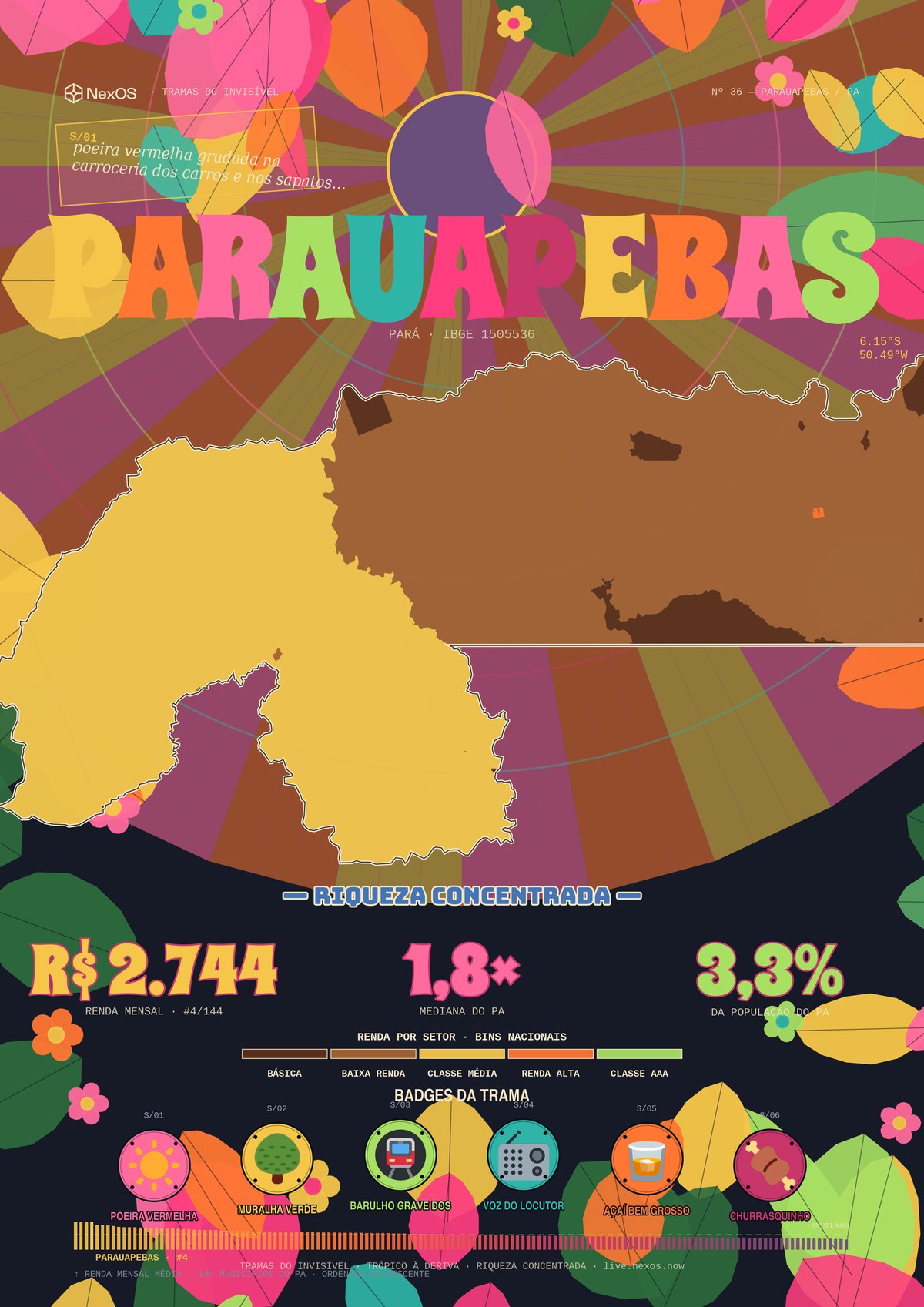
Create your own city's poster, for free, at live.nexos.now/poster.

The radio that still keeps time
In a city of passage, radio is the one thing that stays. The voice of the DJ on Rádio Arara Azul 96.9 FM calling out sales and reading listener shout-outs over the corner-store counter is, according to the municipality’s own Trama, a permanent sound — almost a clock for the city, alongside the whistle of the ore train.
Arara Azul covers 94.1% of the population — the legal name behind it, “Sistema Rádio Carajás da Amazônia,” gives away which family it belongs to: the same economy that runs the mine runs the dial. Local digital is lean and mobile-first: the site pebinhadeacucar.com.br leads with 187,000 monthly pageviews, but it’s UNPLUGGED — direct sales only, outside the programmatic auction. The one that’s plugged in is portalpebao.com.br (25,700 pvs/mo), the city’s only digital doorway for automated buying. It’s all local, measured and buyable in one shot through the Alright Network, NexOS’s curation of Brazil’s largest local media inventory:

The city that scrolls Kwai and Pinterest
And there’s the digital layer no “mining town” stereotype predicts. In NexOS’s curated inventory, Parauapebas has 38 healthy domains — a smaller market than Caxias’s or Petrolina’s, consistent with a city whose connectivity is still classified as “mixed, expanding.” But read by intensity (how much each user accesses, not raw volume), the consumption mix is the youngest in the series so far:
The bloc that dominates — video, gaming and social — is driven by Pinterest and Kwai, the two biggest names in the inventory: a young city scrolling image and short-video feeds, not passively watching TV like the older cities in the series. Right behind it comes the usual connected TV (TCL, coolita.com), then apps and classifieds (Speak Master, OLX), regional news (Metrópoles, g1, CNN Brasil) and, midway down the list, a detail that confirms the Trama itself: Bible apps rank among the most intense domains — the digital echo of the “motorcycles lined up in front of evangelical churches” the Trama records as real sociability in the city.
Internet coverage still has a gap: the urban area has signal across 96.8% of its territory, but the rural zone — where part of the mine’s operation sits — is covered in just 23.5%. Fixed broadband adds up to 40 connections per 100 residents, and the city’s connectivity profile is classified as “mixed, expanding”: low capacity for heavy creative formats, favoring audio, text and light images over 4K video. That’s why radio never left the scene, and why the city’s programmatic inventory is more compact than the bigger cities in the series: here, planning media means understanding that the connection hasn’t reached everywhere the money already has.
The crossroads still negotiating with itself
There’s a spatial tension the Trama records without mincing words: the city is expanding into the surrounding forest — new neighborhoods and informal settlements cutting into the “green wall of the Carajás forest” that still closes the horizon behind the buildings. At the same time, whoever arrived first feels pushed further out by rent pressure, while gated developments rise near the nicer areas. It’s a city divided not by old neighborhood versus new, but by who’s in the mine’s stable economy and who lives off gig work, apps and informal trade — a line that runs through almost every sidewalk conversation.
At night, that same crossroads gets loud: bars, car sound systems and motorcycles with open exhausts compete for decibels with people working irregular shifts who need to sleep during the day. The city carries stored trauma — road and workplace accidents in the mining chain, sudden floods, and a diffuse sense of guilt and helplessness among those who know the economy that feeds their family also presses on the creek and forest around it. It’s not headline material every day; it’s the low-voice topic when the subject is the children’s future — the few children who, here, almost never grow up seeing their own grandparents nearby.
How Parauapebas wants to be talked to
Whoever talks to Parauapebas talks like someone sitting in a plastic chair on the sidewalk, standing fan running against the Amazon heat, in no rush to leave — but with no certainty of staying either. It’s a city that presents itself by what it built in four decades, not by what it was before: whoever arrived “at the start” holds founder status, even if they migrated from another state twenty years ago. The tone that works is the direct, warm register of the North’s interior, with no capital-city polish — thick açaí served in a big cup, street-corner barbecue skewers smoking away to loud music, the Amazon downpour that comes all at once and sends everyone running under the nearest awning.
In the end, the Crossroads of Iron and Forest is exactly that paradox with a street address: a R$26.4 billion economy that never puts down roots, an ore train crossing the night while two motorcycles pass for every car, a Pix balance that surges while the financed apartment stays behind. It’s the city that generates fortune and decides, year after year, whether that’s a destination or just another stop.
Explore the X-ray of Parauapebas on NexOS · City hall: parauapebas.pa.gov.br · IBGE profile: cidades.ibge.gov.br/brasil/pa/parauapebas. Also see Family archetypes of Brazil and the 4-layer method.
This piece is part of the Tramas series — territorial intelligence as method. Data cross-referenced by NexOS: IBGE (GDP, 2022 Census), Central Bank of Brazil (Pix, ESTBAN — credit and real-estate lending), DETRAN (vehicle fleet), ANATEL and curated local media inventory. Symbolic profile, invisible networks and classification: Tramas do Invisível methodology.

Americana, Brazil: nostalgic for the old street, but with fewer multigenerational households than the national average
Americana's Trama profile talks about surnames that repeat across neighborhoods and neighbors who know each other by sight, but NexOS's family archetype data shows only 12.09% of households are multigenerational.

São Carlos, Brazil: behind the tech-hub label, industry pulls 46.7% of BNDES financing, well ahead of trade and services
R$273.7 million in BNDES financing (910 operations) makes industry, led by machinery, the biggest borrower of development credit in a city that sells itself as a university hub.