

Araraquara, Brazil: the rich city that barely uses Pix
Top 2% in Brazil for total payroll and Bolsa Família among the lowest 10% — yet it moves money like a small town, off Pix. The 'sugarcane capital' that is, on paper, salary and services.


They call Araraquara the Home of the Sun and the sugarcane capital — and the sun really is the character that sets the city’s daily rhythm. But the cane became scenery, and the economic portrait is that of a rich city with old habits. Araraquara ranks among the top 2% of Brazilian municipalities by total payroll, has Bolsa Família among the lowest 10% in Brazil — and, at the same time, moves money over Pix like a small town, way down the national ranking.
This is the inversion that makes it a case for territorial intelligence: the money is there, it’s top-tier, and it’s formal. It just moves slowly, the way it always has — in the salary that lands in the account, in credit, in installment plans. Little of it over Pix.
use Pix least
Wealth
The habit that stands out
Araraquara has 242,000 inhabitants and a GDP of R$ 14.7 billion — about R$ 61,000 per person. The average income per tax filer is R$ 6,251 a month, in the top 2% in Brazil; formal payroll is in the top 2% in Brazil, and credit per inhabitant in the top 10% in Brazil. Only 9.6% of households depend on Bolsa Família — among the least dependent 10% of municipalities in Brazil. On nearly every measure of formal wealth, the city is elite.
But one number breaks the curve. When you measure Pix intensity relative to income, Araraquara plunges to among the 20% that use Pix least in Brazil — that is, among the cities that move the least Pix for the size of the economy they have. A rich city that transacts like a poor one, or like a city from another era. The money is there; it just doesn’t pass through the instant card reader in the proportion you’d expect from people who earn so much.
Why the money moves slowly
The explanation lies in the design of the economy — and it debunks the cane-field legend:
Two thirds of Araraquara’s wealth is services — and agribusiness, that mythical cane, is worth 1.2%. The city is not a farm: it’s a clinic, a student house, a wholesale-retail store, a bank, a lottery agent and a paycheck. It’s an economy of formal, stable income, and that changes how money moves. People living on a formal salary, on credit and on an old-counter routine — the same mechanic, the pharmacy that knows the family, the corner store that keeps a tab — don’t need instant Pix the way an informal trader in a city of sidewalk stalls and plastic chairs does. The formality that makes it rich is also the formality that preserves the habit: debit, salary, installments, money that circulates in broad, predictable cycles, not in card-reader bursts. That income-and-spending portrait is open on NexOS’s public dashboard.
It’s the opposite, for example, of Imperatriz, in Maranhão — a city of top-tier Pix and credit coexisting with a third of households on Bolsa Família. In Araraquara, the equation inverts: plenty of salary, little social dependence, and still little Pix. Quiet, urban, formal wealth — with old habits.

What this reveals
This portrait knocks down the stereotype of the “simple interior.” The city’s symbol in NexOS is “Warm Home of the Mid-Sized City” — and the warmth is right: the strong sun that makes the asphalt shimmer in the early afternoon is part of the identity. But the “interior” of the rural imagination doesn’t match the numbers. In formal income, Araraquara is one of the richest cities in Brazil, with university life (UNESP, Uniara), a private healthcare network that serves the whole region and a downtown that draws people coming in from the smaller towns in search of a doctor, a dentist and a lawyer. The NexOS profile classifies it as Concentrated Wealth (score 0.92) and a media Oasis.
Low Pix, in this reading, isn’t backwardness: it’s the signature of an economy that was already rich before Pix existed and didn’t need to change its habits to stay rich. For anyone selling, that’s gold — it tells the channel, the pace and the tone in which the people of Araraquara are willing to be approached.

Who lives here
Araraquara’s family profile is that of a mature mid-sized city, with established families and people who stayed. The dominant group is married with young children (18.2%), followed by married with teenage children (14.6%) and a large share of multigenerational households (13.7%) — three or more generations under the same roof, typical of a city where you’re born, study and build a family in the same place.
It’s a city organized around networks of trust and neighborliness — and that, too, explains the low Pix. Here the commercial relationship is over the counter, with the long-standing customer, with whoever keeps a tab. There’s a marked local pride: the people of Araraquara see themselves in a city “better structured” than its neighbors, with good healthcare and education, and they demand it be well cared for. University youth changes the rhythm of the streets, fills student houses and bars, but the backbone of the city is established families, people who take the bus from the neighborhoods to downtown every day, or drive their own car to work. See how these family archetypes shape consumption across the country.
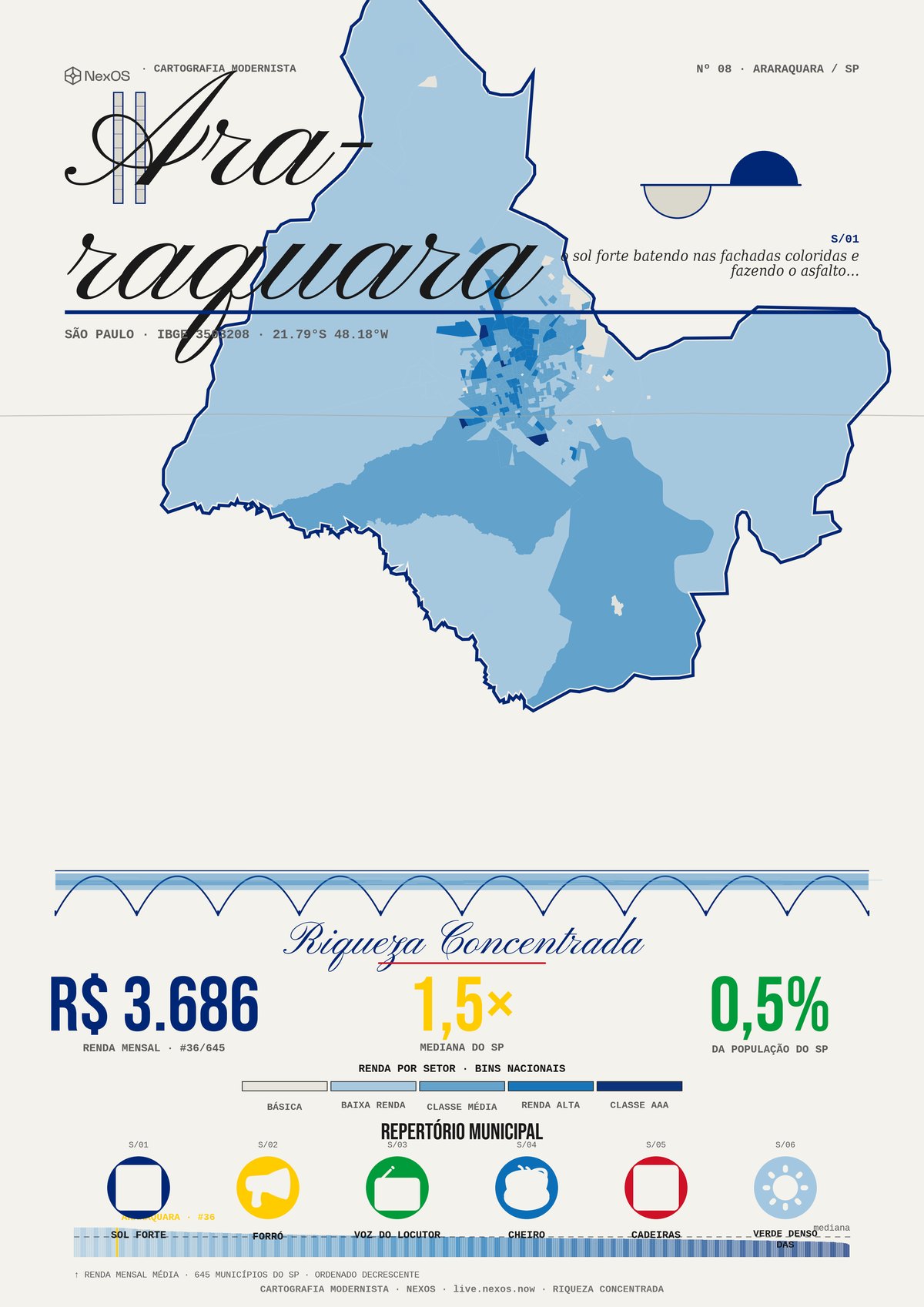
Create your city's poster, for free, at live.nexos.now/poster.
The media map nobody buys from outside
Araraquara is a complete media hub — TV, radio, digital — and all of it local, buyable. It’s no news desert: it’s an oasis. There are 12 radio stations, 4 TV channels and 9 local sites active.
| Layer | Who owns Araraquara’s attention |
|---|---|
| Radio | Rádio Morada do Sol 98.1 FM leads streaming; behind it, EP 95.7, Cultura 97.3, Nativa 91.9 and the university station Uniara 100.1 |
| TV | Four local broadcasters, including Rede Mulher and the educational Matonense, with 100% coverage |
| Local digital | araraquaraagora.com is the leader (173k pageviews/month), followed by portalmorada.com.br and araraquaranews.com.br |
The digital leader, Araraquara Agora, delivers 173,000 pageviews a month and is already plugged into programmatic media — buyable in one shot through the Alright Network, NexOS’s curation of the largest inventory of local and regional media in Brazil:

There’s still a third layer — what the people of Araraquara consume on their phones. Cross-referencing the programmatic inventory, you can read the city by access intensity per topic. And what emerges is the portrait of a young, studious, practical city:
The most intense category is games — a young, university crowd, with Overwolf on top — ahead of education (Escola Games, Toda Matéria) and music (CifraClub). Then come capital-city news read on the phone (UOL, Correio Braziliense, CNN) and the pair that defines the local economy: used goods (OLX) and cars (Webmotors), from people who research before they spend. Looking outlet by outlet, by access intensity per user:
Local radio on all day, a Sunday match on the amateur pitch, a used car researched on the phone before closing the deal — Araraquara’s media isn’t nostalgia: it’s the real channel, with a real audience, on sale to any agency in Brazil. One that simply never looked.
How Araraquara wants to be spoken to
Here communication works when it sounds like talk at the bar counter or the supermarket checkout: direct, no fluff, with price and benefit right up front. “Cê,” “a gente,” “vamo combinar,” “não tem erro” fit in without forcing it. The right tone speaks of the real routine — the blazing heat, the crowded bus, the rush between work and college, the monthly shop at the wholesale-retail store, the healthcare appointment — and prefers a photo of real people from the city to a generic stock image. The triggers are the heat and the search for shade and cold water, the pride of being a well-structured regional hub, the memory of the railway and the culture of planned purchases.
The same logic that keeps Pix low is the one that governs the conversation: Araraquara trusts what it knows — the counter, the neighbor, the same old radio. It’s a rich city that prefers the old rhythm — and perhaps that’s why it only wants to be spoken to the way it always has been there: eye to eye, naturally, like someone who already has money but doesn’t make a fuss about being in a hurry. The question that remains: when the Home of the Sun decides to move faster, who will have gotten there first to talk to it?
Explore the Araraquara x-ray on NexOS · City hall: araraquara.sp.gov.br · IBGE profile: cidades.ibge.gov.br/brasil/sp/araraquara. See also Chapecó, SC — the farm capital that barely farms — and the family archetypes.
This piece is part of the Tramas series — territorial intelligence as method. Data cross-referenced by NexOS: IBGE (GDP, 2022 Census), the Central Bank (Pix and credit), RAIS/CAGED, CadÚnico/Bolsa Família, ANATEL and curated local media inventory. Profile and classification: the Tramas do Invisível methodology.

Americana, Brazil: nostalgic for the old street, but with fewer multigenerational households than the national average
Americana's Trama profile talks about surnames that repeat across neighborhoods and neighbors who know each other by sight, but NexOS's family archetype data shows only 12.09% of households are multigenerational.

São Carlos, Brazil: behind the tech-hub label, industry pulls 46.7% of BNDES financing, well ahead of trade and services
R$273.7 million in BNDES financing (910 operations) makes industry, led by machinery, the biggest borrower of development credit in a city that sells itself as a university hub.