

Foz do Iguaçu: 64% of the economy is energy, not tourism
64% of the economy is industry — and industry here means Itaipu, not the Falls. Wealth in the top 10% and an SPI Opportunity score of 43: two Foz on the same bridge.


In Foz do Iguaçu, tourism brings the fame, energy brings the GDP. The city is known worldwide for a waterfall — the Iguaçu Falls — and for a triple border that fits on a postcard. But when you open the economic ledger, the water that matters isn’t the water that falls: it’s the water that turns turbines. Almost two thirds of everything Foz produces comes from industry. And “industry,” here, has a proper name: Itaipu.
It’s this inversion that makes Foz a case study in territorial intelligence. The city that sells itself as a leisure destination is, in the numbers, an energy capital disguised as a tourist hotspot.
top 10%
The waterfall that doesn't move the GDP
Foz do Iguaçu has roughly 285,000 inhabitants and a GDP of R$ 17 billion. The tourist who arrives imagines an economy of hotels, agencies and shops — and it exists, it’s big and it employs people. But it isn’t what tips the scale. The shape of the value added is almost the opposite of the stereotype:
No mid-sized Brazilian city has 64% of its economy in industry by accident. Foz does because it hosts, on the Brazilian side, the largest hydroelectric plant in the hemisphere by generation — Itaipu Binacional. In national accounting, energy is booked as industry. So the dam that holds back the Paraná river doesn’t just light up much of the country: it single-handedly inflates the largest slice of the municipal GDP. Take Itaipu out of the ledger and the “industrial city” becomes what the tourist sees — a border economy of services, retail and hospitality.
That’s why the icon misleads. The Iguaçu Falls are the image; Itaipu’s concrete wall is the cash register. The water that makes the fame falls; the water that makes the GDP is dammed.
Who lives off energy — and who lives off the border
This hidden engine leaves its mark on the wealth profile. Foz ranks in the top ten percent of the country in wealth per filer (top 10% in Brazil) and in income per filer (top 7% in Brazil), and its formal payroll mass is in the top 2% in Brazil — the numbers of a city that concentrates qualified, technical and stable jobs. It’s the upper floor: the plant engineer, the binational civil servant, the high-end tourism professional, the established merchant. Average income of the head of household: R$ 3,549, above the national average.
But there’s a second floor, and it doesn’t live in the same indicators. Pix use relative to income is among the 40% lowest-Pix-using places in the country — low for an economy of this size — a sign of a city where a lot of money still flows in cash, in the bilingual informality of the triple border: the street currency exchange, the cross-border shuttle traders, the commerce that crosses the Friendship Bridge into Ciudad del Este and comes back. And 21.7% of households receive Bolsa Família (coverage among the lowest in the country). Capital wealth on top, an economy of cash and transfers below — on the same bridge.
The cruelest portrait of this divide isn’t in income. It’s in the Social Progress Index. Foz handles the basics well — Basic Human Needs at 77 and Foundations of Wellbeing at 75. But on the Opportunity dimension — access to higher education, rights, inclusion, freedom of choice — the city plunges to 43, against an overall SPI of around 65:
Translating: Foz guarantees the roof, the water, the vaccine and the basic school. What it doesn’t deliver for much of the population is a chance to rise. The energy that moves the GDP doesn’t automatically turn into opportunity in the life of someone selling diapers at the border or guiding tourists by the day. There are two Foz — and the bridge between them is narrower than the Friendship Bridge.

Who lives here
Foz’s family DNA is that of a city of work and crossing. The dominant group is married couples with young children (19.8%, in line with the national average), followed by married couples with teenage children (16.3%). But two traits break from the obvious and draw the border: multigenerational families — three generations under one roof — weigh 15.2%, above average, a portrait of migration, housing costs and the bonds that tighten where income is unstable; and single-mother or single-father families add up to 7.7%, the group most exposed to the opportunity gap the SPI exposes.
It’s a young, migrant and plural population — Paraguayans, Argentines, Lebanese, Chinese, Brazilians from every corner. The city speaks Portuguese, Spanish and Arabic on the same block, and lives an identity that swings between the pride of a world-famous postcard and the hardship of those who hold up the real economy at the border.
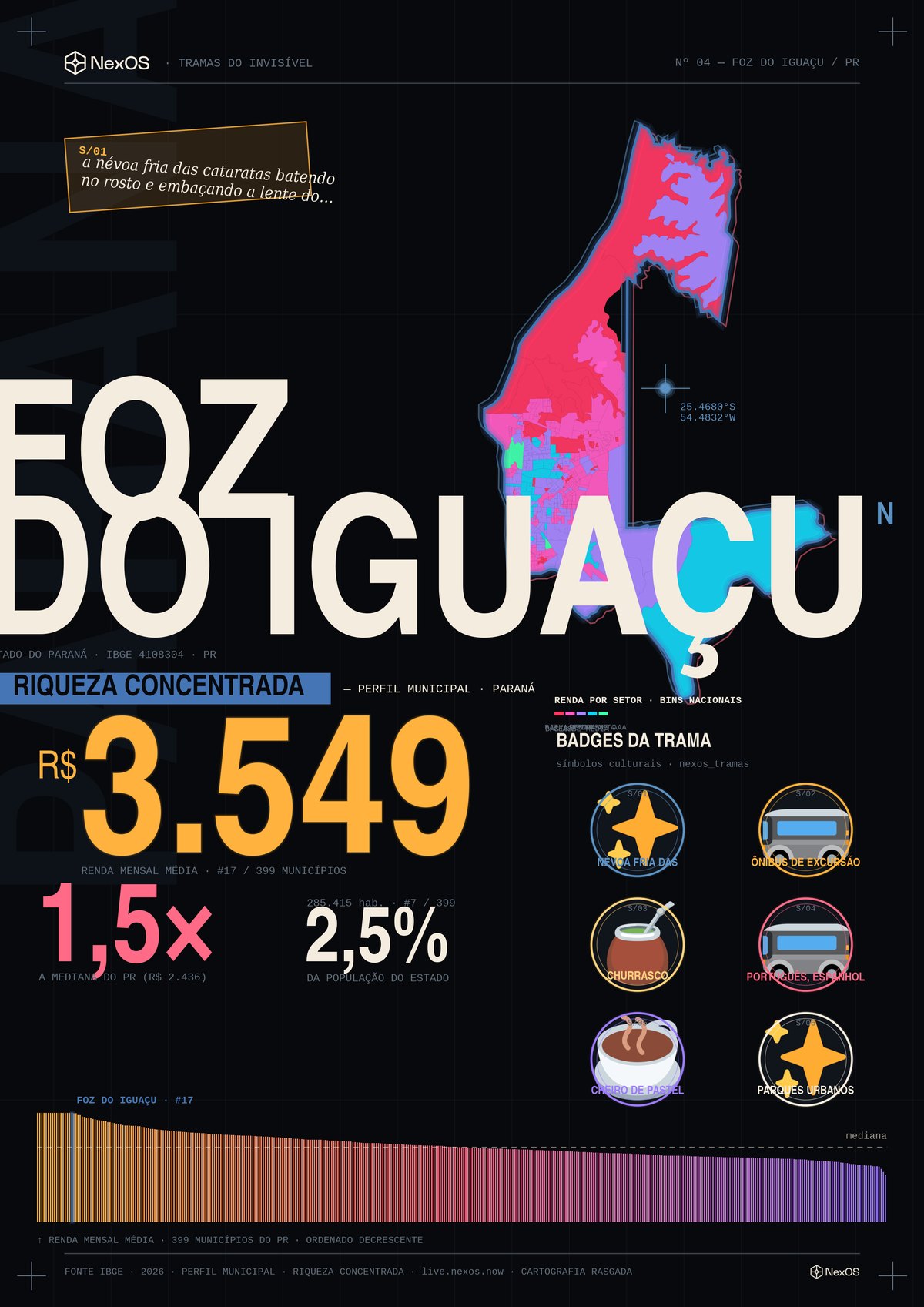
Create your city's poster, for free, at live.nexos.now/poster.

The media map nobody buys from outside
Foz is, in NexOS jargon, a complete media hub — TV, radio and digital, all local and buyable. And it isn’t “interior” in the poor sense of the word: far from being a news desert, it’s a border oasis, with 23 radio stations, 2 broadcast TV stations and 10 local sites active, adding up to 1.34 million pageviews per month in the city’s digital press alone.
| Layer | Who commands Foz’s attention |
|---|---|
| Radio | Viola Foz 91.7 FM leads; 23 stations headquartered with full city coverage |
| TV | Televisão Naipi and TV Cataratas — local signal with their own broadcasting |
| Editorial digital | foz.portaldacidade.com leads (565k pvs/month), closely followed by h2foz.com.br (536k pvs/month) |
| Connected digital | h2foz.com.br is the local outlet with the most programmatic inventory tied to demand |
The detail that sets Foz apart from almost the entire market: these outlets have a capital-city portal’s audience and almost no one from outside buys them. The editorial leader, foz.portaldacidade.com, runs “unplugged” — direct sales only. h2foz is already connected and delivers real monthly programmatic inventory. All measured, all local, and all available in a single move through the Alright Network, the curation NexOS makes of the largest local and regional media inventory in Brazil:

There’s still a third layer — what people in Foz consume on their phones. By cross-referencing the programmatic inventory with access intensity per user, you can read the city by theme. And here the border doesn’t hide: it dominates.
The city’s most intense category is border: the domain comprasparaguai.com.br is, by far, one of the most accessed in Foz — people planning their next crossing of the bridge as both a sport and a source of income. Behind it come the games (Overwolf, Poki, Medal, Bluestacks) of a young, connected audience, football (Sofascore, scores365, ge), music (CifraClub at the top), faith (an offline Bible app) and classifieds (OLX). Looking outlet by outlet, by access intensity per user:
Currency exchange at the border, a game on Sunday, guitar tabs and the bridge crossing searched on the phone — Foz’s media isn’t tourist folklore: it’s the real channel, with a real audience, on sale to any agency in Brazil. One that simply never looked beyond the Falls.
Two cities, one bridge
Foz do Iguaçu is the city where the water speaks loud — but it speaks two languages. For the tourist, it’s the waterfall roaring at the Falls. For the accounting, it’s Itaipu’s wall moving 64% of the GDP. And for those who live there, it’s a third thing: a two-floor border, with capital wealth on top and an economy of cash and Bolsa Família below, separated by an SPI Opportunity score of 43 that doesn’t fit on the postcard.
Energy gives the number. Tourism gives the photo. What remains is the question neither of them answers: will the water that lights up all of Brazil one day light up both Foz?
Explore the X-ray of Foz do Iguaçu on NexOS · City hall: foz.pr.gov.br · IBGE profile: cidades.ibge.gov.br/brasil/pr/foz-do-iguacu. See also Chapecó, SC — another southern economy where industry hides the farm — and the family archetypes.
This piece is part of the Tramas series — territorial intelligence as method. Data cross-referenced by NexOS: IBGE (GDP, 2022 Census), Central Bank (Pix and credit), CadÚnico/Bolsa Família, SPI Brazil (Imazon/Social Progress Institute), ANATEL and curated local media inventory. Profile and classification: Tramas do Invisível methodology. Cover photo: Rubens Fraulini / Itaipu Binacional.

Americana, Brazil: nostalgic for the old street, but with fewer multigenerational households than the national average
Americana's Trama profile talks about surnames that repeat across neighborhoods and neighbors who know each other by sight, but NexOS's family archetype data shows only 12.09% of households are multigenerational.

São Carlos, Brazil: behind the tech-hub label, industry pulls 46.7% of BNDES financing, well ahead of trade and services
R$273.7 million in BNDES financing (910 operations) makes industry, led by machinery, the biggest borrower of development credit in a city that sells itself as a university hub.