

Americana, Brazil: nostalgic for the old street, but with fewer multigenerational households than the national average
Americana's Trama profile talks about surnames that repeat across neighborhoods and neighbors who know each other by sight, but NexOS's family archetype data shows only 12.09% of households are multigenerational.


Americana’s Trama profile holds a specific kind of nostalgia: among the city’s quiet traumas, it notes that the sense of rising urban violence “feeds a nostalgia for times when ‘kids could play in the street until late’ without so much fear.” It’s a city that remembers surnames repeating across neighborhoods, neighbors who know each other by sight, families walking hand in hand under the shade of the urban groves. But NexOS’s family archetype data shows a different picture: only 12.09% of Americana’s households span more than one generation under the same roof, against 15.04% for the rest of Brazil.
The family shape nostalgia doesn't show
Couples with young children are the city’s largest group, 19.36% of households. It’s a more nuclear family shape than the traditional-neighborhood memory suggests: among Brazilian municipalities, Americana sits close to the fifth that gathers the fewest generations under one roof.
In female-headed households, Americana lands at 42.86%, close to the national average (44.9%) — not a departure like the multigenerational figure, but confirming that the city’s real family shape isn’t bigger or more collective than anywhere else in the country.
Where the real economy lives
In the city’s R$12.83 billion value added, services dominate at 55.70%, followed by industry (35.08%) and public administration (9.12%); farming is nearly nonexistent, 0.11%. Of BNDES lending, the top sector is road transport (R$275.9 million), with textiles and apparel in second (R$169.1 million) — Americana’s industrial heritage still weighs in credit, but behind logistics.
In the local fleet, cars lead by a wide margin, 132,111 units against 37,476 motorcycles, and the Volkswagen Gol (9,163 units) is the most common model. It’s the profile of a fully urbanized city, not an old suburban neighborhood.
Pix received by individuals grew 59.2% between January 2024 and June 2026, from R$1,000.3 million to R$1,592.5 million a month, peaking at R$1,775.4 million in December 2025.
Bank credit grew 9.40% between January 2024 and December 2025, from R$4,192.9 million to R$4,587.0 million, and real estate financing grew much faster, 15.42% over the same period, from R$2,219.7 million to R$2,562.1 million, now 55.85% of all the city’s credit.
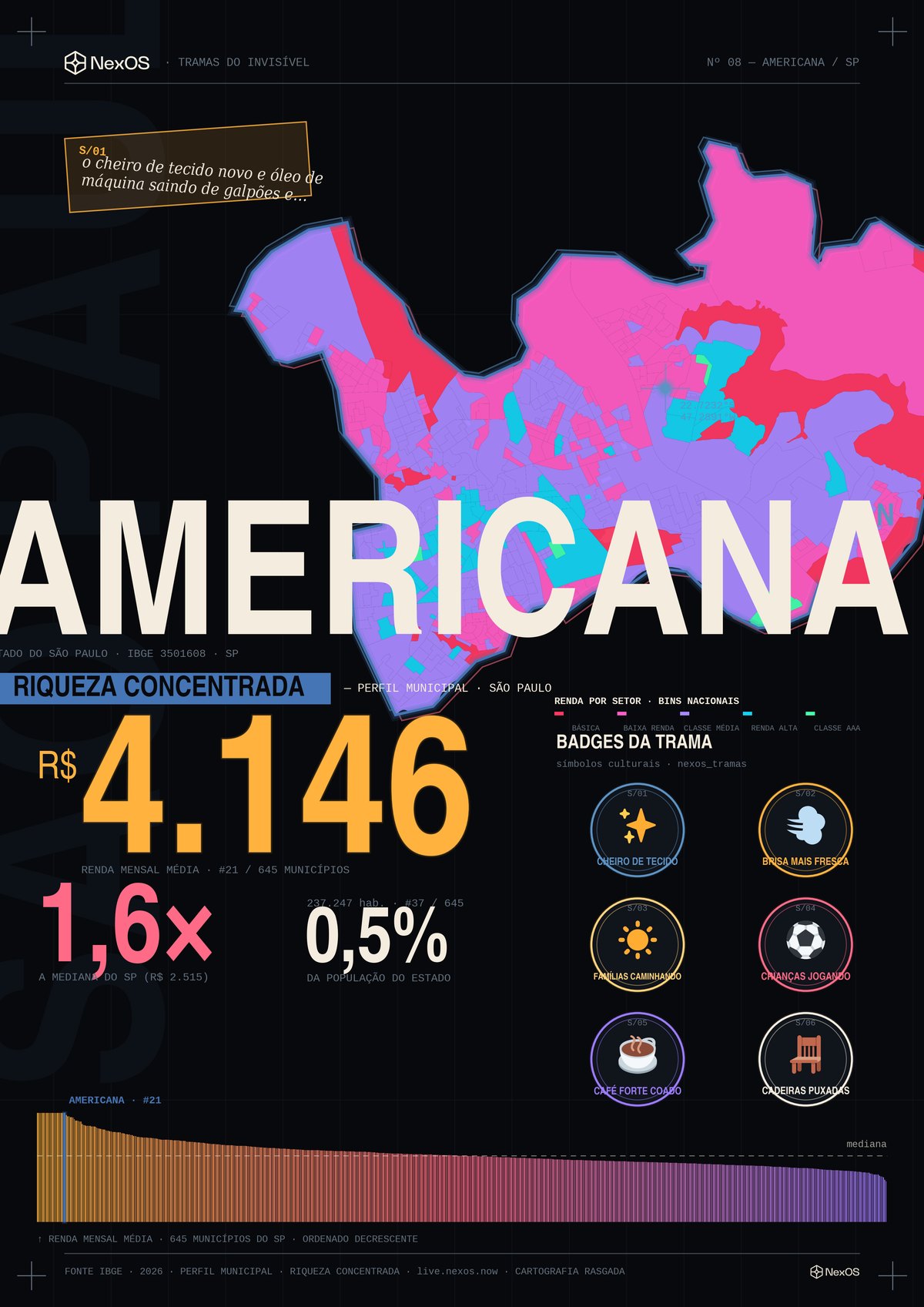
Create your city's poster, for free, at live.nexos.now/poster.


A full media hub, led by Rádio Gold
The media profile NexOS assigns Americana is Full Media Hub (TV+Radio+Digital). Rádio Gold 94.7 FM leads, 13,920 monthly streaming listeners and 100% population coverage, ahead of Rádio Vox 90.3 FM (10,685) and Rádio Notícia 88.9 FM (10,530).
Online, liberal.com.br leads local sites by a wide margin, 766,036 monthly pageviews and plugged into programmatic media, ahead of portaldeamericana.com (165,075) and tododia.com.br (106,470).
Classifieds and utilities lead the city’s digital consumption, closely followed by social and portals and by news and media, where UOL outranks even Globo among the most visited domains in the municipality.

How Americana wants to be remembered
The chair pulled onto the sidewalk, the neighbor watching the street, the surname that repeats from one neighborhood to the next: these are the symbols Americana chooses to tell its own story, a city that remembers fondly when “kids could play in the street until late.” But the real shape of its families has already changed, more nuclear, less multigenerational than the national average. The nostalgia holds onto a street that today’s data no longer confirms.
Explore Americana’s X-ray on NexOS · City hall: americana.sp.gov.br · IBGE profile: cidades.ibge.gov.br/brasil/sp/americana. See also the family archetypes piece and the 4-layer method.
This piece is part of the Tramas series, territorial intelligence as a method. Data cross-referenced by NexOS: IBGE (GDP, Census, agricultural and livestock production), BNDES (indirect operations by subsector), Banco Central (Pix, ESTBAN: credit and real estate financing), CadÚnico/Bolsa Família, DETRAN (vehicle fleet), ANATEL and curated local media inventory. Symbolic profile, invisible networks and classification: Tramas do Invisível methodology.

São Carlos, Brazil: behind the tech-hub label, industry pulls 46.7% of BNDES financing, well ahead of trade and services
R$273.7 million in BNDES financing (910 operations) makes industry, led by machinery, the biggest borrower of development credit in a city that sells itself as a university hub.

Francisco Beltrão, Brazil: known as the "Valley of Antennas," the farm gate is where most BNDES credit actually lands
R$823.97 million in farming credit, 54.1% of all BNDES lending in the city, nearly 4 times what industry managed to raise.