

Francisco Beltrão, Brazil: known as the "Valley of Antennas," the farm gate is where most BNDES credit actually lands
R$823.97 million in farming credit, 54.1% of all BNDES lending in the city, nearly 4 times what industry managed to raise.


Francisco Beltrão sees itself as the “Valley of Antennas”: between hills and winter fog, radio, TV and internet towers shape the skyline as much as the araucaria pines, and the city sees itself as a regional hub for Southwest Paraná, with hospitals, colleges and distributors pulling people in from smaller municipalities. But development credit tells a different story: R$823.97 million in BNDES lending went to farming, 54.1% of all the credit the bank disbursed in the city, nearly 4 times what all of industry managed to raise (R$215.5 million).
Two cities in the same credit line
The upper floor of the city runs on services: 54.01% of R$3.26 billion in value added comes from trade, health, education and other services, nearly double industry (21.51%) and more than five times farming (10.27%). It’s the city of hospitals, colleges and antennas.
The lower floor, what actually holds up that structure in development credit, is the farm gate: farming, the smallest share of GDP among the four major sectors, is the biggest borrower of BNDES credit in the city, alone worth more than infrastructure, industry and trade combined.
What connects the two Francisco Beltrãos
In the local fleet, cars lead with 46,529 units, more than double the 17,167 motorcycles, and the Volkswagen Gol (4,907 units) is the most common model, a more urban than rural profile.
In NexOS’s family archetype data, couples with young children are the largest group (21.64% of households), and 25-39 year-olds show up above the national average (10.22% against 7.14%); multigenerational families, by contrast, fall below the average (11.18% against 15.04%).
Pix received by the city (individuals + businesses) grew 107.8% between January 2024 and June 2026, from R$703.7 million to R$1,462.4 million a month, peaking at R$1,935.4 million in May 2026.
Bank credit grew 21.96% between January 2024 and December 2025, from R$1,478.9 million to R$1,803.6 million, and real estate financing grew at almost the same pace, 20.61%, from R$509.7 million to R$614.7 million, now 34.08% of all the city’s credit.
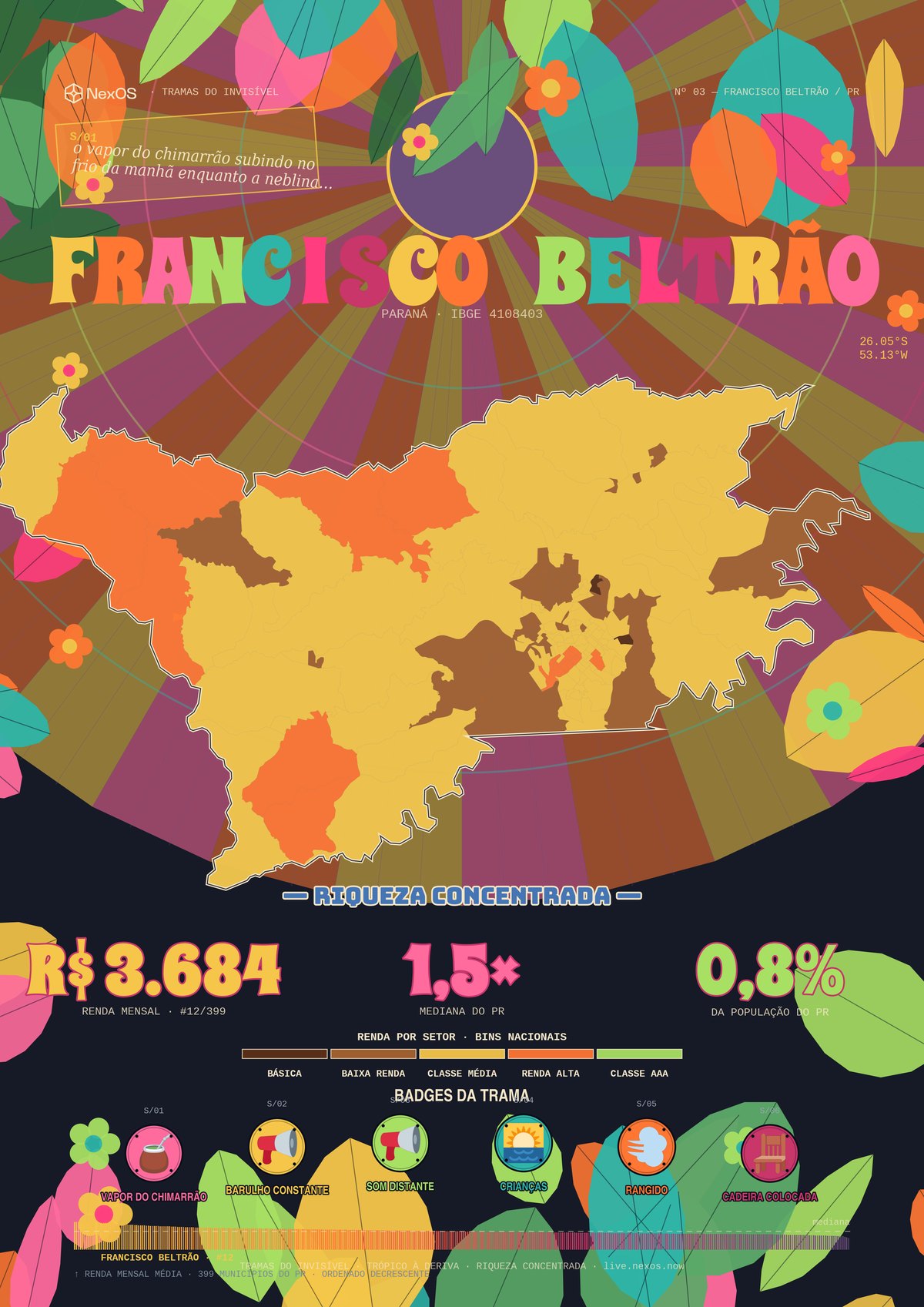
Create your city's poster, for free, at live.nexos.now/poster.


A real valley of antennas, led by Rádio Massa
The media profile NexOS assigns Francisco Beltrão is Full Media Hub (TV+Radio+Digital) — the “Valley of Antennas” isn’t just a figure of speech. Rádio Massa 95.3 FM leads, 13,144 monthly streaming listeners and 99.3% population coverage, ahead of Rádio Princesa 92.3 FM (9,980) and Rádio Educadora 96.3 FM (7,141).
Online, ppnewsfb.com.br is by far the strongest local site, 530,079 monthly pageviews and plugged into programmatic media, ahead of rbj.com.br (203,355) and jornaldebeltrao.com.br (74,760), both unplugged, selling only through direct sales.
Classifieds and utilities lead the city’s digital consumption, ahead of news and media, where ppnewsfb.com.br itself competes on equal footing with Globo among the most visited domains in the municipality.

How Francisco Beltrão wants to be seen
Antenna towers on the hill, a full hospital, a packed college: the symbols Francisco Beltrão chooses to tell its own story speak of a regional hub, a city that solves problems for people coming from elsewhere. The farm gate doesn’t show up in that picture, but it’s the one still cashing the biggest check from development credit. Neither image cancels the other out; the city is, at the same time, the valley that picks up radio signal and the valley that picks up farm financing, each pulling toward a different side of the same economy.
Explore Francisco Beltrão’s X-ray on NexOS · City hall: franciscobeltrao.pr.gov.br · IBGE profile: cidades.ibge.gov.br/brasil/pr/franciscobeltrao. See also the family archetypes piece and the 4-layer method.
This piece is part of the Tramas series, territorial intelligence as a method. Data cross-referenced by NexOS: IBGE (GDP, Census, agricultural and livestock production), BNDES (indirect operations by subsector), Banco Central (Pix, ESTBAN: credit and real estate financing), CadÚnico/Bolsa Família, DETRAN (vehicle fleet), ANATEL and curated local media inventory. Symbolic profile, invisible networks and classification: Tramas do Invisível methodology.

Americana, Brazil: nostalgic for the old street, but with fewer multigenerational households than the national average
Americana's Trama profile talks about surnames that repeat across neighborhoods and neighbors who know each other by sight, but NexOS's family archetype data shows only 12.09% of households are multigenerational.

São Carlos, Brazil: behind the tech-hub label, industry pulls 46.7% of BNDES financing, well ahead of trade and services
R$273.7 million in BNDES financing (910 operations) makes industry, led by machinery, the biggest borrower of development credit in a city that sells itself as a university hub.