

Limeira, Brazil: in the "city of jewels," industry is worth 43 times more than agriculture
Even with oranges and sugarcane still present in the rural landscape, Limeira's agriculture accounts for just R$113 million of R$13.48 billion in value added.


Limeira sees itself as the “City of Waves and Jewels”: the glow of semi-precious jewelry in downtown storefronts and the signal of radio waves crossing the city form the identity it chooses to tell about itself. But the real economic ledger shows a different scale: industry is worth 43 times more than all of agriculture combined. In 2024, industry generated R$4.85 billion in value added against just R$113 million from agriculture, out of R$13.48 billion in total.
An economy that turned its back on the countryside
Development credit deepens that gap. Of the R$1.43 billion BNDES disbursed in Limeira, infrastructure (dominated by road transport) leads with R$649.9 million, followed by industry (R$543.2 million) and trade and services (R$229.8 million). Agriculture gets R$2.76 million across just 45 operations, 0.19% of the total: barely 1 in every 500 reais of development credit reaches the fields.
Even so, farming stays visible in the landscape: 12,000 hectares of sugarcane yielded R$131.4 million in gross production value in 2024, and oranges, an old symbol of the paulista countryside, still cover 800 hectares and are worth R$48.6 million. It’s an agriculture that remains along the highway and on the horizon, but has practically vanished from the city’s official ledger.
Who lives in the city of jewels
In NexOS’s family archetype data, couples with young children are the most common group in Limeira, 18.4% of households, and nearly half of homes, 47.0%, are headed by women. In the local fleet, cars dominate with 152,160 units against 55,069 motorcycles, and the Volkswagen Gol (12,944 units) remains the city’s most common model.
Pix received by the city (individuals + businesses) grew 54.0% between January 2024 and June 2026, from R$2,550.1 million to R$3,926.5 million a month, peaking at R$4,453.8 million in December 2025.
Bank credit grew 13.5% between January 2024 and December 2025, from R$4,094.9 million to R$4,645.9 million, and real estate financing grew faster, 20.1% over the same period, from R$1,966.1 million to R$2,362.2 million, now 50.9% of all the city’s credit.
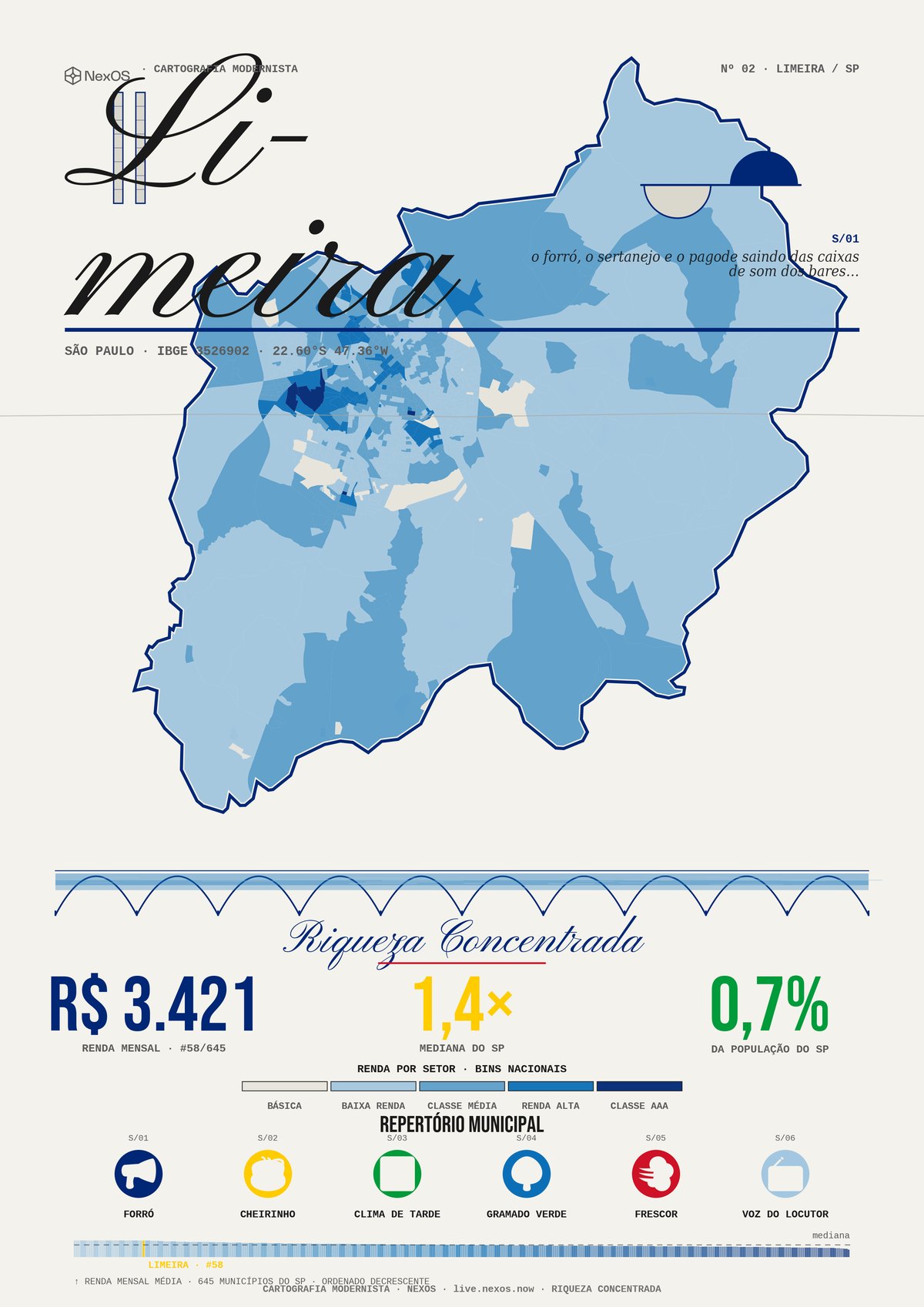
Create your city's poster, for free, at live.nexos.now/poster.


A full media hub, led by Rádio Estereosom
The media profile NexOS assigns Limeira is Full Media Hub (TV+Radio+Digital). Rádio Estereosom 99.9 FM leads, 14,198 monthly streaming listeners and 100% coverage, ahead of Rádio Educadora 1020 AM (10,818) and Rádio Magnificat 103.5 FM (5,252).
Online, rapidonoar.com.br leads among local sites, 417,075 monthly pageviews and plugged into programmatic media, ahead of elimeira.com.br (208,183 pageviews, also plugged, with 1.1 million programmatic impressions a month).
Classifieds and utilities lead the city’s digital consumption, ahead of news and media, where UOL and Globo compete for space with elimeira.com.br itself, among the most visited domains in the municipality.

How Limeira wants to be seen
The jewelry-shop window, the radio signal, the quiet shine of someone polishing what’s in their hands: the symbols Limeira chooses to tell its own story speak of small-scale trade and waves that connect the city. But the real value that moves Limeira comes from the warehouse and the production line, forty-three times larger than everything still planted and raised in what’s left of the countryside. Oranges and sugarcane remain in the landscape; the money that counts has already moved to the factory.
Explore Limeira’s X-ray on NexOS · City hall: limeira.sp.gov.br · IBGE profile: cidades.ibge.gov.br/brasil/sp/limeira. See also the family archetypes piece and the 4-layer method.
This piece is part of the Tramas series, territorial intelligence as a method. Data cross-referenced by NexOS: IBGE (GDP, Census, agricultural and livestock production), BNDES (indirect operations by subsector), Banco Central (Pix, ESTBAN: credit and real estate financing), CadÚnico/Bolsa Família, DETRAN (vehicle fleet), ANATEL and curated local media inventory. Symbolic profile, invisible networks and classification: Tramas do Invisível methodology.

São Carlos, Brazil: behind the tech-hub label, industry pulls 46.7% of BNDES financing, well ahead of trade and services
R$273.7 million in BNDES financing (910 operations) makes industry, led by machinery, the biggest borrower of development credit in a city that sells itself as a university hub.

Francisco Beltrão, Brazil: known as the "Valley of Antennas," the farm gate is where most BNDES credit actually lands
R$823.97 million in farming credit, 54.1% of all BNDES lending in the city, nearly 4 times what industry managed to raise.