

São Carlos, Brazil: behind the tech-hub label, industry pulls 46.7% of BNDES financing, well ahead of trade and services
R$273.7 million in BNDES financing (910 operations) makes industry, led by machinery, the biggest borrower of development credit in a city that sells itself as a university hub.


São Carlos sees itself as an interior “tech-lab city”: campuses, research centers and an airport that talks to the aerospace industry shape how the city sees itself. But what actually pulls development credit isn’t the innovation hub: it’s machine-shop industry, lathes, motors, parts. Of the R$585.8 million BNDES disbursed in the city, 46.7% (R$273.7 million, 910 operations) went to industry, well ahead of trade and services (R$186.0 million, 31.8%).
The motor the label doesn't show
Within industry itself, the leader isn’t any startup or laboratory: it’s machinery, R$92.2 million across 378 operations, a third of everything industry borrowed on its own. Metallurgy (R$36.7 million), pulp and paper (R$28.6 million) and textiles (R$40.0 million) round out the picture. It’s shop-floor credit, not classroom credit.
The blind spot in the landscape
Farming barely registers in the city’s value added, just 1.4% of an R$18.39 billion GDP, but it’s still very visible on the ground: 36,000 hectares of sugarcane yielded R$351.0 million in gross production value in 2024, more than all of “farming” weighs in the city’s official accounts. It’s a sector that vanished from the ledger, but not from the territory.

Who works the real motor
In NexOS’s family archetype data, couples with young children are the most common group in São Carlos, 18.5% of households, and 46.1% of homes are headed by women. In the local fleet, cars dominate with 132,989 units against 39,306 motorcycles, and the Volkswagen Gol (13,155 units) is by far the city’s most common model.
Pix received by the city (individuals + businesses) grew 63.0% between January 2024 and June 2026, from R$1,657.0 million to R$2,700.5 million a month, peaking at R$2,952.2 million in December 2025.
Bank credit grew 15.6% between January 2024 and December 2025, from R$3,904.4 million to R$4,514.3 million, and real estate financing grew even faster, 26.0% over the same period, from R$2,196.4 million to R$2,768.1 million, now 61.3% of all the city’s credit.
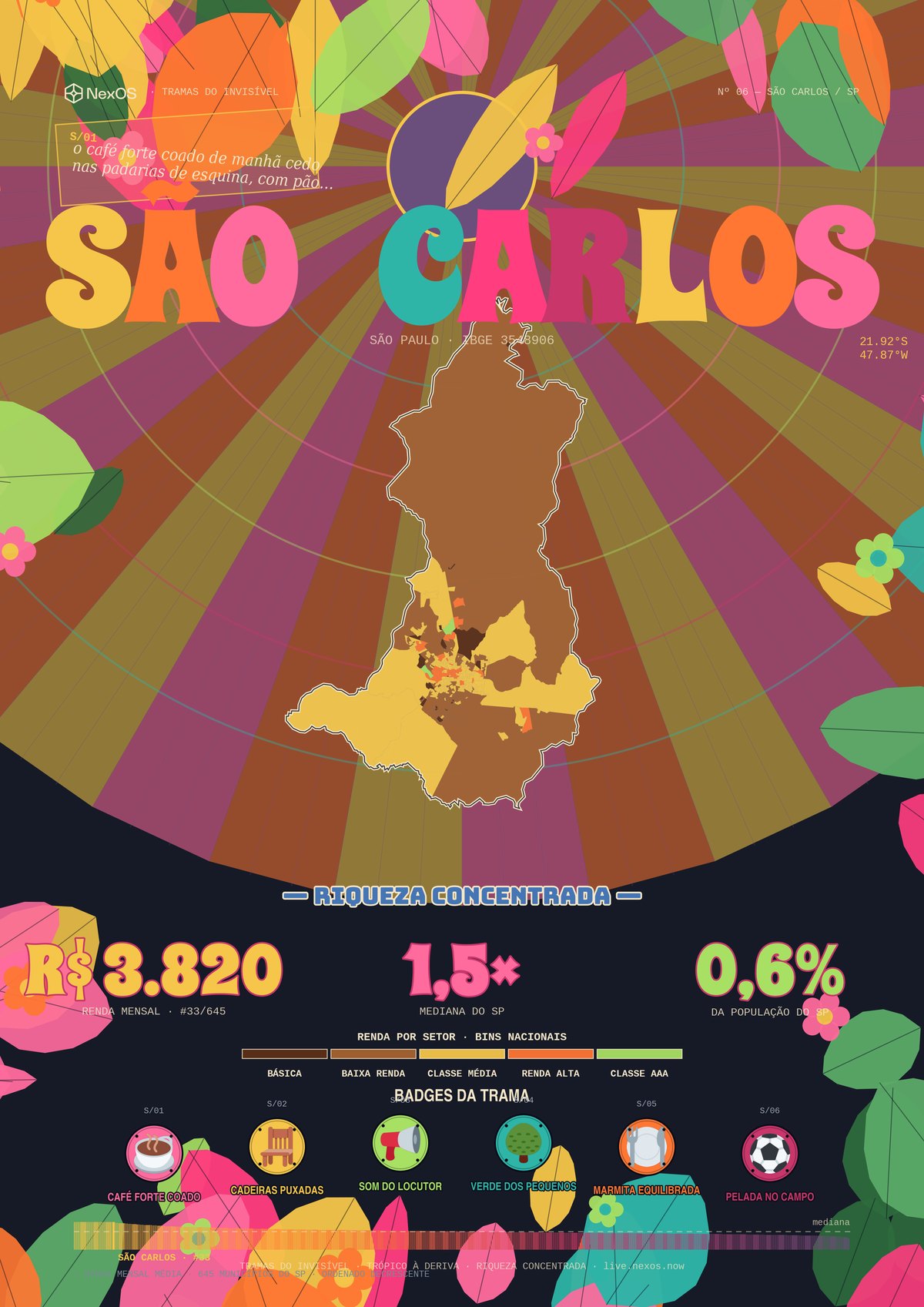
Create your city's poster, for free, at live.nexos.now/poster.

A full media hub, led by Rádio DBC
The media profile NexOS assigns the city is Full Media Hub (TV+Radio+Digital). Rádio DBC 106.3 FM leads, 16,169 monthly streaming listeners and 100% coverage, ahead of Rádio Sertaneja 91.1 FM (12,105) and Rádio Clube 104.7 FM (7,393).
Online, saocarlosagora.com.br is the strongest local site, 2,115,766 monthly pageviews and plugged into programmatic media, ahead of jornalpp.com.br (88,320) and saocarlosemrede.com.br (109,864). cartacapital.com.br also shows up in the city with a much larger volume (17.5 million monthly pageviews), but as a diluted regional site, not a hyperlocal one.
Classifieds and utilities lead the city’s digital consumption, ahead of news and media, where Globo and UOL compete for space with saocarlosagora.com.br itself, among the most visited domains in the municipality.

How São Carlos wants to be seen
Campuses, a tech airport, labs lit up at night: the symbols São Carlos chooses to tell its own story speak of innovation and research. But the credit that actually moves through the city speaks a different language, that of machinery, metallurgy, the lathe. The university gives it the label; the motor that pulls the financing looks a lot more like a machine shop than a laboratory.
Explore São Carlos’s X-ray on NexOS · City hall: saocarlos.sp.gov.br · IBGE profile: cidades.ibge.gov.br/brasil/sp/saocarlos. See also the family archetypes piece and the 4-layer method.
This piece is part of the Tramas series, territorial intelligence as a method. Data cross-referenced by NexOS: IBGE (GDP, Census, agricultural and livestock production), BNDES (indirect operations by subsector), Banco Central (Pix, ESTBAN: credit and real estate financing), CadÚnico/Bolsa Família, DETRAN (vehicle fleet), ANATEL and curated local media inventory. Symbolic profile, invisible networks and classification: Tramas do Invisível methodology.

Americana, Brazil: nostalgic for the old street, but with fewer multigenerational households than the national average
Americana's Trama profile talks about surnames that repeat across neighborhoods and neighbors who know each other by sight, but NexOS's family archetype data shows only 12.09% of households are multigenerational.

Francisco Beltrão, Brazil: known as the "Valley of Antennas," the farm gate is where most BNDES credit actually lands
R$823.97 million in farming credit, 54.1% of all BNDES lending in the city, nearly 4 times what industry managed to raise.