

Anápolis, Brazil: the crossroads city that became inland Goiás's biggest logistics and medicine hub
In the middle of Goiás farm country, a highway crossroads became the biggest logistics and medicine hub in inland Goiás. Here, the stereotype misleads: soybeans are just 1% of local GDP, and what really moves the city is the truck.


Say “Goiás” and the image that comes up is farmland: soybeans to the horizon, tractors, the Midwest’s breadbasket. Anápolis disproves that image from the inside out. Here, in the middle of Brazil’s most agricultural state, farming accounts for just 1.1% of GDP. What you see through the car window (warehouse after warehouse, truck after truck, factory after factory) is a far more accurate portrait of the city than any field of crops.
Because Anápolis doesn’t live off harvests. It lives off passing through: people and cargo that arrive, cross, work and, increasingly, stay. The city was born as a resting point for cattle drovers atop the plateau, grew when the railroad arrived, and was cemented by the age of the great highways. The symbol the municipality’s own Trama profile uses to describe itself, “Crossroads of Goiás,” isn’t a figure of speech: it’s the backbone of a R$20.4-billion economy built on what crosses the city, not on what it plants.
Wealth
The engine the icon hides
The icon is farming. The engine is something else. In the GDP mix, what actually sustains Anápolis is the pairing of industry (33.8%) and services (51.6%), with public administration adding 13.6%. Agriculture, the face Goiás shows the rest of Brazil, barely registers on the chart.
And there’s a finer layer only BNDES’s proprietary data reveals: inside industry and services, what actually pulls the most financing from the development bank isn’t the generic factory, it’s specifically road transport. The subsector alone drew R$777 million in BNDES loans, more than triple the runner-up (commerce and services, R$250 million) and nearly 8 times the amount released for chemicals and petrochemicals (R$102 million), where the pharmaceutical industry that made Anápolis’s DAIA industrial district famous sits. In other words: the medicine exists, it matters, it employs people, but the biggest development financing goes to the truck that hauls that medicine, and everything else, out of town.
That doesn’t make medicine a minor character. The municipality’s own Trama profile describes health and higher education as pillars that work almost like a second economy: the sheer number of hospitals, clinics and colleges keeps professionals, students and patients from out of town circulating, filling boarding houses, studio rentals and restaurants nearby. It’s an engine that shows up in no sector-GDP statistic, but it’s felt on the street: Anápolis’s medicine isn’t just what rolls out manufactured from DAIA, it’s also what arrives in the form of people seeking treatment.
The car is common, the truck is what decides
The city has 172,884 cars against 87,962 motorcycles: the car is the most common vehicle on Anápolis’s streets, with the Volkswagen Gol (19,702 units) the runaway leading model. From that angle, the city looks like any mid-size Midwest Brazilian town (the opposite of what the series found in Parauapebas, where the motorcycle leads by a wide margin).
The data point that matters for this story sits one rung down, in the cargo fleet: there are 36,032 pickups and light utility vehicles (the delivery truck, the pharma company’s van) and 10,367 heavy trucks, one of the sturdiest cargo fleets in the whole Tramas series. The truck idling on the shoulder of the BR-153 highway, waiting its turn to enter one of DAIA’s warehouses, is what actually tells Anápolis’s story.

The money that never stops passing through
If there’s proof that Anápolis lives off flow rather than stock, it’s in Pix. The value received per month in the city jumped from R$3.86 billion in January 2024 to R$7.85 billion in June 2026, up 103% in two and a half years, the biggest expansion in the entire Tramas series so far. It’s money coming in, going out and circulating again at a pace no single harvest could sustain on its own.
The contrast shows up when you look at longer-term credit. Of the city’s R$9.19 billion in credit operations, R$4.66 billion (around 51%) is real-estate financing, a share that grew steadily, 23% over two years, much slower than Pix. The territorial reading is direct: half of Anápolis’s wealth has already turned into brick and sat still; the other half, the part moving in real time, is the one growing fastest. The city finances its own concrete at the old pace, while everyday money already runs at the pace of someone in a hurry.
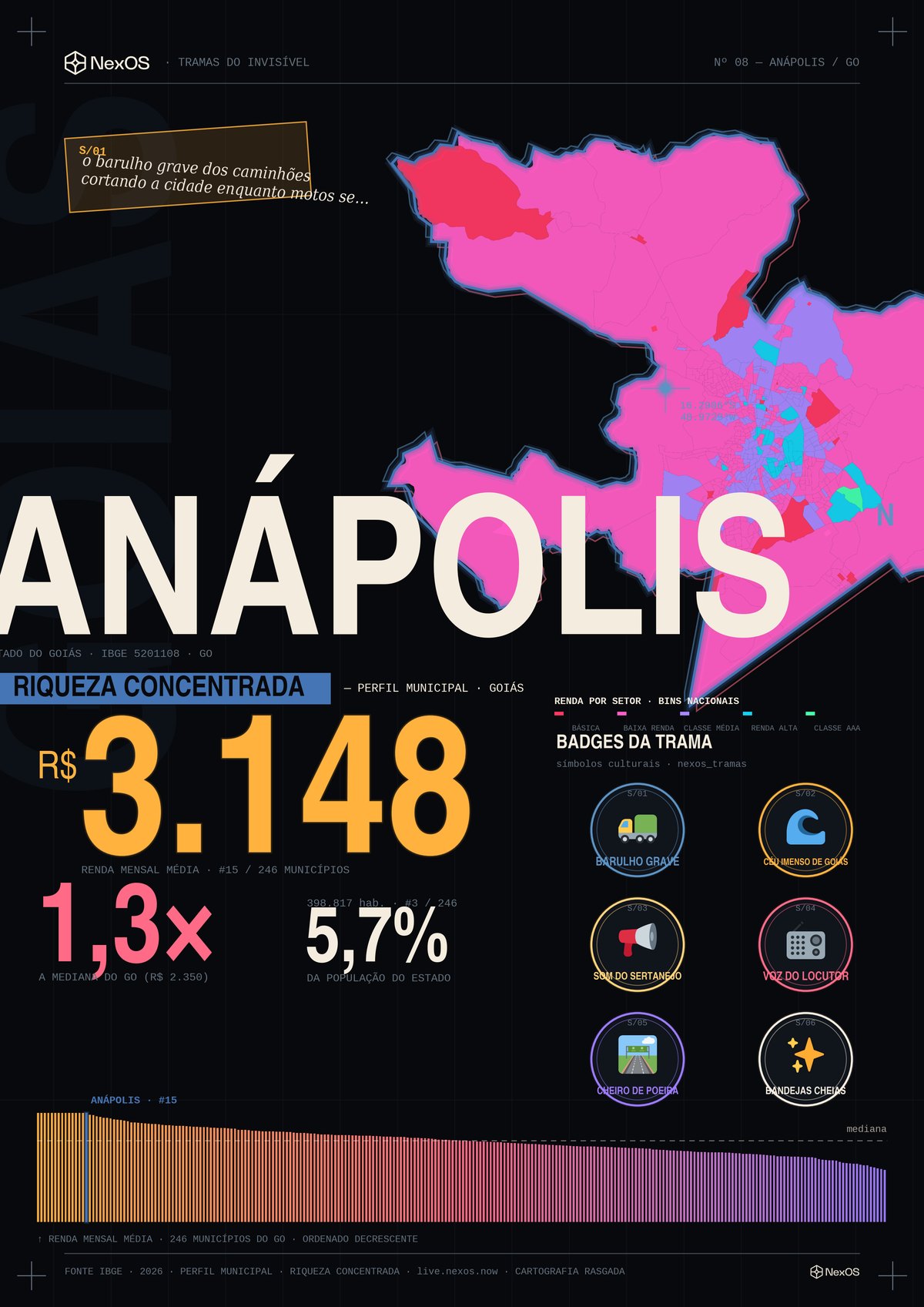
Create your city's poster, free, at live.nexos.now/poster.
Who comes to work, not to grow old
The family archetypes confirm what the “crossroads city” idea suggests: Anápolis takes in people of working, studying or treatment age, and it isn’t, proportionally, a city where those people grow old. Married elderly couples make up just 2.83% of households, 31% below the national average; elderly people living alone are 2.35%, 13% below average. Meanwhile, young adults aged 25-39 (7.82%) and single-parent households (7.19%) both sit above the national average: the profile of someone who recently arrived to fill a job, attend college or get medical treatment, not someone who was born, raised and grew old in the same neighborhood.
The profile NexOS assigns the city is Concentrated Wealth, with a wealth score that puts it among the richest 15% of Brazil, yet classified as a “State-level Oasis”: a hub that stands out within Goiás, not necessarily on the national ranking of major powerhouses. Social vulnerability is low for the series’ standards: 10,259 families receive Bolsa Família welfare, putting Anápolis among the 7% of Brazilian municipalities with the lowest reliance on the program, far from the level of Petrolina or Parauapebas.

The crossroads has friction
No crossroads is all smooth flow. Anápolis’s own Trama profile records the price of living at the junction: dangerous crossings and constant noise from trucks for those living near the main roads, and the living memory of highway accidents, roadside crosses that still mark the city. There’s also quiet verticalization around commercial corridors and shopping malls, pushing longtime downtown residents out, while new subdivisions grow faster than infrastructure at the city’s edges. And hospitals and colleges, the same engine that draws people in, also leave scars: whole families spend stretches accompanying a relative’s treatment, in boarding houses and studio rentals that exist only because of that flow.
It’s a tension the city feels but rarely names: the same movement that sustains its GDP (trucks, patients, students, all passing through) also wears down the streets, pushes up rent, and leaves a mark on whoever stays.
The radio that plays in every workshop
Anápolis is what NexOS classifies as a complete media hub: 13 radio stations based locally, 4 broadcast TVs and 10 local sites, a territory with no news desert. Who actually leads attention, measured by real listening rather than signal coverage, is Rádio São Francisco 97.7 FM, with 12,920 monthly listens and 100% population coverage, the voice its own Trama profile describes playing “in the background at auto shops, tire repair stalls and corner stores.”
Online, the clear leader is portal6.com.br, with 12.5 million monthly pageviews (a volume far out of step with the rest of the local inventory), already plugged into real-time programmatic buying. Behind it, hyperlocal sites like rotapolicialanapolis.com.br and portalcontexto.com are also plugged in; others, like dmanapolis.com.br and anapolisnoticias.com.br, remain unplugged, sold only through direct deals. The city logs 32.3 pageviews per resident per month, one of the highest per-capita digital readings in the series.

Connected, but still in short form
Anápolis is a 100% connected territory: 99.4% urban coverage and 84.1% rural, well above the series average. But creative capacity is still light: the ANATEL infrastructure score favors audio, text and images, not heavy video. It’s an addressable city, just still in short form.
What Anápolis consumes intensely reads like a busy population: Pinterest and Yahoo lead social and portals; classifieds (OLX) confirm a city of people who buy, sell and move house often, another mark of “passing through.” And there’s a data point that breaks the industrial-city stereotype: an offline Bible app ranks among the most intense, echoing what the Trama profile itself records about church livestreams watched at night and parish WhatsApp groups. Domain by domain, by access intensity per user:
How Anápolis wants to be spoken to
Whoever speaks to Anápolis speaks to someone balancing a factory or hospital shift with church at night and a weekend barbecue. It’s a city organized around work, faith and study: neighbors crossing paths early at the bus stop and at night at service, WhatsApp groups for the street and the church standing in for the town square, passing along job openings, charity raffles and campaigns for someone who’s sick. The tone that works here isn’t farming’s epic register nor drought’s tragic one: it’s the tone of someone always on the way to somewhere, to work, to treatment, to college, who values whoever understands that this city never stops passing people forward.
In the end, Anápolis proves data beats stereotype: in the middle of the state most associated with soybeans in Brazil, the city that turns over R$20.4 billion a year does it with the truck, the hospital, the factory and the church, not the tractor. It’s the Crossroads of Goiás doing exactly what a crossroads does: letting things pass through, and charging its toll for it.
Explore the X-ray of Anápolis on NexOS · City hall: anapolis.go.gov.br · IBGE profile: cidades.ibge.gov.br/brasil/go/anapolis. See also Parauapebas, Petrolina and the 4-layer method.
This piece is part of the Tramas series, territorial intelligence as method. Data cross-referenced by NexOS: IBGE (GDP, 2022 Census), BNDES (indirect operations by subsector), Central Bank (Pix, ESTBAN: credit and real-estate financing), CadÚnico/Bolsa Família, DETRAN (vehicle fleet), ANATEL and curated local media inventory. Symbolic profile, invisible networks and classification: Tramas do Invisível methodology.

Americana, Brazil: nostalgic for the old street, but with fewer multigenerational households than the national average
Americana's Trama profile talks about surnames that repeat across neighborhoods and neighbors who know each other by sight, but NexOS's family archetype data shows only 12.09% of households are multigenerational.

São Carlos, Brazil: behind the tech-hub label, industry pulls 46.7% of BNDES financing, well ahead of trade and services
R$273.7 million in BNDES financing (910 operations) makes industry, led by machinery, the biggest borrower of development credit in a city that sells itself as a university hub.