

Petrolina, Brazil: the 4th-richest city in Pernambuco is the country's top grape producer, deep in the backlands
In the São Francisco backlands, a city that became the country's biggest grape hub and one of its largest goat herds, exporting fruit to Europe. But the abundance holds a paradox: 40% of families still receive welfare, and one in five homes has no running water.


Say “sertão” — the Brazilian backlands — and the image that comes up is drought, exodus, cracked earth. Petrolina disproves every one of those words. On the banks of the São Francisco river, where the sun punishes and the wind kicks up red dust, the backlander tamed the water of the Velho Chico and made the scrubland grow grapes: rows upon rows of vines heavy with bunches, drip-irrigated in the middle of the semi-arid. And not just any grape — Petrolina is the largest grape producer in Brazil, alone responsible for R$3.66 billion of the fruit, shipped out at dawn in refrigerated trucks bound for Europe and the United States.
That’s why Petrolina is the 4th-richest city in Pernambuco — in the middle of the backlands. And it’s also why it holds one of Brazil’s most revealing paradoxes: an agricultural powerhouse that exports to the world while, at the same time, 40% of its families receive Bolsa Família welfare and one in five homes has no running water inside. The city that waters the fruit hasn’t yet watered its own tap.
Coronelism
The grape that beat the drought
Petrolina has 386,000 residents and a GDP of R$10.6 billion. The legend says it’s the fruit city — and this time, the legend has proof across the whole world. In the last measured harvest, Petrolina’s vineyards picked 610,000 tonnes of grapes, enough to put the city in first place in Brazil for that crop, ahead of any traditional region in the South or Southeast. Add mango (282,000 tonnes, 5th in the country), guava, banana and coconut: it’s nearly R$4 billion in fruit pulled from ground the map insists on painting as barren.
But there’s a second productive face the vineyard postcard hides, and it’s as backland as it gets: the goat. Petrolina has one of the largest goat herds in Brazil — 300,000 head, 5th-largest in the country — plus another 222,000 sheep. Modern irrigated fruit and the traditional semi-arid goat-raising coexist in the same municipality. It’s the signature of a backland that produces at two speeds: that of irrigation technology and that of age-old resilience.
There’s a detail that dismantles the stereotype at the root: in the measured economy, the fruit weighs less than its fame suggests — farming is 12% of GDP, against 50% for services. Not because the fruit is scarce, but because it has already transformed before being counted. Petrolina’s grape doesn’t stay a grape: it becomes a car dealership, an accounting office, a clinic, a college, a bank queue. The vineyard is the engine; commerce and services are where the money lands. When the harvest is good, it isn’t the field that swells — it’s the River Shopping mall that fills, the clinic that packs out. That block-by-block economic mosaic is what we open up in Petrolina’s territorial X-ray.
The city that rides a motorcycle
If Caxias do Sul hides its wealth in a used hatchback and the farm economy of Sinop parades in a pickup, Petrolina has another signature on wheels — and it’s pure Northeast. Here, the vehicle in charge isn’t the car: it’s the motorcycle. The city has 89,628 motorcycles against 79,355 cars. The motorbike is the workhorse of the urban backlands: the moto-taxi threading through the neighborhoods, the market vendor hauling the crate, the worker heading out at dawn to the irrigated field. Where public transit is thin and distances are long, two wheels solve the day.
And there’s the other vehicle, the one that carries the wealth out: the 4,191 trucks, many refrigerated, which the municipality’s own Trama profile describes leaving “at dawn” loaded with grapes and mangoes. It’s the summary image of Petrolina in motion — the worker’s motorbike crossing the hot city while the fruit truck rolls down the highway toward the port and the airport. Two wheels to live, eighteen to export.

The Pix that exploded
If fruit is the engine, the money it moves runs faster and faster — and in real time. Pix payments received in Petrolina surged: from around R$2.1 billion a month in early 2024 to R$3.6 billion by mid-2026 — up 72% in two and a half years. The average resident transacts R$5,500 per person a month, double that of any other municipality in the Pernambuco backlands.
And credit shows where that wealth settles: of the city’s R$4.2 billion in credit operations, R$2.4 billion — nearly 57% — is real-estate financing. It’s an extremely high share: almost half of all the city’s credit is planted in bricks. The grape money becomes an apartment: the Petrolina growing vertically around the River Shopping is the same one financing itself upward, while the city’s outskirts still wait for the water to arrive.
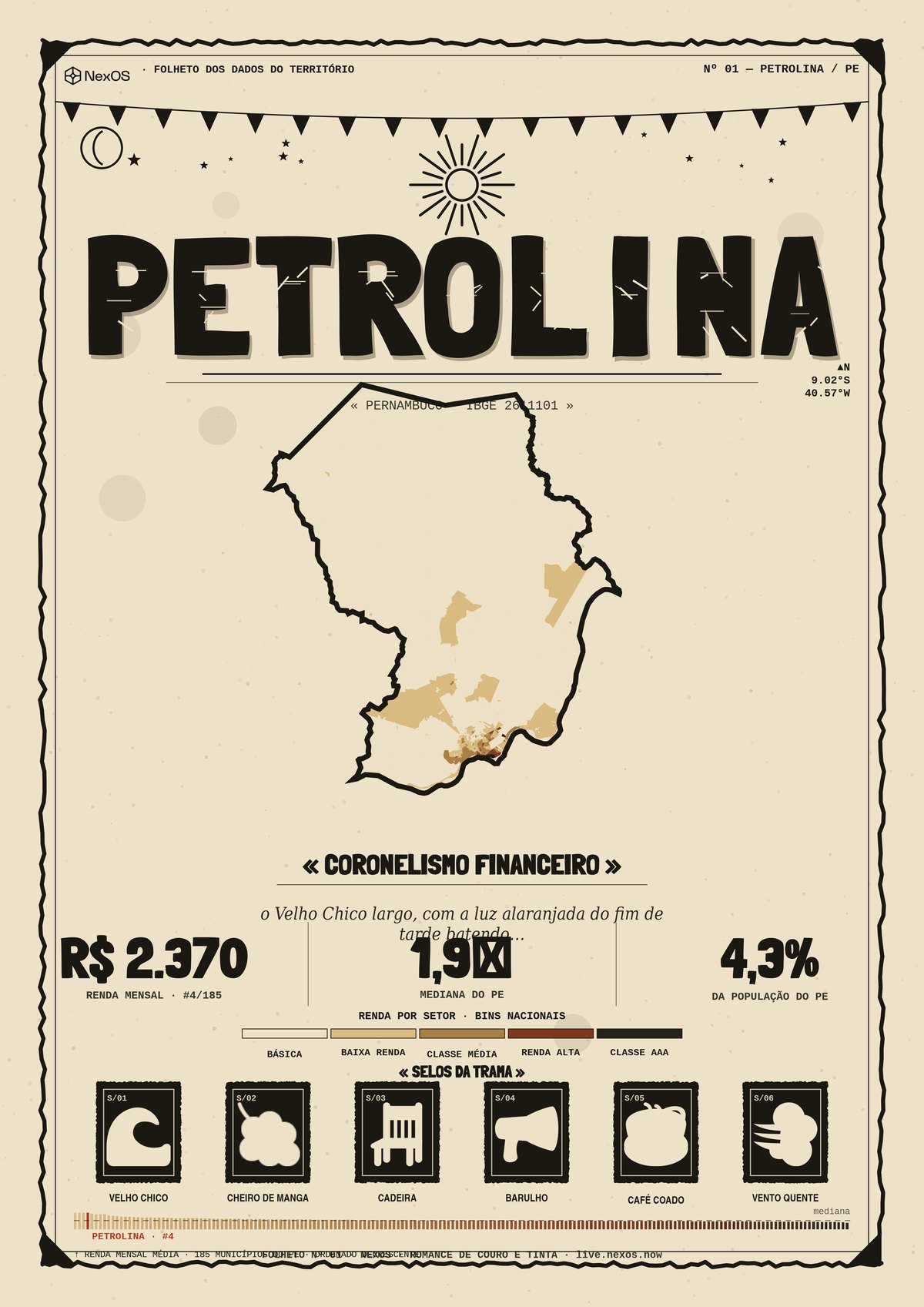
Create your city's poster, free, at live.nexos.now/poster.
The paradox of Financial Coronelism
Here’s the reading only territorial intelligence catches. With all that money circulating, Petrolina is not a rich city in the distributed sense of the word. The profile NexOS assigns it is Financial Coronelism: high purchasing power concentrated at the top, coexisting with structural inequality. The numbers prove it: average income is R$2,369 — modest for a city that generates R$4 billion in fruit — 40.5% of families receive Bolsa Família and only 10.8% file income tax.
And the harshest portrait is the one about water. In a city set on the banks of the Northeast’s largest river, only 78% of homes have running water inside. One in five houses in Petrolina still depends on a bucket, a well or a water truck — in the Brazilian capital of irrigated grapes. It’s the summary of the paradox: the technology that makes the desert yield export fruit hasn’t yet reached the kitchen tap of much of the population. The abundance exists; the distribution doesn’t.
It’s not a city that needs to be “discovered” — it’s a city that needs to be read in full. Whoever sees only the prosperous vineyard misses the outskirts hauling buckets; whoever sees only the poverty misses the export powerhouse. Petrolina is both at once, and it’s in that contrast that the agenda for the next ten years lives.

Radio rules, and Grande Rio is the hub
To speak to Petrolina, forget the capital-city manual. The medium that dominates the backlands’ attention is radio — and the metric that matters isn’t signal coverage, it’s listening. Rádio Grande Rio is the absolute hub: the 680 AM station alone pulls 37,000 monthly streaming listens (AM, which the rest of the country wrote off, reigns here), and its 100.7 FM sibling another 25,000. It’s the same voice the municipality’s Trama profile describes “echoing through market stalls and workshops as a constant soundtrack.”
Petrolina’s digital scene is mobile-only and made of columnists. WhatsApp on nearly every phone, and the local press that circulates isn’t the institutional portal — it’s the personal-name blogs, a cultural mark of interior-Northeast journalism. In NexOS’s curated inventory, the leader is carlosbritto.com (370,000 monthly pageviews), followed by edenevaldoalves.com.br and divulgapetrolina.com, which already plugs into programmatic buying. All of it local, measured and buyable in one shot through the Alright Network, NexOS’s curation of the largest local media inventory in Brazil:

There’s one more clue only locals catch: Petrolina has no cinema. Whoever wants to watch a film crosses the bridge over the São Francisco to the Cinemark at Juá Garden, in Juazeiro, Bahia — the twin city right across the river. That’s the Bridge-City logic: Petrolina and Juazeiro work as one, two states and a single urban life. Whoever plans media for one has to understand the other.
The programmatic city the backlands hide
And there’s the layer the backland stereotype denies entirely: Petrolina is a genuine market for addressable digital media — 116 healthy domains in NexOS’s curated inventory. Read by intensity (how much each user accesses, not raw volume), the city looks young, working-class and on its phone.
What Petrolina consumes intensely tells the city. Free TV over the internet (coolita) leads; right behind comes music — and not just any, it’s the CifraClub of those learning the forró and piseiro that play on Grande Rio. Then games (Poki), and the most revealing data point: TodaMatéria among the most intense — the student cramming for an exam, dreaming of the civil-service job and college. The picture closes with classifieds (OLX), the image network (Pinterest) and football (Sofascore). Domain by domain, by access intensity per user:
And there’s the same backland technical catch: Petrolina has no fiber backhaul, and connectivity is “mixed, expanding” — favoring light formats (audio, text, image) over heavy video. Add the split between “plugged” sites (biddable in real time, like divulgapetrolina.com) and “unplugged” ones (direct buy only, like carlosbritto.com), and the lesson is the same as every city in the series: buying Petrolina on a global platform’s autopilot means leaving the city out.
How Petrolina wants to be spoken to
Whoever speaks to Petrolina speaks like someone sitting in the plastic chair pulled onto the sidewalk at dusk, waiting for the street to cool: with human warmth, directness, no pomp. The backlander values affection and distrusts anything that sounds distant — the “premium” tone of a capital doesn’t stick here. What works is the strong drip coffee early on, the cornmeal couscous with egg before the sun, the forró and piseiro blasting from a car on Friday, the June-festival bunting cutting across the street. And what works, above all, is recognition: this is a city that did the impossible — it planted grapes in the backlands and became the country’s biggest — and still waits for that same ingenuity to reach everyone’s tap.
In the end, the river-city of the Velho Chico is that paradox at a simmer: a powerhouse that exports fruit to the world and hauls buckets on its outskirts, wealth running in Pix and inequality that persists, a sun that punishes and water that saves. Whoever wants to speak to Petrolina first needs to understand that it already tamed the desert once. It’s just waiting for someone to look beyond the vineyard.
Explore the X-ray of Petrolina on NexOS · City hall: petrolina.pe.gov.br · IBGE profile: cidades.ibge.gov.br/brasil/pe/petrolina. See also the Feira de Santana case and the 4-layer method.
This piece is part of the Tramas series — territorial intelligence as method. Data cross-referenced by NexOS: IBGE (GDP, PAM/PPM farm and livestock output, 2022 Census), Central Bank (Pix, ESTBAN — credit and real-estate financing), Federal Revenue (income tax), CadÚnico/Bolsa Família, DETRAN (vehicle fleet), ANATEL and curated local media inventory, IPS Brasil. Symbolic profile, invisible networks and classification: Tramas do Invisível methodology.

Americana, Brazil: nostalgic for the old street, but with fewer multigenerational households than the national average
Americana's Trama profile talks about surnames that repeat across neighborhoods and neighbors who know each other by sight, but NexOS's family archetype data shows only 12.09% of households are multigenerational.

São Carlos, Brazil: behind the tech-hub label, industry pulls 46.7% of BNDES financing, well ahead of trade and services
R$273.7 million in BNDES financing (910 operations) makes industry, led by machinery, the biggest borrower of development credit in a city that sells itself as a university hub.