

Caxias do Sul, Brazil: the city that builds the country's trucks and drives around in a beat-up Gol
Rio Grande do Sul's second-largest economy is a R$37.9 billion metal powerhouse — where farming is 1% of output and nearly half of all credit is real estate. But the iron city doesn't show off: its factory workers drive used hatchbacks, and thousands of decades-old Chevettes and Beetles still cross the highlands.


Ask anyone what the Serra Gaúcha is and they’ll say: wine, cold weather, Italian immigration, a weekend in Gramado. That’s the postcard answer — and it leaves out who actually pays the bill. Because the largest city in that highland region doesn’t live off grapes. Caxias do Sul is a R$37.9 billion industrial machine, the second-largest economy in Rio Grande do Sul, and farming — the “wine” part of the legend — accounts for just 1% of the value it generates. What drives Caxias is metal: welding, sheet steel, engines, vehicle bodies.
And here is the paradox that makes it a case study in territorial intelligence: Caxias builds the buses and trucks that run across all of Brazil — yet the average resident drives a used Gol, a Corsa, and thousands of Chevettes and Beetles that simply refuse to die. The city that builds vehicles for the country doesn’t parade them on its own streets. The wealth is concentrated where it doesn’t show off.
Wealth
The iron that became services
Caxias has 463,000 residents — the second most populous city in the state, behind only Porto Alegre — and a GDP of R$37.9 billion. But the picture of what this economy produces dismantles both stereotypes at once: it’s neither the highland wine nor the lone factory. It is, above all, services underpinned by heavy industry:
Caxias’s industry is one of the largest industrial shares among big Brazilian cities: more than a third of everything the city produces. It’s the metalworking axis — the same one the municipality’s Trama profile describes as “the smell of cut metal, welding and machine oil coming from the sheds.” Caxias assembles bus bodies — Marcopolo was born here — and road implements, led by the Randon group, that leave on car-carriers for the rest of Brazil and for export. It’s the city that, being so industrial, manufactures the very means of transport for the rest of the country.
But that strength carries a scar, and that too is data. The city’s collective memory holds the metalworking crises — cycles of contraction that turned into unemployment and fresh starts, especially among older workers. It’s an economy that knows how to rise and how to fall, and that developed a trait of caution because of it: here you don’t flaunt, you save. The average household-head income is R$3,787 — 1.4 times the state median — a skilled working-class income, not an elite one. And only 8% of families receive Bolsa Família welfare, against a quarter of the population that files income tax. It’s the signature of a profile NexOS classifies as Concentrated Wealth: a lot of money circulating, unevenly distributed, held with discretion.
The city that builds trucks and drives a Gol
If the wealth of a farm town like Sinop parades in a pickup, the wealth of Caxias does the opposite: it hides in a used hatchback. The city’s fleet is perhaps the most honest portrait of its working-class soul — and the contrast with what it produces is almost ironic.
Caxias has 250,000 cars, and the list of the most common ones has nothing of the showroom about it. The Volkswagen Gol leads (15,500), followed by the Palio (10,200), Corsa (10,200) and Uno (9,000) — the pantheon of Brazil’s economy car over the last three decades. And right behind them, the number that says it all: 6,574 Chevettes, 6,291 Celtas and 5,285 Beetles still registered and driving through the highlands. Cars discontinued 10, 20, even 40 years ago, kept alive in a city with a repair shop on every corner and a culture of fixing rather than replacing.
Now flip the switch and look at what Caxias produces, not what it drives. In the heavy-vehicle fleet the other Caxias appears: 7,819 trucks and a heavyweight presence of Marcopolo — the bus-body maker born in the city — among the brands running locally, alongside Mercedes-Benz, Scania and Volvo. It’s the signature of a hub that breathes logistics and heavy industry: the truck that pulls in and out of the shed all day long, carrying what the city made to the rest of the country.
The contrast is the social code of Caxias in two fleets. On one side, the heavy vehicles — the production machine, industrial pride on wheels. On the other, the light ones — the Gol and the Chevette of the worker who built that industry and never felt the need to trade the car for status. And there’s a third, new chapter: even cautious, Caxias is already a strong electric-car market, with nearly 1,400 plug-in electrified vehicles in its fleet, led by the BYD Dolphin (655) and the Haval H6 SUV (358), as told in the BR on Wheels series. The metalworker is starting to swap the combustion engine for the plug — his own way, without fanfare.

The financial pulse: where iron money turns into bricks
If the fleet shows how Caxias spends with discretion, the financial system shows where it saves — and the answer is surprising. Not in the garage: in bricks.
Start with the flow — and the flow of Caxias has a name: Pix. People here transact like a big-city population, and the curve keeps climbing. The value received via Pix jumped from around R$5 billion a month in early 2024 to R$6.4 billion by mid-2026 — up nearly 30% in two and a half years — with the number of individual payers rising from 293,000 to 341,000. Every year-end the line spikes with the 13th-month bonus (the R$7.9 billion peak in December 2025) and eases back in January, but the underlying trend is one direction only: up.
It’s an entire economy migrating to real time, month after month.
But the number that defines Caxias is in credit. The city carries R$10 billion in credit operations — and nearly half of it has a single destination:
That’s R$4.75 billion in real-estate financing — nearly half of all the city’s credit, and a balance that grew without pause, quarter after quarter, since 2024. It makes Caxias the second-largest real-estate credit market in Rio Grande do Sul, behind only Porto Alegre, which is seven times bigger. In plain terms: the metal money doesn’t stay in metal. It becomes apartments. The city the Trama describes as territory of “vertical growth advancing along well-served corridors, pushing lower-income families to the edge” has that process etched into its banking data. Caxias is, literally, financing itself upward — and the discretion of the garage coexists with a silent race for the square meter.
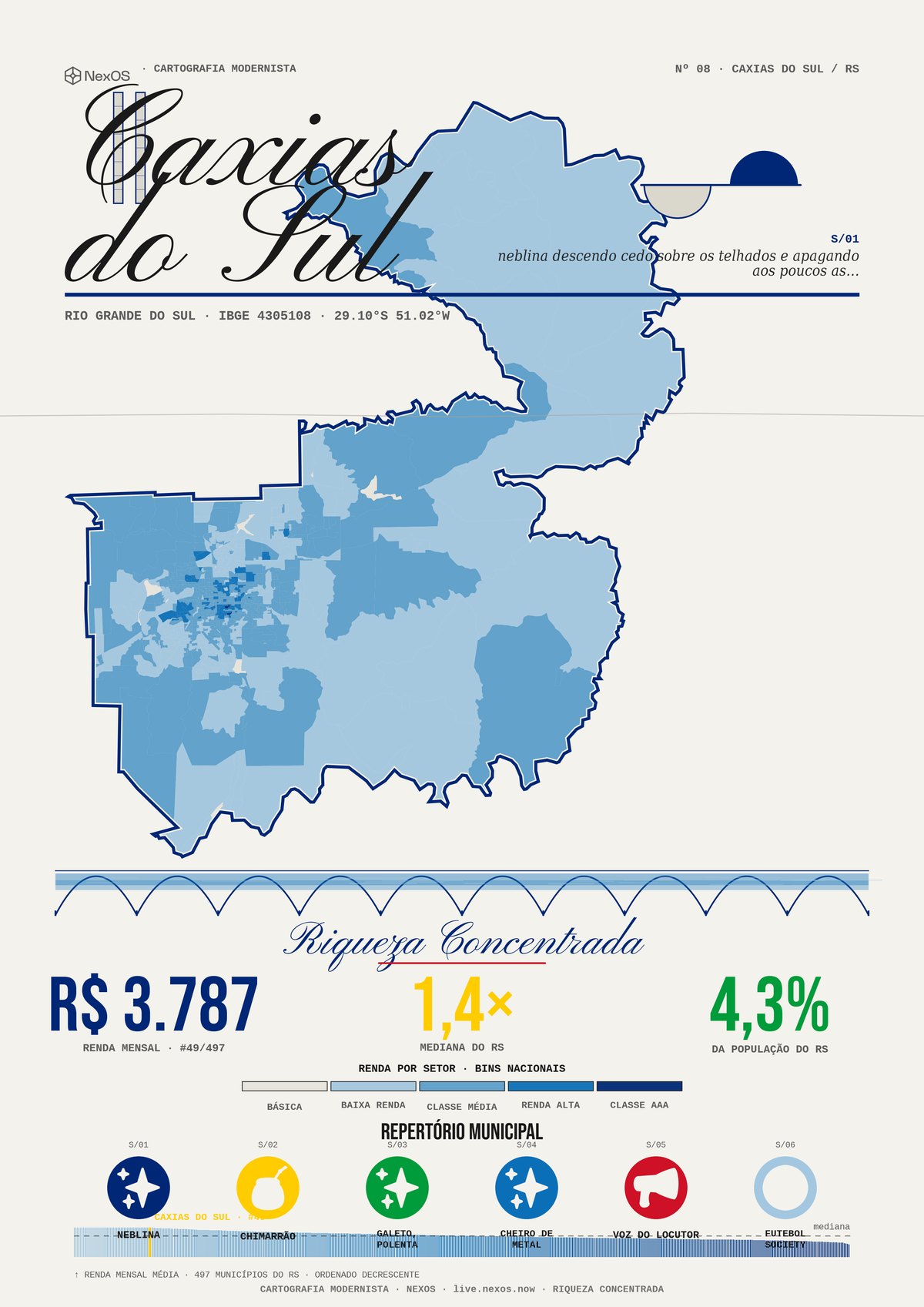
Create your city's poster, free, at live.nexos.now/poster.
The city of shifts
Caxias is organized in shifts, and anyone who wants to speak to it needs to know that. There are those who clock in early at the factory, those who start the day in the downtown offices, those who only reach the university at night after work. The city takes pride in being a “city of work” — but that pride carries tiredness with it: many people split their time between the formal job, the side gig and caring for the home. Sociability is reserved on the street and warm indoors, at the CTG hall or the condo party room — because in the highland cold, life withdraws inward.
It’s a city of migrant origin that has never stopped receiving people. The old neighborhoods have settled communities where everyone knows one another by name; the new subdivisions mix people from the interior of RS and other states, forming networks that lean on church, WhatsApp groups and coworkers. And there’s fresh tension in that machinery: the same vertical growth that shows up in real-estate credit pushes lower incomes to more distant hillsides where infrastructure arrives slowly; the trucks that sustain the economy compete for the roads with pedestrians; and the floodlit five-a-side football pitches bother the neighbor who wakes up for the morning shift. It’s the price of a city that grew fast and is still negotiating with itself how to coexist.

The media map no one buys from outside
Here’s what no global platform shows: Caxias is a complete media hub — and the infrastructure is local, measured and buyable. There are 14 local radio stations, 4 broadcast TV stations and 8 local news sites, with no news desert anywhere. And at the top of that pyramid, a medium the rest of the country has written off but that reigns supreme in the highlands: radio.
Caxias’s culture has radio at its center. The municipality’s own Trama profile records “the voice of the Rádio Caxias announcer echoing in workshops, taxis and store counters as a permanent background sound.” It’s not nostalgia: it’s real, measurable audience.
| Layer | Who commands Caxias’s attention |
|---|---|
| Radio | Rádio Caxias 93.5 FM leads the city’s stations — 33,600 streaming listeners and 99.8% coverage — followed by Gaúcha Serra 102.7 (27,000) and Maisnova 98.5 (13,500) |
| TV | 4 local broadcasters, signal reaching 100% of the territory |
| Local digital | radiocaxias.com.br leads local digital media with 160,000 monthly pageviews, ahead of tuaradio.com.br (124,000) and maisnova.com.br (52,000) |
Radio reach in the highlands isn’t measured in towns — it’s measured in people. Each station’s protected field, measured by ANATEL in people reached, blankets the whole highland region from the Caxias–Farroupilha conurbation. And the biggest audience isn’t even from Caxias: it’s Rádio Viva 94.5 FM, from neighboring Farroupilha, which alone reaches 980,000 people — more than Rádio Caxias itself (643,000). Together, the highland stations form a signal quilt with almost no gaps.
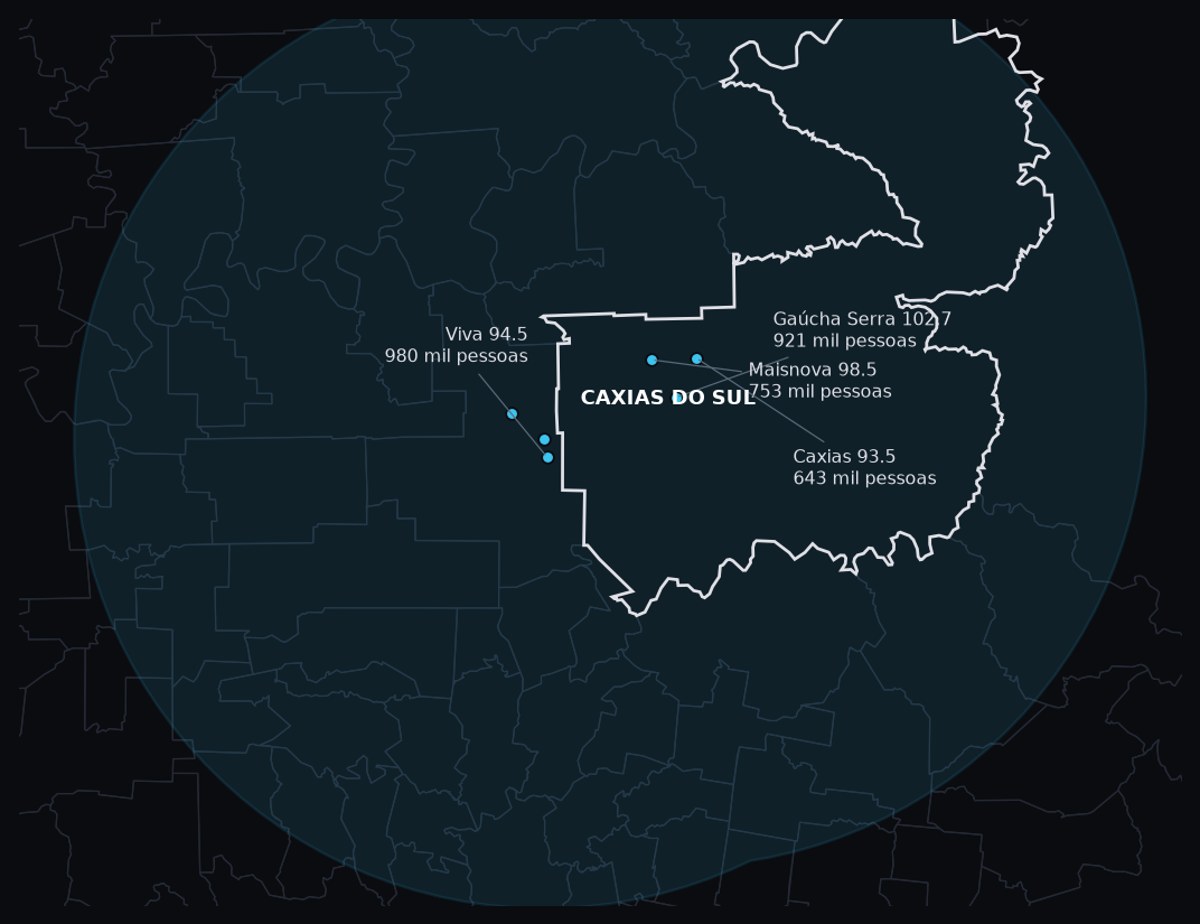
All of it local, measured and buyable in one shot through the Alright Network, NexOS’s curation of the largest local and regional media inventory in Brazil:

The programmatic city the highlands hide
And there’s the layer the interior stereotype denies: Caxias is a market for addressable digital media in its own right. In NexOS’s curated inventory, the city has 246 healthy domains — and the signature of what it consumes, read by intensity (how much each user accesses, not raw volume), dismantles any notion of a “disconnected interior.”
What Caxias consumes intensely looks like a house shut against the cold: free connected TV and streaming dominate by far. coolita.com and TCL Channel — television running over the internet — lead intensity comfortably above everything else. It’s the city that, when the fog rolls in and life withdraws indoors, turns on the smart TV. Behind them come online radio (the highlands that always listened to radio, now streaming), music (CifraClub), soap operas and games. Domain by domain, by access intensity per user:
There is, however, a technical catch every advertiser needs to understand before planning the city — one only visible to those who look at the territory up close. Caxias still has no fiber backhaul, and its connectivity is classified as “mixed, expanding.” In practice, that means low capacity for heavy creative formats: long video and heavy assets stutter; audio, text and light images work. That’s why radio didn’t die here — and why the most valuable local inventory isn’t 4K video, but digital audio and light display. Add to that the split between “plugged” sites (biddable in real time, like radiocaxias.com.br and maisnova.com.br) and “unplugged” ones (direct buy only, like tuaradio.com.br), and it’s clear: buying Caxias on a global platform’s autopilot means leaving half the city out.
How Caxias wants to be spoken to
Whoever speaks to Caxias speaks like someone chatting at the workshop counter: direct, dry, no detours. The highland accent — a blend of Italian and Gaúcho — is fast and practical, and the city demands, without saying so, respect for work: humor about the cold and the grind lands, as long as it doesn’t become mockery of those who toil hard. The “we” that sticks here is the “we” of shared effort — half the city arrived recently, the other half already feels of the land, and the two meet over Sunday grilled chicken, chimarrão in the warm kitchen and the five-a-side game after the shift.
In the end, the city of cold and iron is exactly that paradox: a place that builds the country’s vehicles and drives a used Gol, that generates R$37.9 billion and keeps it all in bricks and discretion, that transacts in real time but never abandoned the morning radio. Where money doesn’t parade, it works — and work, in Caxias, is far too serious to become a façade. Whoever wants to speak to this city first needs to understand that it already knows exactly what it’s worth. It just sees no reason to show it.
Explore the X-ray of Caxias do Sul on NexOS · City hall: caxias.rs.gov.br · IBGE profile: cidades.ibge.gov.br/brasil/rs/caxias-do-sul. See also the BR on Wheels series.
This piece is part of the Tramas series — territorial intelligence as method. Data cross-referenced by NexOS: IBGE (GDP, 2022 Census), Central Bank (Pix, ESTBAN — credit and real-estate financing), Federal Revenue (income tax), CadÚnico/Bolsa Família, DETRAN (vehicle fleet), ANATEL and curated local media inventory. Symbolic profile, invisible networks and classification: Tramas do Invisível methodology.

Americana, Brazil: nostalgic for the old street, but with fewer multigenerational households than the national average
Americana's Trama profile talks about surnames that repeat across neighborhoods and neighbors who know each other by sight, but NexOS's family archetype data shows only 12.09% of households are multigenerational.

São Carlos, Brazil: behind the tech-hub label, industry pulls 46.7% of BNDES financing, well ahead of trade and services
R$273.7 million in BNDES financing (910 operations) makes industry, led by machinery, the biggest borrower of development credit in a city that sells itself as a university hub.