

Araguaína, Brazil: nearly 90% of the economy is services and government, only 2% is agriculture
Surrounded by farmland in northern Tocantins, Araguaína looks like just another agricultural frontier town. The data says otherwise: services and public administration already add up to 86% of the city's economy, against just 2.49% for agriculture, and the biggest BNDES loans don't go to the farm: they go to the road that brings people from across the region looking for a hospital, a college, or a wholesaler.


Say “Araguaína” to someone who’s never been there, and what comes to mind is an agricultural frontier town: pasture, cattle, a truck kicking up dust on a dirt road. The data dismantles that image by a margin that stands out even within this series: agriculture accounts for just 2.49% of the city’s value added. What sustains the economy are services (56.3%) and public administration (29.7%), together 86% of everything Araguaína produces. The municipality’s own Trama profile already records why: a hospital with a line out the door since early morning, a college full of students with backpacks, a wholesaler receiving trucks at dawn, a hub that serves not just its 171,000 residents, but dozens of towns across northern Tocantins.
It’s this regional-hub vocation, not the cattle the landscape suggests, that explains a R$7.36 billion GDP driven by the doctor’s office, the classroom and the wholesale shelf.
Where the economy actually breathes
The GDP breakdown makes the vocation obvious: services pull 56.3%, public administration adds 29.7%, industry sits at 11.5%, and agriculture doesn’t pass 2.49%. Cattle ranching is even growing in absolute terms (302,345 head of cattle in 2024, up from 274,967 in 2022), but it stays marginal in the accounts: the city’s real engine isn’t the corral, it’s the counter and the teller’s window.
Whoever finances growth here also points away from the farm gate. BNDES loans in the city name road transport as the top destination, R$345.3 million, 75% more than the runner-up, commerce and services (R$197.2 million), and more than 13 times what went to agriculture (R$26.2 million). Development lending bets on the highway, not the harvest.
The engine runs on two wheels
In the vehicle fleet, Araguaína has 76,227 motorcycles against 46,463 cars, 1.64 motorcycles for every car. The single leading model isn’t a car or a pickup: it’s the Honda Biz, with 22,785 units, nearly four times the most common car, the Volkswagen Gol (5,733). Pickup trucks like the Fiat Strada, Toyota Hilux and Ford Ranger add up to 20,104 units, and heavy trucks like the Ford Cargo and Volvo FH add up to 4,027, a cargo fleet sized for a city that exists to move goods across the region.
Longer-term credit is growing at a similar pace on both ends. Total bank credit went from R$3.51 billion to R$4.91 billion in two years, up 40%, while real-estate financing went from R$637.5 million to R$876.1 million, up 37%. The key difference: real estate is still only 18% of all credit in the city, far from what’s seen in cities where long-term credit has become mostly brick and mortar. Pix received per month, meanwhile, climbed from R$1.35 billion to R$2.45 billion, up 82% over two and a half years.
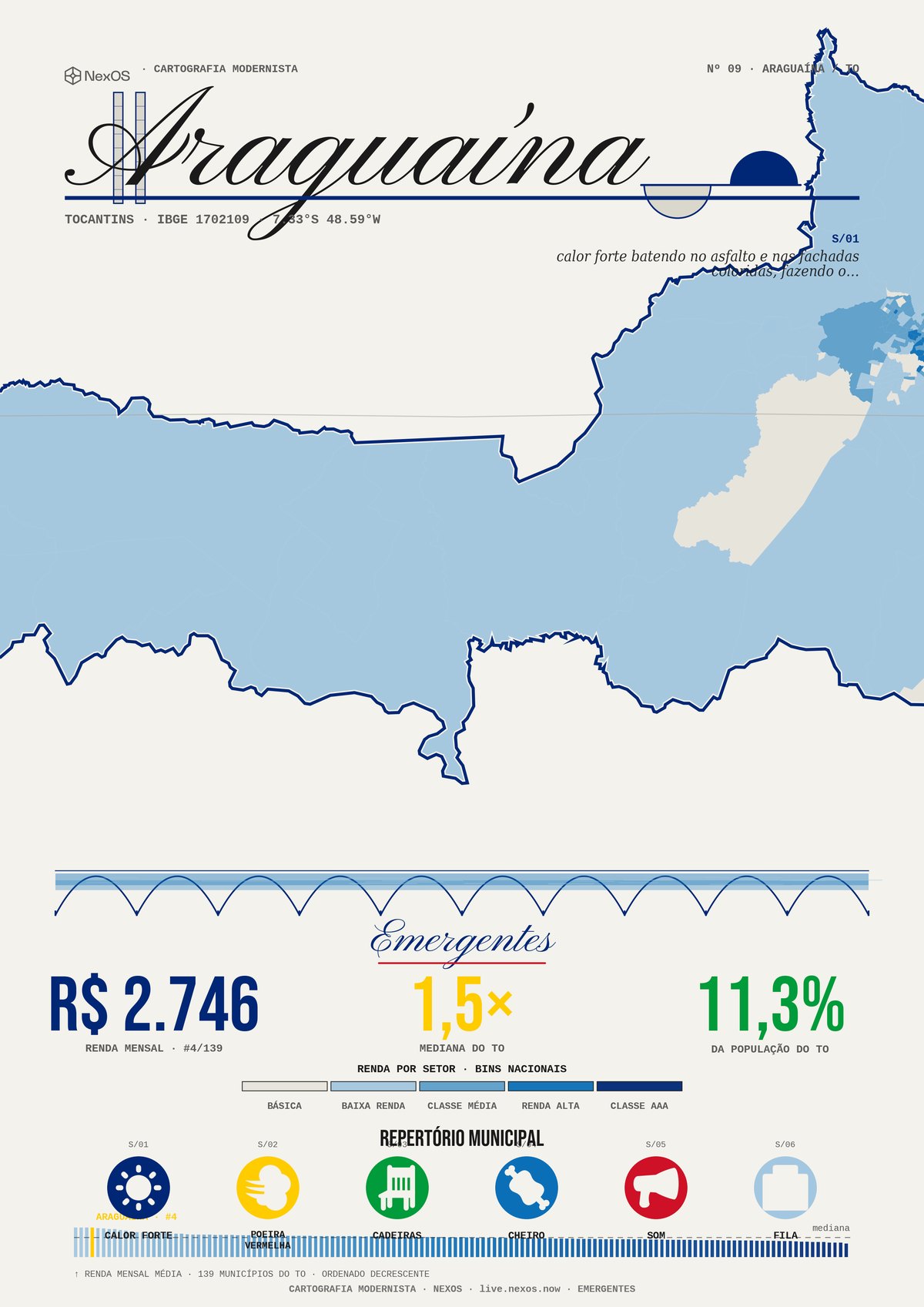
Create your city's poster, free, at live.nexos.now/poster.

Who arrives, who stays
The family archetypes confirm the regional-hub vocation. Married couples with young children are 21.96% of households, 11% above the national average; single-parent households are 8.24%, 22% above average; multigenerational families add up to 17.75%, 18% above the national average. On the other side, elderly couples and elderly people living alone combined are just 3.47% of households, less than half the national average of 6.82%. It’s the demographic signature of a city that takes in people from elsewhere looking for work, medical treatment and a college spot, not people choosing to retire there.
That matches what the municipality’s own Trama profile records about daily life: families arriving from smaller towns to get medical treatment, enroll a child in college, or try their luck in commerce, often sharing a couch or a room with a relative while they get established.
The profile NexOS assigns the city is Emerging, with average household-head income of R$2,746 (the 4th highest among Tocantins’s 139 municipalities) and 20.5% of families receiving Bolsa Família welfare. It’s wealth in flow, people passing through, buying, seeking care, not wealth piled up in stock.
Where the friction lives
Araguaína’s growth presses neighborhood by neighborhood. The Trama profile records small farms and country lots turning into subdivisions without full infrastructure, rent rising near the hospital and college, and small street commerce losing ground to malls and big chains. At night, bars, car-stereo walls and event venues compete for the same late hours as people who need to wake up early to work in hospitals, schools and shops, almost always without any area set aside for nightlife.

The radio that plays across the whole city
Araguaína is a complete media hub (TV, radio and digital). The clear leader, by real listening, is Rádio Tocantins 97.7 FM, with 16,152 monthly listens, ahead of Rádio Araguaia 99.7 FM (8,659) and Rádio Terra 96.5 FM (7,746).
Digital tells a different story. The leading site, afnoticias.com.br, has 586.6k monthly pageviews and already operates plugged into programmatic buying, more than four times the runner-up, portalonorte.com.br (118.9k). Of the 10 local sites mapped, only these two are plugged into programmatic buying; the other 8, including araguainanoticias.com.br (108.8k pageviews, nearly as big as the runner-up), sell only through direct deals.

Connected, but still in light form
Infrastructure is still mixed: urban coverage of 96.7%, but rural coverage of just 14.3%, with no dedicated fiber backhaul. ANATEL classifies the city as “mixed connectivity, expanding,” with creative capacity still limited to short video, images and social, not heavy video.
Pinterest dominates the apps-and-utilities block, closely followed by Coolita (free TV) and an offline Bible app, echoing the same nighttime worship the Trama profile itself records affecting neighborhood peace. Afnoticias.com.br itself, the clear leader in pageviews, ranks only after these in intensity per cookie: where radio shouts, the local portal whispers. Domain by domain, by access intensity per user:
How Araguaína wants to be spoken to
Whoever speaks to Araguaína speaks to someone who organizes life around the hospital, the college and the shop floor: an early line with an exam folder tucked under an arm, a student with a backpack crossing a hot neighborhood, a vendor calling out deals at the door of a wholesaler. It’s the city the whole region crosses to get things done, even without ever showing up on the map as a “capital” of anything.
In the end, Araguaína proves that heat isn’t only about climate: it’s a hospital with a line out the door, a packed college and cargo trucks rolling in and out all day, while the cattle that gave the landscape its name barely shows up in the accounts. The cauldron of northern Tocantins keeps boiling with people arriving to stay a while, not cattle grazing.
Explore the X-ray of Araguaína on NexOS · City hall: araguaina.to.gov.br · IBGE profile: cidades.ibge.gov.br/brasil/to/araguaina. See also Governador Valadares and the 4-layer method.
This piece is part of the Tramas series, territorial intelligence as method. Data cross-referenced by NexOS: IBGE (GDP, 2022 Census), BNDES (indirect operations by subsector), Central Bank (Pix, ESTBAN: credit and real-estate financing), CadÚnico/Bolsa Família, DETRAN (vehicle fleet), ANATEL and curated local media inventory. Symbolic profile, invisible networks and classification: Tramas do Invisível methodology.

Americana, Brazil: nostalgic for the old street, but with fewer multigenerational households than the national average
Americana's Trama profile talks about surnames that repeat across neighborhoods and neighbors who know each other by sight, but NexOS's family archetype data shows only 12.09% of households are multigenerational.

São Carlos, Brazil: behind the tech-hub label, industry pulls 46.7% of BNDES financing, well ahead of trade and services
R$273.7 million in BNDES financing (910 operations) makes industry, led by machinery, the biggest borrower of development credit in a city that sells itself as a university hub.