

Campina Grande, Brazil: 64% of all the city's credit is now real estate financing
Known for hosting the world's biggest São João festival, Campina Grande is also one of Paraíba's highest-income cities, trailing only the state capital. But the strongest data point is in long-term credit: 64% of everything the city borrows has already become real estate financing, a sign of wealth piling up in brick.


In Campina Grande, 64% of all the city’s bank credit is now real estate financing — the largest brick-and-mortar share recorded anywhere in this series so far. It’s the strongest data point from a city the rest of the country knows for another reason: the world’s biggest São João festival, accordion music and bonfires taking over every neighborhood corner in June. The festival lasts two weeks. Long-term credit tells the story of the whole year, and it points somewhere else: apartment, building, thirty-year financing.
With 419,379 residents, Paraíba’s second-largest city is also one of the state’s highest-income cities, trailing only the capital, João Pessoa. NexOS’s own Trama calls Campina Grande the “Borborema Gear”: people, goods and news converging on downtown, arriving from across Paraíba’s Agreste region, spinning between commerce, university and festival, up on the highlands where the cool wind gives this noisy urban machine its own particular flavor.
The credit that became brick
Brazil’s Central Bank tracks this month by month through ESTBAN: the outstanding balance of real estate financing in the city went from R$2.90 billion in January 2024 to R$3.79 billion in December 2025, up 31% in two years. That share is also growing faster than the city’s total credit: real estate’s slice of the local loan portfolio rose from 59.9% to 63.9% over the same period, the 64% in the headline.
Pix follows the same pattern of money coming in and turning into wealth: from R$2.94 billion received per month in January 2024 to R$4.49 billion in June 2026, up 53%. Long-term credit grows right alongside the volume moving day to day, a sign of wealth that doesn’t sit still: it piles up in real estate.
Behind the bonfire, an industry that carries weight
GDP composition (R$12.91 billion in 2023) shows another side of the city: services account for 53.9% of value added, public administration for 23.5%, industry for 22.1%, and agriculture for just 0.4%. That industrial share is nearly 1.5x the average for the state of Paraíba as a whole (14.9%), and it also edges out, by a narrower margin, the average for the entire Northeast region (20.9%).
BNDES loans follow a similar pattern: commerce and services lead, with R$195.0 million disbursed, ahead of road transport (R$150.8 million), other activities (R$92.1 million), machinery (R$27.3 million) and pulp and paper (R$16.8 million).
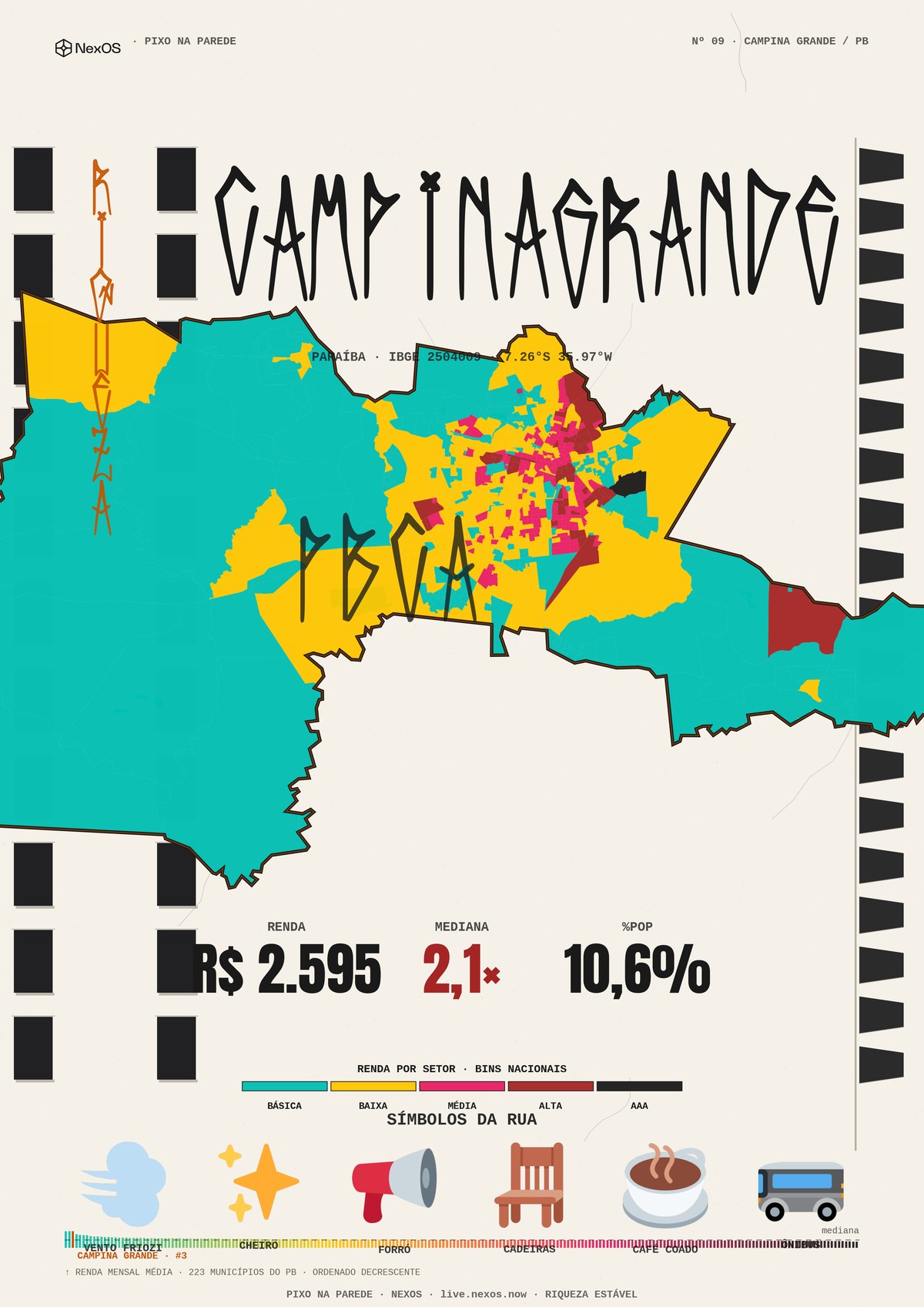
Create your city's poster, for free, at live.nexos.now/poster.

Almost Paraíba's highest income
By income tax filings, Campina Grande ranks 4th among Paraíba’s 222 municipalities in average income per filer (R$78,627 a year). Ahead of it are only the capital, João Pessoa, and two municipalities with very few filers (13,731 and 2,176), too small a base for a reliable average. Setting aside those statistical outliers, Campina Grande is, in practice, Paraíba’s highest-income city outside the capital. The city’s average monthly income, R$2,595, is already 2.1 times the median across all of Paraíba’s municipalities.
The vehicle fleet confirms that purchasing power: 107,599 cars against 93,738 motorcycles, cars slightly ahead, at 47% of the fleet against 41% for motorcycles. The most common model is still the Honda CG 125 (17,775 units), a sign that the motorcycle remains essential for daily commuting, even in a higher-income city.
The gear has friction
The municipality’s own Trama records the friction inside a gear that never stops turning. Downtown, pedestrians, street vendors, formal merchants and cars compete for the same narrow sidewalk, crowded with goods and parked motorcycles; parks and neighborhood pickup-soccer fields live under constant threat of becoming a building or a parking lot. The real estate pressure fueling that credit boom has its own cost too: near universities and the health care corridor, single-story houses are turning into boarding houses, clinics or small buildings, changing who lives there and pushing up rent. And the festival that defines the city also generates friction: at the peak of São João, the sound of bonfires, forró music and fireworks runs deep into the night, dividing those who celebrate from those who need to sleep for the next day’s shift.

The radio from the highlands, and the site that leads
Campina Grande is a full media hub: 14 locally based radio stations, 6 broadcast TV stations and 10 local websites. Rádio Caturité 104.1 FM leads with 45,179 monthly streaming listens, ahead of Rádio Campina FM 93.1 (43,159) and Rádio 98 FM Correio (41,302).
Online, paraibaonline.com.br is the city’s leading site, with 533,620 monthly pageviews (the biggest local site seen in the series after Anápolis’s portal6), and the only one of the city’s 10 local sites plugged into programmatic ad buying. The other nine operate only through direct deals.

Where the signal still doesn't reach
Internet coverage is uneven: 98.7% of the urban area is covered, but rural coverage sits at 51.4%, with no fiber-optic backhaul — the profile ANATEL classifies as “mixed connectivity, expanding,” with creative capacity still limited to audio, text and light images.
Free TV dominates consumption intensity: Coolita and TCL Channel lead by a wide margin. In the second cluster, study, faith and music sit side by side: CifraClub, Toda Matéria and a Catholic rosary app share space with Scores365 and Sofascore, the digital diet of someone who studies, roots for a team and prays on the same phone. Domain by domain, by intensity of access per user:
How Campina Grande wants to be talked about
Talking to Campina Grande means talking to someone who sits in a plastic chair on the sidewalk at dusk to comment on the day, keeps the radio on in the background at the repair shop and the barbershop, and treats São João as living heritage, not passing tourism. It’s the tone of a place that blends the pace of a regional metropolis with the habit of an unhurried, small-town conversation.
In the end, Campina Grande proves that Brazil’s most famous festival and the city’s most discreet data point walk together: while São João remains the image the city sells to the rest of the country, it’s real estate financing, climbing month after month, that shows where the wealth is actually piling up.
Explore the X-ray of Campina Grande on NexOS · City hall: campinagrande.pb.gov.br · IBGE profile: cidades.ibge.gov.br/brasil/pb/campina-grande. See also Juazeiro do Norte and the 4-layer method.
This piece is part of the Tramas series, territorial intelligence as method. Data cross-referenced by NexOS: IBGE (GDP, 2022 Census), BNDES (indirect operations by subsector), Central Bank (Pix, ESTBAN: credit and real-estate financing), Federal Revenue (income tax by municipality), DETRAN (vehicle fleet), ANATEL and curated local media inventory. Symbolic profile, invisible networks and classification: Tramas do Invisível methodology.

Americana, Brazil: nostalgic for the old street, but with fewer multigenerational households than the national average
Americana's Trama profile talks about surnames that repeat across neighborhoods and neighbors who know each other by sight, but NexOS's family archetype data shows only 12.09% of households are multigenerational.

São Carlos, Brazil: behind the tech-hub label, industry pulls 46.7% of BNDES financing, well ahead of trade and services
R$273.7 million in BNDES financing (910 operations) makes industry, led by machinery, the biggest borrower of development credit in a city that sells itself as a university hub.