

Juazeiro do Norte, Brazil: faith moves R$6.46 billion and makes the city the biggest economy in the Cariri region
In the heart of Ceará's Cariri region, devotion to Padre Cícero built a pilgrimage city that became a regional economic engine: services add up to 66.5% of GDP, spanning hospitals, colleges and commerce that draws people from the whole region. There's also a curious signal: the money circulating through Pix already exceeds the city's own declared income, a trace of an economy running below the official radar.


Say “Juazeiro do Norte” and the image that comes up is pilgrimage: hot pavement, a lit candle, people arriving from afar to pay a promise to Padre Cícero. The data confirms that image, just at the wrong scale. Devotion didn’t stay at the level of faith: it became the biggest economy in the Cariri region, a R$6.46 billion GDP that already outpaces neighboring Crato (R$4.94 billion) and every other city in the region. Services add up to 66.5% of that GDP: hospitals, colleges, popular commerce and religious tourism itself, all turning together.
And there’s an even more curious data point, one that doesn’t show up on the pilgrimage postcard: the money passing through the city via Pix is already bigger than the income Juazeiro officially declares. The profile NexOS assigns the city, “Emerging,” exists precisely because of this: an economy that runs, in large part, below the radar.
Where faith becomes economy
The GDP breakdown makes the mechanism clear: services pull 66.5%, public administration adds 23.3%, industry sits at 9.4%, and agriculture is just 0.7%. The municipality’s own Trama profile describes how it works: shopping malls and wholesale markets that draw people from neighboring towns, a network of outpatient clinics that treats patients from across the region, colleges that drive rent and commerce, and religious tourism itself sustaining guesthouses, popular restaurants and the trade in devotional items.
BNDES loans in the city follow the same pattern: commerce and services lead (R$69.1 million), ahead of road transport (R$32.7 million). This isn’t a city with hidden industry behind the icon of faith: it’s commerce and services, top to bottom.
The behavior that stands out from income
Here’s the finding only cross-referencing the data reveals. The “Emerging” profile NexOS assigns Juazeiro do Norte exists for a specific reason: the volume of Pix moved relative to declared income sits at the 80th percentile nationally, and the formal-job balance (CAGED) stays positive. In practice, this is the portrait of an economy that transacts more than it declares, a sign of robust informal activity, from the street vendor living off the pilgrimage to the small shop turning over digital money that never enters the formal income statistics.
Longer-term credit shows that same wealth piling up: real-estate financing went from R$939 million to R$1.29 billion in two years, up 37%, already 55.7% of the city’s total credit. And monthly Pix received jumped from R$1.23 billion to R$2.08 billion, up 70% over the same span: the money comes in, circulates and turns into brick at a pace no formal income statistic fully captures.
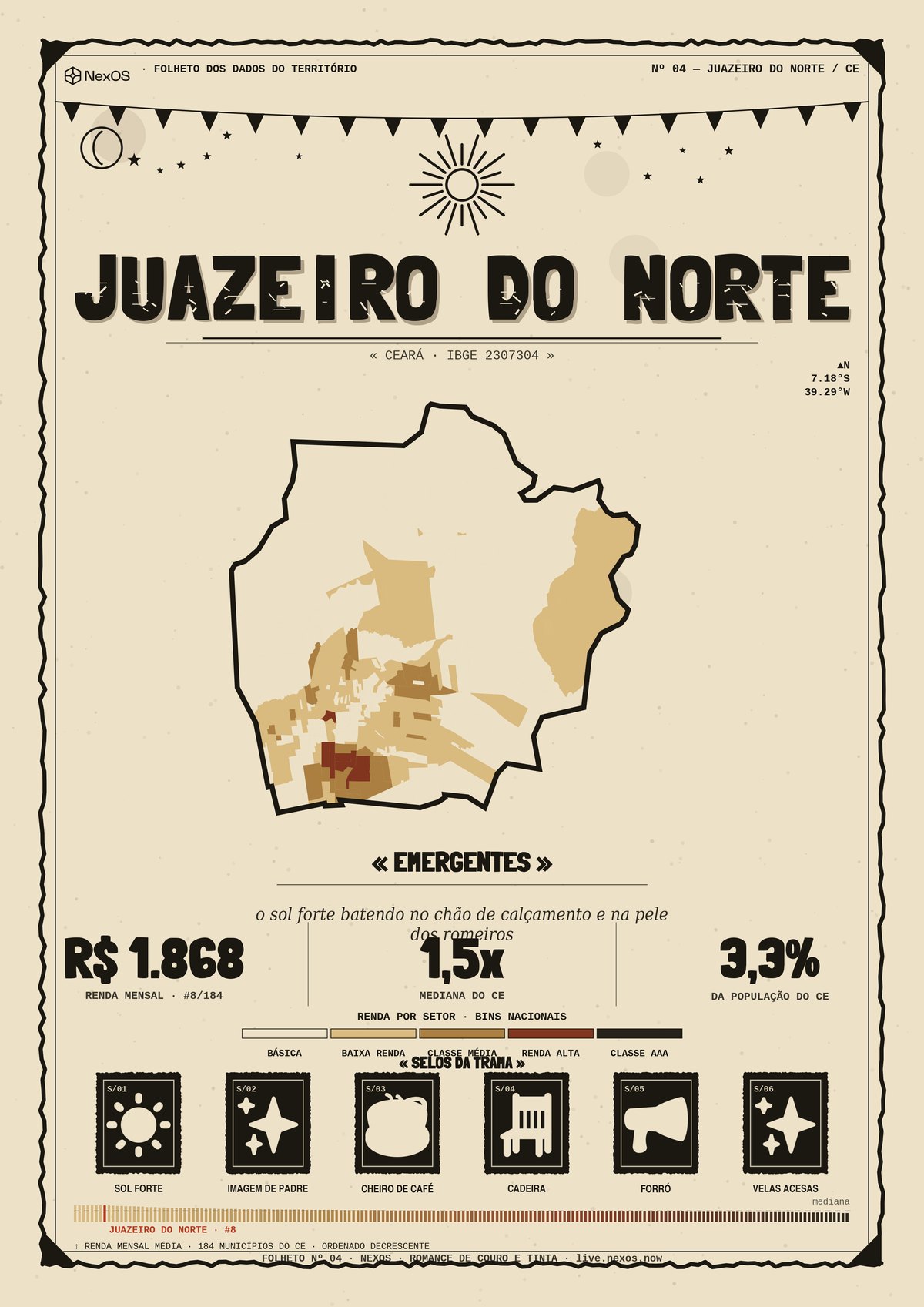
Create your city's poster, free, at live.nexos.now/poster.

Two wheels for everything
The vehicle fleet confirms the same pattern of a city built on intense flow and short distances: 84,612 motorcycles against 52,693 cars, and the most common vehicle in the city is the Honda CG 125 (16,051 units). Motorcycles and light utility vehicles add up to nearly two-thirds of the registered fleet, the typical shape of a city that moves in short trips, between neighborhood, commerce and pilgrimage.
Who stays in Juazeiro do Norte
The family archetypes show a pattern worth noting: married elderly couples make up 1.9% of households, 54% below the national average, and elderly people living alone are 1.82%, 33% below average. By contrast, multigenerational households add up to 17.5%, 16% above average, and single-parent households weigh 9.17%, 36% above. Juazeiro do Norte concentrates extended, young families living under the same roof far more than the national average.
On social vulnerability, 34,832 families receive Bolsa Família welfare, out of 76,326 registered in CadÚnico, for a population of 286,120, a dependency rate sitting right at the national median (55th percentile), neither among the highest nor the lowest in the series.

The pilgrimage has its price
The municipality’s own Trama profile records the tension of hosting a wave of faith that multiplies the population during pilgrimage season. Residents complain about sidewalks taken over by stalls, accumulated trash and noise late into the night; street vendors depend on exactly that excess to make a living. The area around the mall, the airport and the university district faces real real-estate pressure, with old houses giving way to buildings, studio rentals and commercial units, and household bedrooms turning into makeshift guesthouses during pilgrimage season. At night, bar noise and drum-and-worship services share the street with those who need to sleep early for the next day’s shift.
The radio that sets a record
Juazeiro do Norte is a complete media hub: 14 radio stations based locally, 3 broadcast TVs and 5 local sites. And here’s the number no other city in the series had reached: Rádio Vale 99.9 FM has 118,805 monthly listens, more than double the runner-up. It’s a radio audience outside any pattern seen in this coverage so far.
Digital tells the opposite story. The leading site, caririensi.com.br, has 3,901 monthly pageviews, and none of the five local sites are plugged into programmatic buying: all operate through direct deals only. Where radio sets a record, Juazeiro do Norte’s digital scene stays nearly nonexistent.

Connected, but still in short form
Coverage comes close to total: 99.9% in the urban area and 100% in the rural zone, one of the best figures seen in the series. Even so, creative capacity stays limited to audio, text and light images, without the infrastructure for heavy video.
Free TV (Coolita, TCL Channel) dominates consumption intensity. And the “study, faith and culture” block confirms what the city is: an offline Bible app ranks among the most intense, alongside study and quote sites, the digital diet of someone balancing pilgrimage, school and work. Domain by domain, by access intensity per user:
How Juazeiro do Norte wants to be spoken to
Whoever speaks to Juazeiro do Norte speaks to someone who calls the shopkeeper “meu patrão,” knows the neighbor by name, and holds the sidewalk until the street cools down. It’s a city that changes scale during pilgrimage season, when a resident becomes a host to pilgrims and the everyday city coexists, for weeks, with the city of pilgrimage. The tone that works here isn’t institutional or capital-city: it’s the tone of someone who hosts people from out of town all year round and knows how to turn that into income, commerce and faith, all at once.
In the end, Juazeiro do Norte proves that devotion and economy don’t live in separate worlds. Faith in Padre Cícero turned a pilgrimage city into the biggest economy in the Cariri region, driven by services, health and commerce, with a meaningful share of the money running through channels no official statistic fully sees.
Explore the X-ray of Juazeiro do Norte on NexOS · City hall: juazeirodonorte.ce.gov.br · IBGE profile: cidades.ibge.gov.br/brasil/ce/juazeiro-do-norte. See also Governador Valadares and the 4-layer method.
This piece is part of the Tramas series, territorial intelligence as method. Data cross-referenced by NexOS: IBGE (GDP, 2022 Census), BNDES (indirect operations by subsector), Central Bank (Pix, ESTBAN: credit and real-estate financing), CadÚnico/Bolsa Família, DETRAN (vehicle fleet), ANATEL and curated local media inventory. Symbolic profile, invisible networks and classification: Tramas do Invisível methodology.

Americana, Brazil: nostalgic for the old street, but with fewer multigenerational households than the national average
Americana's Trama profile talks about surnames that repeat across neighborhoods and neighbors who know each other by sight, but NexOS's family archetype data shows only 12.09% of households are multigenerational.

São Carlos, Brazil: behind the tech-hub label, industry pulls 46.7% of BNDES financing, well ahead of trade and services
R$273.7 million in BNDES financing (910 operations) makes industry, led by machinery, the biggest borrower of development credit in a city that sells itself as a university hub.