

Governador Valadares, Brazil: industry is just 13% of GDP, what sustains the city is the white coat
In a city known for decades of migration to the United States, industry barely shows up: just 13% of GDP. What sustains the economy is a corridor of clinics, hospitals and doctor's offices serving people from neighboring towns. What wealth remains is among the most concentrated in Brazil.


Say “Governador Valadares” and what comes to mind is dollars: the city that sent people to the United States for generations and lives off remittances. The data dismantles that image at the root, just not in the way you’d expect. It isn’t the dollar that sustains the city in the numbers NexOS can measure: it’s the white coat. Industry accounts for just 13% of GDP, nearly invisible for a mid-size city in Minas Gerais, while services add up to 63.3%. And inside that services block, the municipality’s own Trama profile is direct: clinics, doctor’s offices and hospitals form “a corridor of white coats and clipboards,” serving people from neighboring towns, not just residents.
It’s this regional health vocation, silent in the industrial statistics, that explains a R$8.61 billion GDP driven by the doctor’s office, the lab and the hospital bed, not the factory.
Wealth
Where the economy actually breathes
The GDP breakdown makes the vocation obvious: services pull 63.3% of the economy, public administration adds 22.7%, industry barely reaches 13%, and agriculture is just 1%. For a city in the Minas Gerais interior, that’s a services-capital composition, not a manufacturing hub.
Whoever finances this city also points to services, not to the factory. Of BNDES loans in the city, road transport leads (R$209 million), but by a slim margin over commerce and services (R$181 million): unlike other cities in the series, there’s no single subsector that dominates outright here. It’s a spread-out development-loan portfolio, consistent with an economy that is, at its root, a services economy.
Wealth standing still, money on the move
In the vehicle fleet, Governador Valadares has the rarest balance in the series: 76,353 cars against 64,813 motorcycles, a ratio much closer to 1-to-1 than any other city covered so far. But model by model, the leader isn’t a car: it’s the Honda CG 150 motorcycle (11,578 units), ahead even of the Volkswagen Gol (9,863). The city looks like a car city, but rides a motorcycle.
Longer-term credit shows wealth that’s stopped growing. Real-estate financing went from R$1.46 billion to R$1.55 billion in two years, up just 6%, already accounting for 40.6% of all credit in the city. Meanwhile, Pix received per month jumped from R$1.65 billion to R$2.89 billion, up 75% over the same period. It’s the portrait of a wealthy city whose wealth is dammed up in old real estate, while everyday money already runs at a different pace.
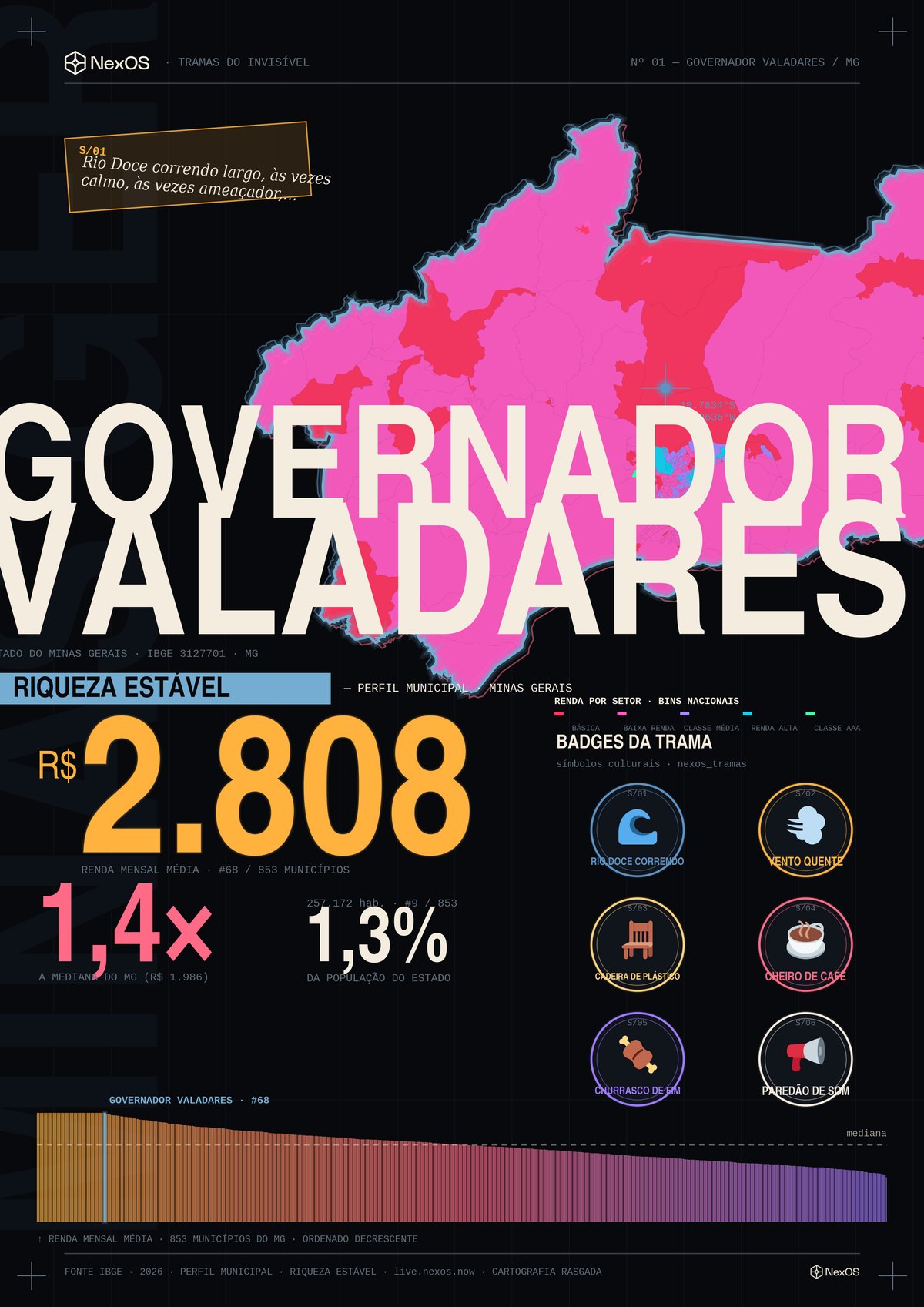
Create your city's poster, free, at live.nexos.now/poster.

Who stays in the city that exported people
The family archetypes show a profile that stands out from most cities in the series: married couples with young children are just 17.5% of households, 11% below the national average. By contrast, single-parent households weigh 8.17%, 21% above average, and elderly people living alone are 3.42%, 27% above the national average. This isn’t a city of young people starting families: it’s a city of those who stayed, often alone, while part of the family left.
That reading matches what the municipality’s own Trama profile records about life in the city: many people have relatives living elsewhere, in another state or another country, and keep the bond through video calls and money arriving on the phone screen. It’s the same migration culture that gave the city its “dollar capital” reputation, just that, in the data NexOS can measure, it shows up as social texture, not as the engine of the local economy.
The profile NexOS assigns the city is Stable Wealth, but with a rare nuance: wealth concentration sits at the 93rd percentile, among the 7% most concentrated municipalities in Brazil. Even so, its territorial-standout classification is “Low Presence”: even concentrated, the city isn’t read by NexOS as a hub that stands out regionally. Social vulnerability is moderate: 13,757 families receive Bolsa Família welfare, out of 48,846 registered in CadÚnico.
The porch has friction
No porch over the river is just contemplation. The municipality’s own Trama profile carries the mark of two recent traumas: floods that made families lose furniture, documents and keepsakes, and the mud that came down the Rio Doce a few years back, changing the color of the water and the trust of those who always saw the river as an ally. Every heavy rain reignites that old fear.
There’s also spatial tension: the riverbank is contested between those walking in peace, those selling food, those throwing events, and those crossing at high speed on a motorcycle. Neighborhoods valued for their river views and view of the Pico da Ibituruna peak draw new buildings and renovations, pushing lower-income families toward areas more vulnerable to flooding. And the night has its own tug-of-war: bars, car-stereo walls and churches with drum-and-mic worship share the street with those who need to sleep early.

The radio that plays in the waiting room
Governador Valadares is a complete media hub: 8 radio stations based locally, 4 broadcast TVs and 6 local sites. The clear leader, by real listening, is Rádio Mundo Melhor 97.7 FM, with 29,983 monthly listens, more than double any leader seen in the series so far, playing “as the soundtrack of bakeries, workshops and homes during the day,” in the words of its own Trama profile.
Digital tells a very different story from radio. The leading site, drd.com.br, has 96.3k monthly pageviews and already operates plugged into programmatic buying, but the combined local sites add up to just 0.45 pageviews per resident per month, the lowest per-capita reading seen in the series so far. Where radio shouts, local digital still whispers.

Connected, but still in short form
Urban coverage reaches 97.9%, but rural coverage sits at 68.3%, below the series average. ANATEL classifies the city’s infrastructure as “mixed connectivity, expanding,” with creative capacity still limited to audio, text and light images, not heavy video.
Free TV (TCL Channel, Coolita) dominates consumption intensity, closely followed by a block of apps and utilities. And faith shows up here as real data, not assumption: an offline Bible app ranks among the most intense, echoing the nighttime worship services the Trama profile itself records disturbing the peace of nearby neighborhoods. Domain by domain, by access intensity per user:
How Governador Valadares wants to be spoken to
Whoever speaks to Governador Valadares speaks to someone who organizes life by neighborhood: the neighbor known by name, the gate pulled open at dusk, a walk along the riverbank for whoever can. It’s a city that balances longing and pragmatism, with relatives far away and money arriving on the phone screen, and that settles street alerts, doctor recommendations and job openings in a WhatsApp group. The tone that works here belongs to someone who has already seen the river rise and fall, literally and economically, and keeps building life around it.
In the end, Governador Valadares proves that wealth isn’t always a factory: it’s a waiting room, a doctor’s office and a lab operating at regional scale, while industry barely shows up on the map. The porch over the Rio Doce keeps watching everything pass by (people, trains, news, rumor) and charging, in floods and in concentrated wealth, the price of being the city everyone crosses through.
Explore the X-ray of Governador Valadares on NexOS · City hall: valadares.mg.gov.br · IBGE profile: cidades.ibge.gov.br/brasil/mg/governador-valadares. See also Anápolis and the 4-layer method.
This piece is part of the Tramas series, territorial intelligence as method. Data cross-referenced by NexOS: IBGE (GDP, 2022 Census), BNDES (indirect operations by subsector), Central Bank (Pix, ESTBAN: credit and real-estate financing), CadÚnico/Bolsa Família, DETRAN (vehicle fleet), ANATEL and curated local media inventory. Symbolic profile, invisible networks and classification: Tramas do Invisível methodology.

Americana, Brazil: nostalgic for the old street, but with fewer multigenerational households than the national average
Americana's Trama profile talks about surnames that repeat across neighborhoods and neighbors who know each other by sight, but NexOS's family archetype data shows only 12.09% of households are multigenerational.

São Carlos, Brazil: behind the tech-hub label, industry pulls 46.7% of BNDES financing, well ahead of trade and services
R$273.7 million in BNDES financing (910 operations) makes industry, led by machinery, the biggest borrower of development credit in a city that sells itself as a university hub.