

Araguari, Brazil: arabica coffee (R$444.2 million) has overtaken soybeans (R$311.9 million) in the city's fields
With less than a third of soybean's planted area (13,175 hectares against 38,000), arabica coffee is now worth more in Araguari's fields.


Araguari sees itself through the smell of coffee brewing early in the morning and the whistle of the train cutting through the city: its own Trama profile calls it “Sonic Crossroads of the Triângulo,” where highway, railway and bus terminal cross to the sound of the radio. But in the fields, a quiet reversal has already happened: arabica coffee is now worth more than soybeans, the grain that was always king in the Triângulo Mineiro. In 2024, coffee fields yielded R$444.2 million against R$311.9 million from soybeans, occupying less than a third of soybean’s planted area: 13,175 hectares against 38,000.
The field that flipped upside down
Coffee isn’t just worth more: it’s more efficient per hectare. Coffee fields yield R$33,700 per hectare planted, against R$8,200 for soybeans, nearly 4.1 times more per area. Coffee alone accounts for 38.3% of all the city’s crop value (R$1.16 billion across temporary and permanent crops combined), more than any other single crop in Araguari.
Where the economy actually lives
Even with coffee’s turnaround, farming stays small in Araguari’s overall economy: just 10.4% of R$5.16 billion in value added, behind services (41.5%), industry (36.5%) and public administration (11.6%). What actually moves the city is trade and services, from the Mart Minas wholesale chain to the clinics and colleges that pull people in from outside.
Development credit follows the same logic: of the R$480.2 million BNDES disbursed in Araguari, road transport leads (R$167.0 million), followed by trade and services (R$139.5 million) and food industry (R$85.9 million). Farming, even with coffee rising, gets R$56.9 million across 187 operations, 11.9% of the total: development money still follows the highway and the storefront more than the field.

Who lives at the crossroads
In NexOS’s family archetype data, the most common group in Araguari is couples with young children, 18.5% of households, and multigenerational families make up 15.4%, close to the national average (15.04%). Nearly half of households, 46.1%, are headed by women, and 15.5% of families receive Bolsa Família benefits.
In the local fleet, cars lead by a wide margin, 47,770 units against 27,898 motorcycles, and the Honda CG 125 (5,968 units) is the city’s most common model.
Pix received by the city (individuals + businesses) grew 80.5% between January 2024 and June 2026, from R$722.4 million to R$1,303.6 million a month, peaking at R$1,505.3 million in September 2025.
Bank credit grew 12.1% between January 2024 and December 2025, from R$1,369.2 million to R$1,535.4 million, and real estate financing grew more than double that, 25.2% over the same period, from R$651.7 million to R$815.9 million, now 53.1% of all the city’s credit.
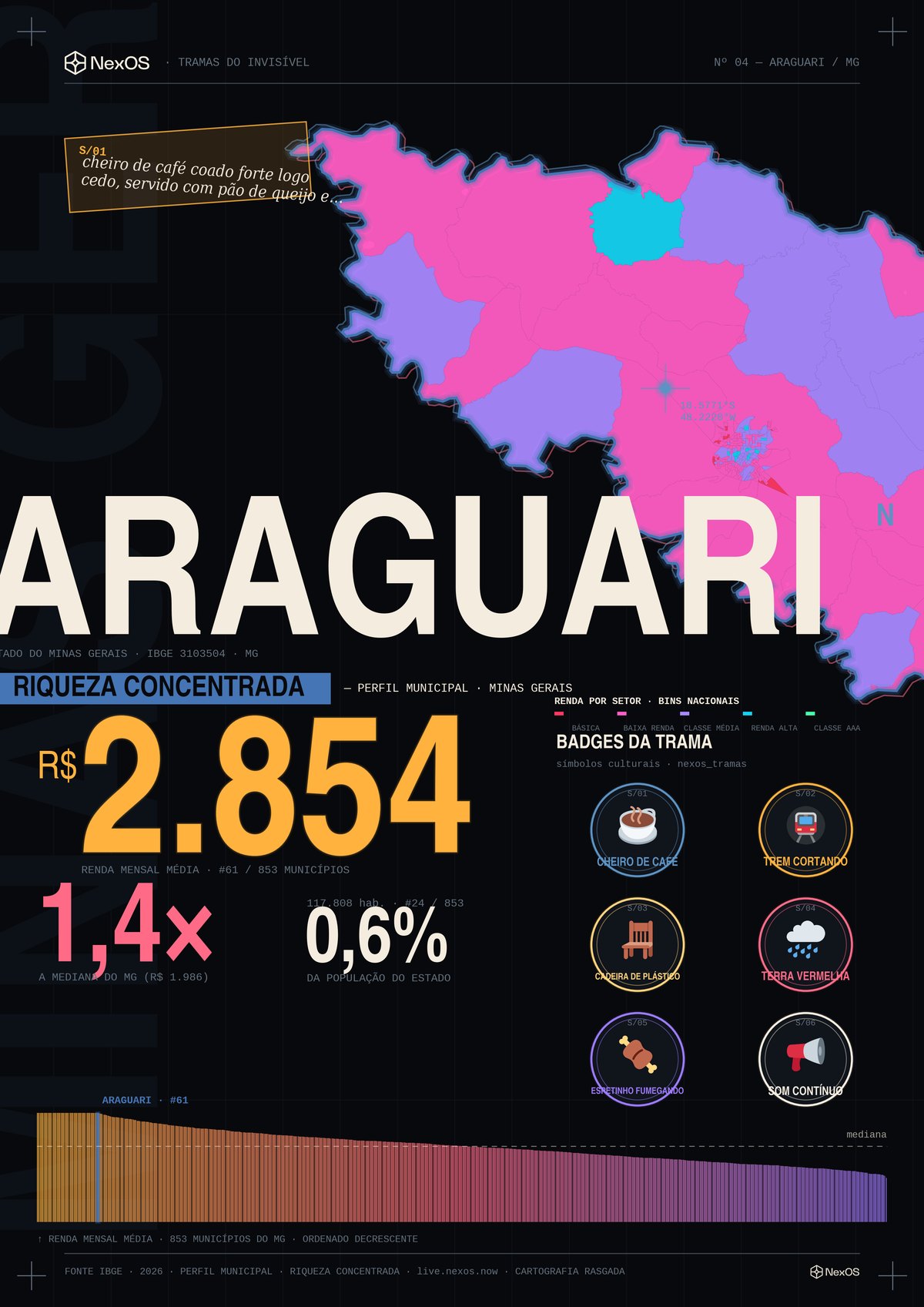
Create your city's poster, for free, at live.nexos.now/poster.

A local radio oasis, led by Rádio Planalto
The media profile NexOS assigns Araguari is Local Oasis (Radio+Sites). Rádio Planalto 1110 AM leads, now streaming-only, with 6,221 monthly listeners and 100% population coverage, ahead of Rádio Mais FM 93.5 (4,640) and Rádio Regional 104.7 FM (3,092).
Online, only 4 local sites were mapped, led by jornalcontabil.com.br (118,403 monthly pageviews) and gazetadotriangulo.com.br (14,953), and neither is plugged into programmatic media: both sell only through direct sales.
Classifieds and utilities lead the city’s digital consumption, driven by OLX, ahead of video and TV, where Kwai and streaming apps compete for space with Globo, which leads news and media.

How Araguari wants to be heard
The smell of brewing coffee, the train whistle, the plastic chair pulled onto the sidewalk: the symbols Araguari chooses to tell its own story remain the same ones as always, a city of passage between highway, railway and farmland. But in the fields that sustain those symbols, the reversal has already happened quietly: coffee has passed soybeans, occupying less land and worth more. The city keeps talking about the train and the radio; anyone who pays attention to the soil will notice the grain that drives it has changed.
Explore Araguari’s X-ray on NexOS · City hall: araguari.mg.gov.br · IBGE profile: cidades.ibge.gov.br/brasil/mg/araguari. See also the family archetypes piece and the 4-layer method.
This piece is part of the Tramas series, territorial intelligence as a method. Data cross-referenced by NexOS: IBGE (GDP, Census, agricultural and livestock production), BNDES (indirect operations by subsector), Banco Central (Pix, ESTBAN: credit and real estate financing), CadÚnico/Bolsa Família, DETRAN (vehicle fleet), ANATEL and curated local media inventory. Symbolic profile, invisible networks and classification: Tramas do Invisível methodology.

Americana, Brazil: nostalgic for the old street, but with fewer multigenerational households than the national average
Americana's Trama profile talks about surnames that repeat across neighborhoods and neighbors who know each other by sight, but NexOS's family archetype data shows only 12.09% of households are multigenerational.

São Carlos, Brazil: behind the tech-hub label, industry pulls 46.7% of BNDES financing, well ahead of trade and services
R$273.7 million in BNDES financing (910 operations) makes industry, led by machinery, the biggest borrower of development credit in a city that sells itself as a university hub.