

Arapiraca, Brazil: the city that markets itself as an urban hub has farming bigger than all of industry
Farming is 22.1% of Arapiraca's value added, more than double industry (8.9%). Behind the number: 720,000 birds and R$11.7 million in freshwater shrimp.


Arapiraca markets itself as an urban hub for Alagoas’s Agreste region: a mall, a college scene, a full local media hub, and rows of motorcycles parked outside shops and diners. The city’s own Trama profile calls it “Chatty Crossroads of the Agreste,” the hub of vans, buses and radio that pulls the whole region through it. Yet in the city’s GDP composition, farming accounts for 22.1% of value added, more than double industry’s share (8.9%).
The farming value added, R$1.16 billion, is even larger than public administration (18.1%) and more than double industry. Underneath the regional-hub image, there’s poultry, shrimp and cropland carrying a real share of that economy.
The engine the urban-hub image leaves out
Arapiraca’s value added comes to R$5.25 billion, within a GDP of R$6.88 billion. Services lead (50.9%), but farming comes in second (22.1%), ahead of public administration (18.1%) and well above industry (8.9%).
Formal credit doesn’t reflect that weight. Trade and services hold the largest BNDES disbursement to local companies, R$101.4 million in loans (619 operations), closely followed by road transport, R$83.6 million (622 operations). Farming shows up with just R$3.2 million financed across 20 operations, a minimal slice of formal credit for a sector that accounts for more than a fifth of the city’s value added.
Bank credit follows the same path. The city’s total credit balance grew 28.9% over two years, from R$2.28 billion (January 2024) to R$2.94 billion (December 2025). Real estate financing grew even faster, 31.4% over the same period, and now accounts for 65.6% of all bank credit in the city: nearly two out of every three reais lent in Arapiraca go into brick, not into cropland.
The real production shows up in other tables. Temporary crops totaled R$53.7 million in 2024, led by cassava (R$15.9 million) and leaf tobacco (R$14.8 million), the same tobacco that still lingers in the memory of families who once worked the curing sheds. Livestock adds up to 19,100 head of cattle and 720,000 birds (542,000 of them chickens), and aquaculture turned over R$15.5 million in 2024, R$11.7 million of that in freshwater shrimp alone.
In the local fleet, motorcycles total 84,343 registered units, led by the Honda Biz (15,329), ahead of the city’s 48,945 cars, consistent with the rows of parked motorcycles the city’s own Trama profile names as one of Arapiraca’s cultural symbols.
Who lives in the two Arapiracas
In NexOS’s family archetype data, Arapiraca strays from the national pattern on two fronts: married couples with young children make up 21.71% of households (national average, 19.74%), and multigenerational households add up to 16.69% (national average, 15.04%), both above the country’s average. The Bolsa Família welfare rate is 38.7% of families, nearly four in ten, a high number for a city that markets itself as a regional consumption hub.
Pix received by the city (individuals + businesses) grew 67.8% between January 2024 and June 2026, from R$1.20 billion to R$2.02 billion a month, peaking at R$2.20 billion in December 2025.
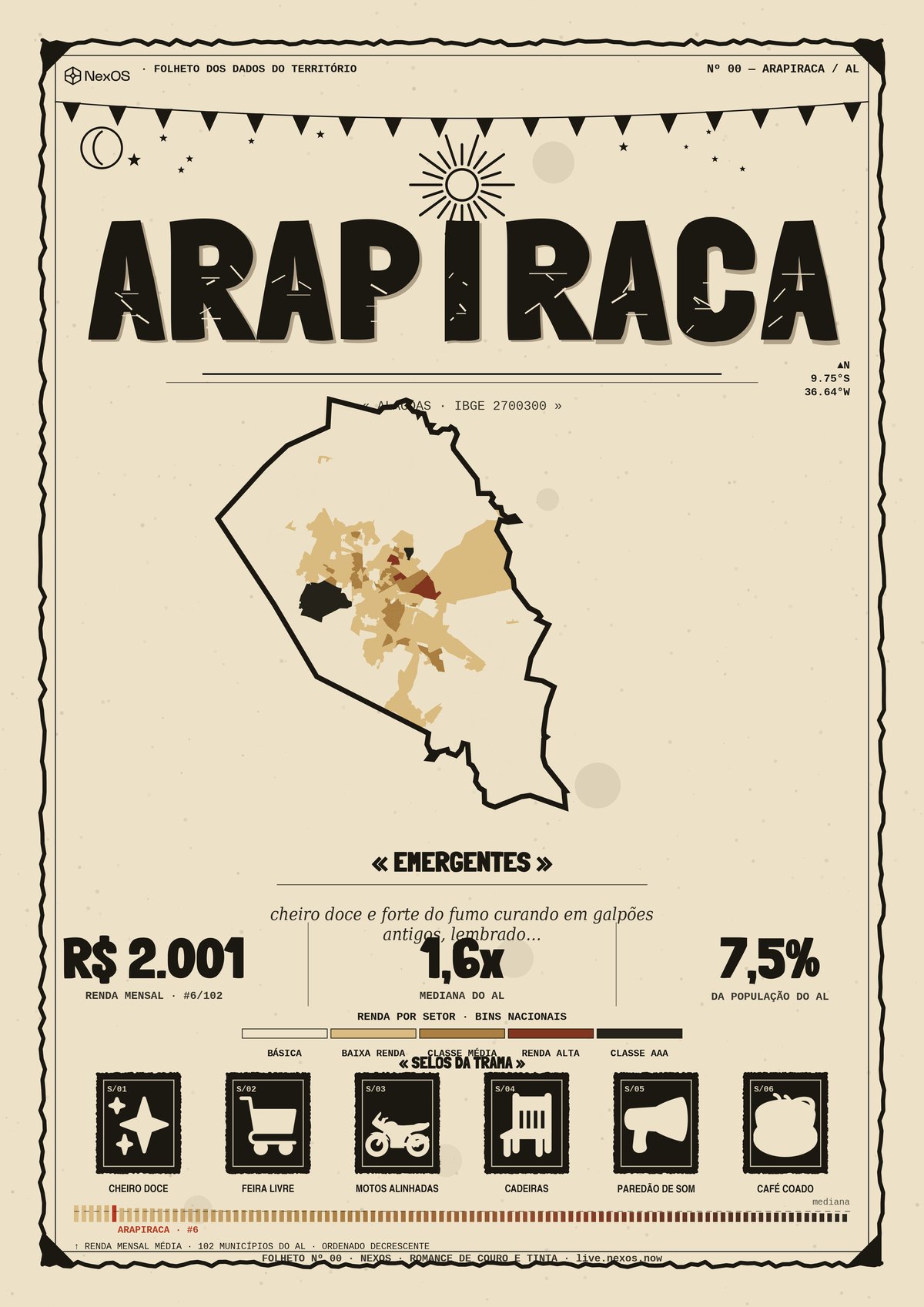
Create your city's poster, for free, at live.nexos.now/poster.


A full media hub, led by the 96 FM
The media profile NexOS assigns Arapiraca is Full Media Hub (TV+Radio+Digital). Rádio 96 FM Arapiraca leads by a wide margin, 59,168 monthly streaming listeners, more than three times the runner-up, Rádio Líder 101.9 FM (18,216).
Online, jaenoticia.com.br holds the largest local traffic, 361,508 monthly pageviews, but remains unplugged from programmatic media, selling only through direct sales. Todosegundo.com.br is the only local site plugged into programmatic media (26,246 monthly pageviews, 1.4 ads per pageview).
Classifieds and utilities lead the city’s digital consumption, driven by OLX. Video and TV come next, with a TV brand’s embedded browser as the single strongest domain, ahead of Pinterest, which leads social and portals. That same TV browser is also the city’s highest-intensity programmatic domain (over 1,100 ad bids per weekly cookie), concentrating far more ad requests per user than broad-reach domains like YouTube or Globo.

How Arapiraca wants to be talked about
The city likes to see itself as bigger than plenty of state capitals out there, with a mall, colleges, an airport and a full media hub. That image is real, backed by media, fleet and credit data. But that image coexists with a concrete fight over space: downtown, street vendors and formal shops share sidewalks with motorcycles parked over the curb, and the arrival of the mall, colleges and new subdivisions pushes lower-income residents further out, into neighborhoods more dependent on motorcycles and vans to reach any service. Underneath that visible friction, the city also runs on an informal network of motorcycle-taxi drivers, van drivers and hairdressers who carry job leads, rumors and neighborhood news from block to block, a bridge no GDP figure captures.
That’s the same city where farming accounts for R$1.16 billion in value added, bigger than all of industry and nearly the size of public administration. The Arapiraca of the mall and the Arapiraca of the poultry farms, the shrimp ponds and the cropland fit in the same territory, and neither cancels the other out.
Explore Arapiraca’s X-ray on NexOS · City hall: web.arapiraca.al.gov.br · IBGE profile: cidades.ibge.gov.br/brasil/al/arapiraca. See also the family archetypes piece and the 4-layer method.
This piece is part of the Tramas series, territorial intelligence as a method. Data cross-referenced by NexOS: IBGE (GDP, Census, agricultural and livestock production), BNDES (indirect operations by subsector), Banco Central (Pix, ESTBAN: credit and real estate financing), CadÚnico/Bolsa Família, DETRAN (vehicle fleet), ANATEL and curated local media inventory. Symbolic profile, invisible networks and classification: Tramas do Invisível methodology.

Americana, Brazil: nostalgic for the old street, but with fewer multigenerational households than the national average
Americana's Trama profile talks about surnames that repeat across neighborhoods and neighbors who know each other by sight, but NexOS's family archetype data shows only 12.09% of households are multigenerational.

São Carlos, Brazil: behind the tech-hub label, industry pulls 46.7% of BNDES financing, well ahead of trade and services
R$273.7 million in BNDES financing (910 operations) makes industry, led by machinery, the biggest borrower of development credit in a city that sells itself as a university hub.