

Catalão, Brazil: 44% of BNDES financing goes to highways, mining gets just 0.2%
In the city that imagines itself a mineral hub of southern Goiás, BNDES financing for road transport (R$189.9 million) outweighs all of industry combined, while mining is left with less than 1% of the total.


Catalão describes itself as the “Hinge of Southern Goiás,” the point connecting Goiás to the Triângulo Mineiro region by truck, airport and bus terminal. The city’s own Trama profile reaches for the image of mining to describe the place. But the financing that actually sustains the local economy doesn’t follow that script: 44% of all BNDES financing that reached local companies went to road transport, R$189.9 million, while extractive industry, mining, got just 0.2%, R$797,600.
Wealth
The hinge that runs on highways, not mining
In GDP value added, industry is Catalão’s largest sector (45.93%), ahead of services (34.42%), farming (11.81%) and public administration (7.84%). So far, nothing contradicts an industrial/mineral-hub image. The surprise shows up when you look at where the credit financing that economy actually goes.
Within infrastructure, road transport leads on its own: R$189.9 million across 807 operations, 44% of everything the city received. Within industry, the largest subsector is transport equipment manufacturing, R$71.6 million across 23 operations, not mineral extraction: extractive industry shows up with just R$797,600 across 3 operations, a 0.2% sliver of the total financed. The formal credit that sustains Catalão follows highways and transport equipment, not mine shafts.
In the local fleet, cars lead with 49,448 units, but the single most common model in the whole city is the Honda Biz motorcycle (6,101 units), ahead even of the Volkswagen Gol (5,834). Pickup trucks add up to 15,446 units, and heavy trucks, used in the cargo transport that dominates financing, total 2,685. Farming has a real presence too: soy was worth R$623.7 million in 2024, and the cattle herd ranged between 173,000 and 184,000 head over the last three years. Even so, what leads formal credit isn’t farm or mine: it’s the highway.
Who lives at the crossroads
In NexOS’s family archetype data, Catalão strays slightly from the national pattern: married couples with young children make up 20.42% of households (national average, 19.74%), a touch above, and multigenerational households add up to 13.52% (national average, 15.04%), below the country’s average. The Bolsa Família welfare rate is 11.80% of families.
Bank credit follows the same concentration-in-transport-infrastructure pattern. The total credit balance grew 9.7% between January 2024 and December 2025, from R$2,899 million to R$3,181 million. Real estate financing grew much faster, 35.9% over the same period, and its share of total credit rose from 20.5% to 25.4%.
Pix received by the city (individuals + businesses) grew 83.3% between January 2024 and June 2026, from R$805.9 million to R$1,477.4 million a month, peaking at R$1,559.7 million in December 2025.
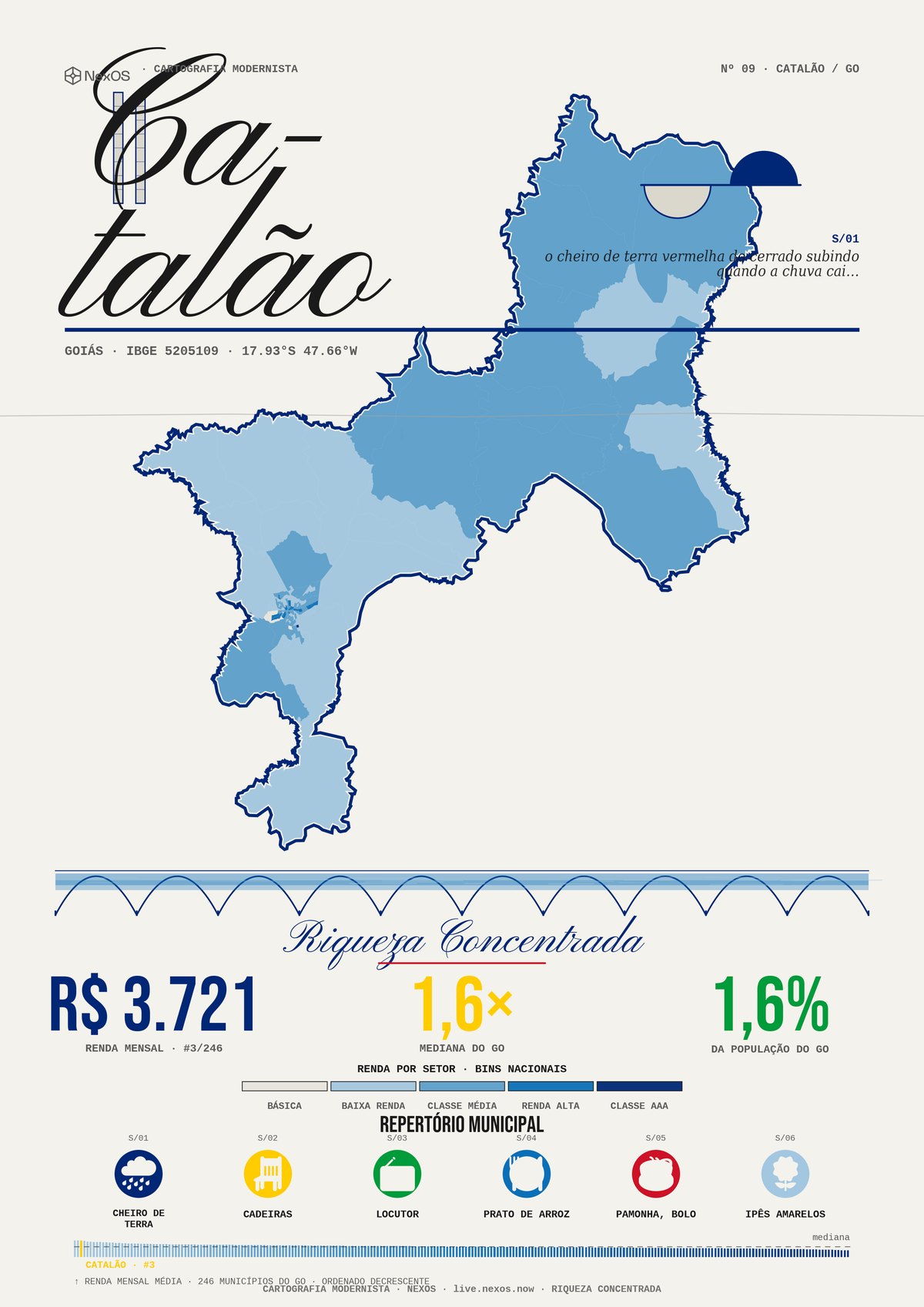
Create your city's poster, for free, at live.nexos.now/poster.


A full media hub, led by Nova Liberdade
The media profile NexOS assigns Catalão is Full Media Hub (TV+Radio+Digital). Rádio Nova Liberdade 102.7 FM leads by a wide margin, 10,406 monthly streaming listeners, more than double the runner-up, Rádio Cultura 101.1 FM (4,625).
Online, zapcatalao.com.br is the only local site plugged into programmatic media (1,178,960 monthly pageviews, 416,164 monthly programmatic impressions, 0.35 ads per pageview). Portalcatalao.com.br, the second-largest local site (147,776 monthly pageviews), remains unplugged, selling only through direct sales.
Classifieds and utilities lead the city’s digital consumption. News and media come next, driven by Globo, ahead of Pinterest, which leads social and portals.

How Catalão wants to be talked about
Catalão presents itself as a hinge between Goiás and the Triângulo Mineiro region: trucks, an airport, a bus terminal and university buses crossing the city all day long. The city’s own Trama profile reaches for the image of mining to describe the place, but the financing that sustains the local economy doesn’t follow that script: nearly half of everything that arrives via BNDES goes to highways, not to mine shafts. The city that markets itself as a mineral hub actually runs on being a place things pass through.
Explore Catalão’s X-ray on NexOS · City hall: catalao.go.gov.br · IBGE profile: cidades.ibge.gov.br/brasil/go/catalao. See also the family archetypes piece and the 4-layer method.
This piece is part of the Tramas series, territorial intelligence as a method. Data cross-referenced by NexOS: IBGE (GDP, Census, agricultural and livestock production), BNDES (indirect operations by subsector), Banco Central (Pix, ESTBAN: credit and real estate financing), CadÚnico/Bolsa Família, DETRAN (vehicle fleet), ANATEL and curated local media inventory. Symbolic profile, invisible networks and classification: Tramas do Invisível methodology.

Americana, Brazil: nostalgic for the old street, but with fewer multigenerational households than the national average
Americana's Trama profile talks about surnames that repeat across neighborhoods and neighbors who know each other by sight, but NexOS's family archetype data shows only 12.09% of households are multigenerational.

São Carlos, Brazil: behind the tech-hub label, industry pulls 46.7% of BNDES financing, well ahead of trade and services
R$273.7 million in BNDES financing (910 operations) makes industry, led by machinery, the biggest borrower of development credit in a city that sells itself as a university hub.