

Itaituba, Brazil: known as the "gateway to the goldfields," 55.2% of its households are headed by women, more than in 90% of Brazilian cities
Family structure also breaks from the national average: 22.83% of households span more than one generation under the same roof (Brazil: 15.04%), and only 1.13% of elderly residents live alone, one of the lowest shares in the country.


Itaituba is the “gateway to the goldfields” on the Tapajós: its own Trama profile describes the city through the back-and-forth of people heading into the bush for gold and coming back down to spend, get medical care and handle paperwork, a landscape of dust-covered pickup trucks, cargo boats and trucks on the Trans-Amazonian highway. But according to the IBGE, a different figure holds the house together: 55.2% of the city’s households are headed by a woman, more than in 90% of Brazilian municipalities.
The household the gold-rush story doesn't show
A third figure reinforces the picture: only 1.13% of Itaituba’s households are elderly people living alone, against a national average of 2.70%, among the lowest shares in the country. A household in Itaituba tends to be full, with several generations sharing the same roof, and it’s rarely an elderly person living alone who holds the structure together.
The gold that doesn't show up in the books either
Itaituba’s visible economy revolves around gold mining and the river: pickup trucks, cargo boats, the back-and-forth of people heading up into the bush and back down. But that same economy barely shows up in formal credit. Of the R$145.9 million BNDES disbursed in the city, 71.5% (R$104.3 million) went to trade and services; the extractive industry, gold mining formalized, got R$1.4 million across just 5 operations, about 1% of the total.
In the city’s R$2.72 billion value added, what actually weighs is urban trade and services, followed by industry and public administration; farming, with a cattle herd of 388,717 head in 2024, is the smallest share. The gold that gives the city its name and reputation flows downriver, informal, outside the official ledger.
In the local fleet, motorcycles dominate by a wide margin, more than triple the number of cars, and the Honda Biz is the most common model. Among pickup trucks, the Toyota Hilux leads, the vehicle that symbolizes going in and out of the goldfields.

Fast money, income that doesn't stretch
Despite the household head’s average monthly income of R$2,037, among the lowest in the state, NexOS classifies Itaituba as having “high purchasing power,” driven by money that circulates fast: Pix received by the city (individuals + businesses) grew 84.6% between January 2024 and June 2026, from R$928.6 million to R$1,714.5 million a month, peaking at R$1,815.0 million in March 2026.
Bank credit grew 19.4% between January 2024 and December 2025, from R$722.4 million to R$862.6 million, and real estate financing grew 13.2% over the same period, from R$196.4 million to R$222.4 million, now 25.8% of all the city’s credit. Even so, 46.83% of families receive Bolsa Família benefits: money passes through the city fast, but not every household manages to hold on to a share of it.
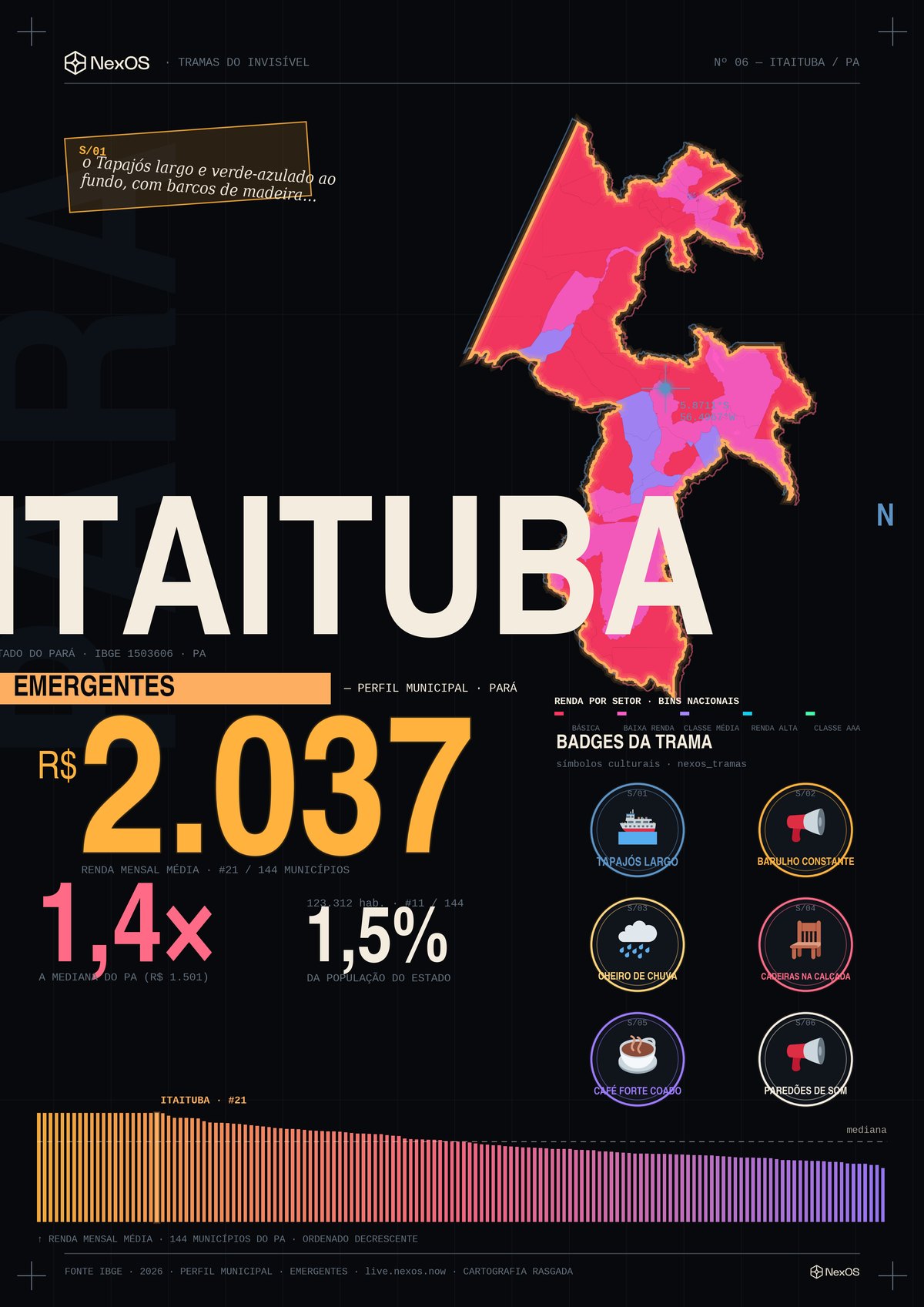
Create your city's poster, for free, at live.nexos.now/poster.

A full media hub, led by Rádio Ita
The media profile NexOS assigns Itaituba is Full Media Hub (TV+Radio+Digital). Rádio Ita 91.3 FM leads, 1,630 monthly streaming listeners and 77.1% population coverage, ahead of a cluster of smaller local FM stations that show up on the signal but haven’t converted coverage into streaming audience yet.
Online, only plantao24horasnews.com.br is plugged into programmatic media among the 7 local sites mapped, 38,870 monthly pageviews and a hyperlocal focus; the rest, like blogdojuniorribeiro.com and portaljamanxim.com.br, sell only through direct sales.
Classifieds and utilities lead the city’s digital consumption, ahead of social and portals, driven by Pinterest, and video and TV, where Kwai dominates well ahead of YouTube.

What the picture leaves out
The gold miner, the trucker, the boatman: those are the figures that illustrate the “gateway to the goldfields,” the image Itaituba projects of itself. The household that sustains that back-and-forth economy doesn’t show up in that picture, even though it’s the majority: more women heading it, more people from different generations under one roof, few elderly living alone. Neither fact cancels out the other; the city remains, at the same time, a gateway to the goldfields and a household organized on entirely different terms on the inside.
Explore Itaituba’s X-ray on NexOS · City hall: itaituba.pa.gov.br · IBGE profile: cidades.ibge.gov.br/brasil/pa/itaituba. See also the family archetypes piece and the 4-layer method.
This piece is part of the Tramas series, territorial intelligence as a method. Data cross-referenced by NexOS: IBGE (GDP, Census, agricultural and livestock production), BNDES (indirect operations by subsector), Banco Central (Pix, ESTBAN: credit and real estate financing), CadÚnico/Bolsa Família, DETRAN (vehicle fleet), ANATEL and curated local media inventory. Symbolic profile, invisible networks and classification: Tramas do Invisível methodology.

Americana, Brazil: nostalgic for the old street, but with fewer multigenerational households than the national average
Americana's Trama profile talks about surnames that repeat across neighborhoods and neighbors who know each other by sight, but NexOS's family archetype data shows only 12.09% of households are multigenerational.

São Carlos, Brazil: behind the tech-hub label, industry pulls 46.7% of BNDES financing, well ahead of trade and services
R$273.7 million in BNDES financing (910 operations) makes industry, led by machinery, the biggest borrower of development credit in a city that sells itself as a university hub.