

Itu, Brazil: behind the fame for exaggeration, a real industry making up 33% of GDP
The second-largest BNDES disbursement to local companies, R$184.9 million, went to mechanical industry, not folklore. The city that jokes about its own size has real factory credit running behind the fame.


Itu is known across Brazil for its “city of exaggeration” reputation: the giant rooster monument, the running joke that everything there is bigger, puffier, more theatrical. Behind the fame, though, there’s real industry: 32.8% of the city’s value added comes from the industrial sector, and the second-largest BNDES disbursement to local companies, R$184.9 million, went to mechanical industry, not to any folklore.
The city’s own Trama profile calls it “City of Real Exaggerations,” and that’s no accident: the nickname has become almost an internal irony, as the profile itself puts it, in a place that grew up seriously, with gated condos, colleges and a dense historic core behind the roadside joke. This week, in fact, the city is hosting the Sou + Agro festival at Parque Maeda, reinforcing the countryside image; but farming accounts for only 0.7% of Itu’s value added. The real engine sits elsewhere.
Wealth
The engine that never becomes a punchline
Itu’s value added comes to R$8.48 billion, within a GDP of R$14 billion. Services lead (57.2%), but industry follows close behind with nearly a third of the economy (32.8%), well ahead of public administration (9.3%) and farming, a minimal share (0.7%).
BNDES disbursements to local companies confirm the read. Road transport leads, R$246.2 million across 888 operations, the most common financing pattern in almost any hub city. But right behind it comes mechanical industry, R$184.9 million across 250 operations, credit for people who genuinely manufacture parts, machines and equipment, not just set up a shop. Food and beverage (R$113.6 million) and trade and services (R$109 million) round out a genuinely diversified economy, exactly as the city’s own Trama profile describes it: wholesale outlets, colleges, healthcare, and underneath all of it, warehouses and factories.
In the local fleet, the Volkswagen Gol leads (8,019 units), followed by the Honda CG 125 motorcycle (5,399) and the Fiat Uno (5,363). One curiosity no other city in the region offers: the Volkswagen Beetle still shows up in the top 10, with 2,644 units on the road, a holdover from an interior city that keeps old cars almost as faithfully as it keeps its jokes.
Who lives in the city of exaggeration
In NexOS’s family archetype data, Itu doesn’t stray far from the national pattern: married couples with young children make up 19.42% of households (national average, 19.74%), and multigenerational households add up to 14.94% (national average, 15.04%). It’s a common family composition for a mid-size interior city, without major deviations from the rest of the country. The Bolsa Família welfare rate is 13.66% of families.
Pix received by the city (individuals + businesses) grew 75.2% between January 2024 and June 2026, from R$1.39 billion to R$2.43 billion a month, peaking at R$2.78 billion in December 2025.
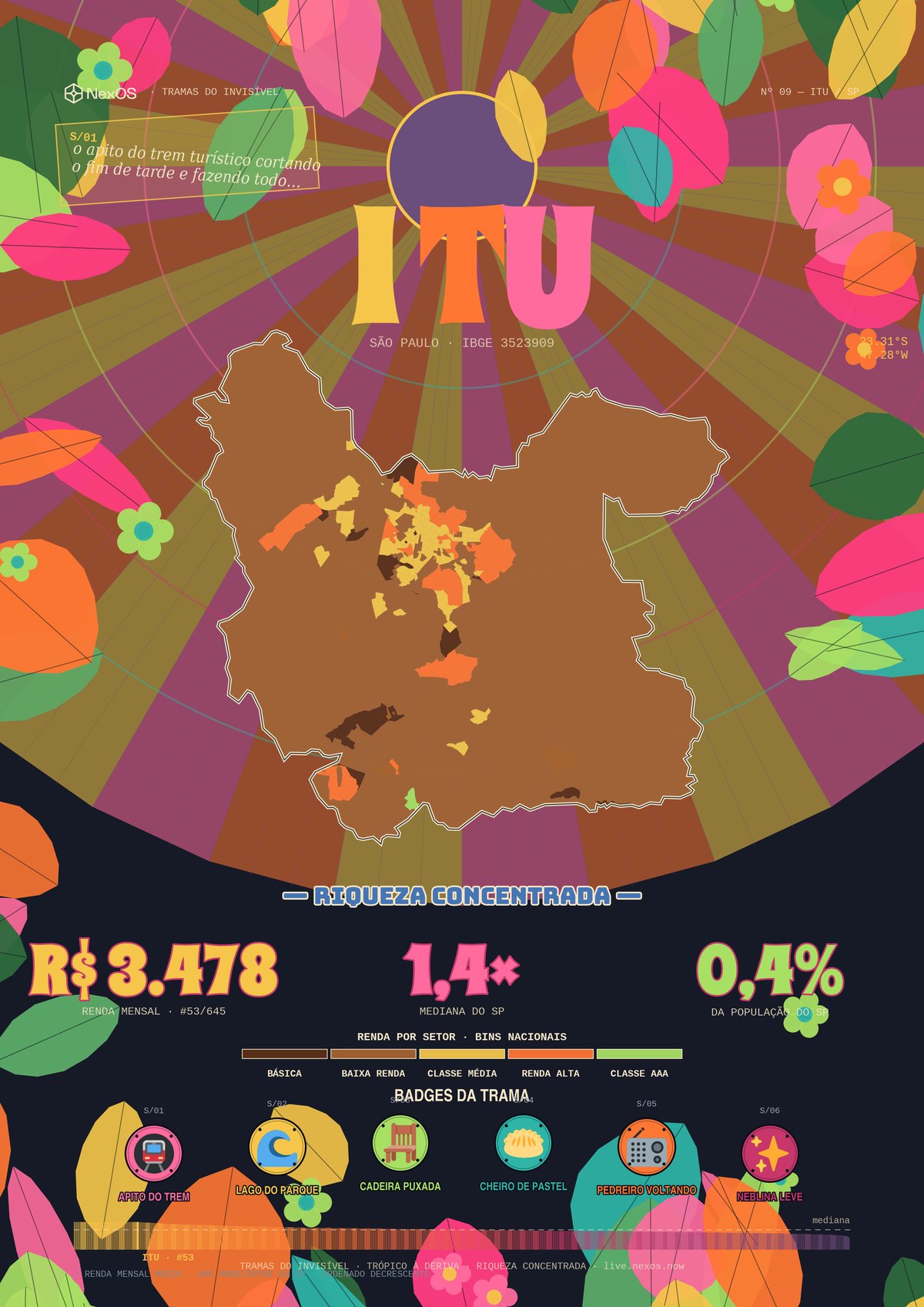
Create your city's poster, for free, at live.nexos.now/poster.


A full media hub, led by the same radio station as ever
The media profile NexOS assigns Itu is Full Media Hub (TV+Radio+Digital). Rádio Cidade 104.7 FM leads by a wide margin, 5,787 monthly streaming listeners, well ahead of Rádio Mix 106.5 FM (1,086).
Online, jornaldeitu.com.br is the only local site plugged into programmatic media (47,000 monthly pageviews, 0.27 ads per pageview). The other three sites mapped, itu.com.br, agoraitu.com.br and ituemdestaque.com.br, remain unplugged, selling ads through direct sales.
OLX leads classifieds and utilities, consistent with a high-income city with steady turnover of used goods. Globo and UOL lead news and media, and Glance, the lock-screen ad format, shows up as the single strongest domain in the whole city.

How Itu wants to be talked about
The giant rooster of Itu’s folklore is a good joke, and the city knows it: it plays with its own exaggeration before anyone from outside gets the chance to. But underneath the monument there are warehouses, mechanical-parts factories and a commercial scene turning over R$14 billion a year. Fame and the real engine don’t compete here; one gives cover to the other, and both fit in the same city.
Explore Itu’s X-ray on NexOS · City hall: itu.sp.gov.br · IBGE profile: cidades.ibge.gov.br/brasil/sp/itu. See also the family archetypes piece and the 4-layer method.
This piece is part of the Tramas series, territorial intelligence as a method. Data cross-referenced by NexOS: IBGE (GDP, Census, agricultural production), BNDES (indirect operations by subsector), Banco Central (Pix, ESTBAN: credit and real estate financing), CadÚnico/Bolsa Família, DETRAN (vehicle fleet), ANATEL and curated local media inventory. Symbolic profile, invisible networks and classification: Tramas do Invisível methodology.

Americana, Brazil: nostalgic for the old street, but with fewer multigenerational households than the national average
Americana's Trama profile talks about surnames that repeat across neighborhoods and neighbors who know each other by sight, but NexOS's family archetype data shows only 12.09% of households are multigenerational.

São Carlos, Brazil: behind the tech-hub label, industry pulls 46.7% of BNDES financing, well ahead of trade and services
R$273.7 million in BNDES financing (910 operations) makes industry, led by machinery, the biggest borrower of development credit in a city that sells itself as a university hub.