

Ji-Paraná, Brazil: average income of R$2,681 a month, but bank credit per person is 7 times higher
Real estate financing already accounts for 40% of all bank credit in the city, growing faster than total credit over the last two years. But look at the garage and you'll see motorcycles financed in small installments: 63.9% of the car-and-motorcycle fleet.


The average household head in Ji-Paraná earns R$2,681 a month. Bank credit per person in the city is R$19,500, nearly 7 times that amount. It isn’t income that sustains the spending NexOS classifies as very high: it’s credit.
The city’s Trama profile calls it “City of the Halfway Point”: a crossroads between river and asphalt, between farmland and a mid-size city. But the halfway point is also where the math doesn’t add up on its own, and credit steps in to cover the difference.
The size of the credit
The city’s total bank credit grew 25.4% over two years: from R$2.12 billion in January 2024 to R$2.66 billion in December 2025. Real estate financing grew even faster, 33.8% over the same period, and now accounts for 40.2% of all bank credit in the city.
Where the leftover credit goes
The city’s total value added comes to R$3.51 billion, led by services (54.9%), with public administration second (25.0%), industry (14.3%) and farming a smaller share (5.9%). The city’s own Trama profile describes the engine behind those services: wholesale outlets like Atacarejo Sq, distributors like Amiral and Minas supplying the region’s commerce, and private universities (Afya, Estácio, Luterano) drawing students from outside, with kitnet rentals and a small ecosystem of snack bars and stationery shops around campus.
BNDES disbursements to local companies confirm that mix: road transport leads with R$186.2 million lent, ahead of trade and services (R$115.7 million) and food and beverage (R$70.6 million, the largest industrial item). A city that describes itself as a crossroads also moves credit to keep trucks, distributors and wholesalers running.
But it’s in the garage that small-installment credit shows up most clearly. Motorcycles are 63.9% of the city’s car-and-motorcycle fleet (60,048 motorcycles against 33,968 cars), and the four most common models on the street are all Honda motorcycles.
The city’s own Trama profile names this kind of achievement as a local success code: showing off “the pickup truck, the lot, the house built bit by bit” marks who has “made it” in the city. Installment credit, whether for a motorcycle or a home, is the tool for that gradual build, not a sign of being out of control.

Younger than the national average
In NexOS’s family archetype data, older-adult households, couples and people living alone, add up to 4.98% of homes in Ji-Paraná, below the national average of 6.82%. Households of married couples with young children are 21.58%, above the 19.74% average. It’s a demographically younger city than Brazil’s average, which matches the recent-settlement story the Trama profile itself tells: neighborhoods and avenues that were still forest and pasture only a few decades ago.
Pix received by the city (individuals + businesses) grew 78.4% between January 2024 and June 2026, from R$953 million to R$1.70 billion a month, peaking at R$1.75 billion in September 2025.
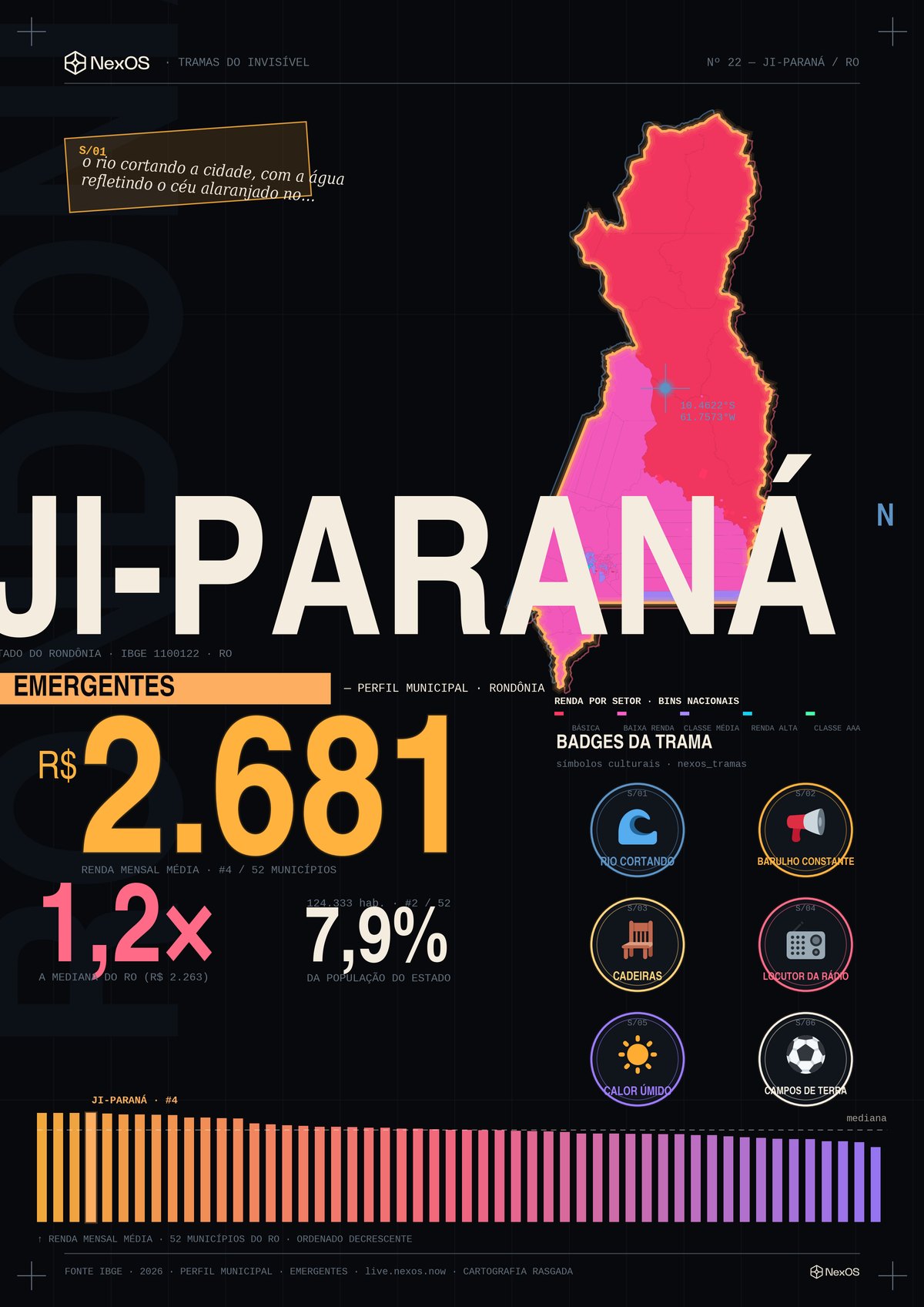
Create your city's poster, for free, at live.nexos.now/poster.

Twelve radio stations and a genuinely plugged-in digital site
The media profile NexOS assigns Ji-Paraná is Full Media Hub (TV+Radio+Digital): 12 radio stations, 1 TV station and a lively digital scene. Rádio Alvorada 90.7 FM leads by a wide margin (6,149 listeners/month of streaming), followed by Rádio Massa 97.3 FM (3,918) and Rádio Atalaia 106.5 FM (2,363).
Online, rondoniatual.com is the local site plugged into programmatic media: 705,600 monthly pageviews, with 0.83 ads per pageview. The other nine local sites mapped, from comando190.com.br to rondoniadigital.com, remain unplugged, selling ads through direct sales.
Intensity by domain shows Kwai ahead in short video, and an offline Bible app among the strongest in faith and leisure, echoing what the Trama profile describes about Sunday mornings with a Bible under the arm and churches packed at night.

How Ji-Paraná wants to be talked about
The crossroads that gives this city’s Trama its name isn’t only geography: it’s the distance between what people earn and what they spend, covered by installment credit, whether for a motorcycle, a home, or keeping the distributor stocked. The city that “has it all” nearby, college, commerce, wholesale, is also the city where almost everyone is paying it off bit by bit, month by month, on a math that income alone wouldn’t close.
Explore Ji-Paraná’s X-ray on NexOS · City hall: ji-parana.ro.gov.br · IBGE profile: cidades.ibge.gov.br/brasil/ro/ji-parana. See also the family archetypes piece and the 4-layer method.
This piece is part of the Tramas series, territorial intelligence as a method. Data cross-referenced by NexOS: IBGE (GDP, Census, agricultural production), BNDES (indirect operations by subsector), Banco Central (Pix, ESTBAN: credit and real estate financing), CadÚnico/Bolsa Família, DETRAN (vehicle fleet), ANATEL and curated local media inventory. Symbolic profile, invisible networks and classification: Tramas do Invisível methodology.

Americana, Brazil: nostalgic for the old street, but with fewer multigenerational households than the national average
Americana's Trama profile talks about surnames that repeat across neighborhoods and neighbors who know each other by sight, but NexOS's family archetype data shows only 12.09% of households are multigenerational.

São Carlos, Brazil: behind the tech-hub label, industry pulls 46.7% of BNDES financing, well ahead of trade and services
R$273.7 million in BNDES financing (910 operations) makes industry, led by machinery, the biggest borrower of development credit in a city that sells itself as a university hub.