

Lauro de Freitas, Brazil: 1 in 3 families on welfare, in a city of very high consumer spending
The very high spending classification comes from indicators like bank credit per capita of R$12,100 and Pix of R$6,500 per resident. Even so, 35% of the city's families depend on Bolsa Família welfare, and the average household head income doesn't exceed R$3,669 a month.


By the indicators NexOS uses to measure spending, bank credit and Pix per resident, Lauro de Freitas carries the very high spending label. The average household head income, R$3,669 a month, is the highest among Bahia’s 417 municipalities, ahead even of the state capital: in Salvador, the same indicator sits at R$3,161. Even so, 35% of the city’s families, more than 1 in 3, receive Bolsa Família welfare.
The city’s Trama profile calls it “Porch of the Capital”: a mid-size city glued to Salvador, from where you can see the airport and the coastline in motion, but that still feels like a neighborhood. It’s an image of proximity, not total dependency, and it’s precisely in that proximity that Bahia’s highest income sits, unmixed, alongside a third of families living on welfare.
Wealth
Where the money goes
The city’s total value added comes to R$6.06 billion, and nearly two-thirds of it comes from services (64.2%). Public administration accounts for 16.5%, industry for 19.3%, and farming barely registers: 0.04% of the total, R$2.5 million next to R$6 billion. Lauro de Freitas is a 100% urban city, with no rural vocation hiding behind the number.
The Trama profile itself describes what actually sustains that services number: gyms like Alpha Fitness, malls like Costa do Joanes Open Mall and Estação Villas, private and low-cost clinics like AmorSaúde, wholesale outlets like Atacadão do Panificador. It’s the landscape of a consolidated middle class, and it shows up in BNDES disbursements to local companies too: trade and services leads with R$251.5 million lent. The second-largest disbursement, though, doesn’t come from industry (which adds up to R$70.4 million across every subsector): it’s road transport, at R$180 million, in a number of operations nearly tied with trade (1,115 versus 1,145). A satellite city of Salvador is also a city that exists to move people and goods through it.
In the local fleet, the five most common models on the street (Volkswagen Gol, Honda CG 160, Fiat Uno, Chevrolet Onix, Honda CG 125) are the same ones that lead in any mid-size Brazilian city: nothing in the garage alone signals the state’s top income.
Who props up that average
Bank credit shows the same income contrast from another angle. Total credit stayed nearly flat over the last two years: from R$2.39 billion in January 2024 to R$2.69 billion in December 2025, a 12.5% rise. Savings deposits, over the same period, grew much faster, from R$1.13 billion to R$1.65 billion, a 46% rise: money being saved growing faster than money being lent. Even so, nearly half of all bank credit in the city (48% in December 2025) is real estate financing.
In NexOS’s family archetype data, household composition strays from the national pattern in two directions. Households headed by a single mother or father make up 8.68% of homes, above the national average of 6.75%. Households of older adults, both couples and people living alone, add up to 4.40%, well below the national average of 6.82%.
It’s a younger, more single-parent city than Brazil’s average, which matches what the Trama profile itself describes: people who arrived from Salvador or from inland towns in recent years trying to put down roots amid rent, condo fees and a daily commute, while whoever is raising kids alone holds together home, work and school without much formal support network nearby. That’s the ground the 35% of families on Bolsa Família fit into: they aren’t some isolated leftover in a wealthy satellite city, they’re families getting by amid a cost of living, rent, transport, school, pushed up by proximity to the capital, where income from informal service work, a motorcycle-taxi fare or a neighborhood shop doesn’t always add up on its own.
Pix received by the city (individuals + businesses) grew 63.1% between January 2024 and June 2026, from R$1.69 billion to R$2.76 billion a month, with a seasonal peak of R$3.07 billion in December 2025, the month of year-end bonuses and holidays.
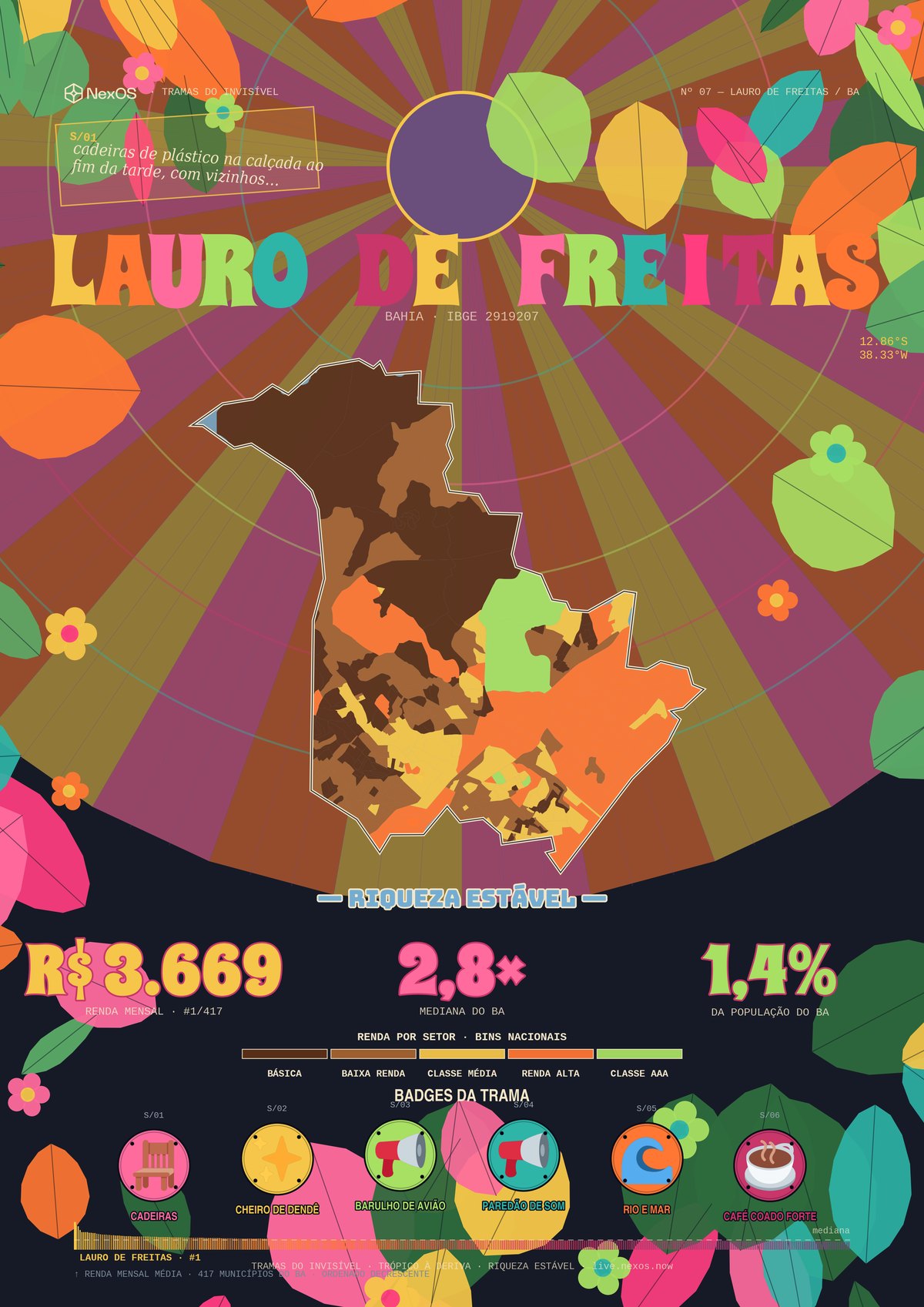
Create your city's poster, for free, at live.nexos.now/poster.


A small radio station leaning against a big capital
The media profile NexOS assigns Lauro de Freitas is Local Oasis (Radio+Sites): local radio and websites, with no meaningful TV coverage. But even that oasis is small next to the city’s size. The three radio stations based there add up to fewer than 220 monthly streaming listeners combined: 119 for leader Rádio Panorama 87.9 FM, 90 for Rádio Lauro 87.9 FM, and none recorded for Litoral Norte FM 102.5. In a city of 203,000 people, that’s neighborhood-size audience, not city-size: most likely, a good share of the public tunes in directly to Salvador’s big stations, outside the local base NexOS measures here.
Online, the six local sites mapped (vilasmagazine.com.br, portalrbn.com.br, ibdah.com.br, lfnews.com.br, agoraemlauro.com, burburinhonews.com.br) all fall in the unplugged category: they sell ads through direct sales, with no connection to programmatic auctions. No single domain in the city clears the intensity floor NexOS curates for the programmatic market; the traffic that exists there is spread thin across national apps and portals.
The category breakdown shows where attention actually concentrates: classifieds and utilities (buying, selling, tax-ID lookups, everyday tools) leads with 27%, news and media follows close behind at 26%, driven by a genuinely Bahia-based outlet, Correio 24 Horas, ahead of Terra and Globo. Social and portals add up to 25%, almost all of it Pinterest. Sports, at just 3%, is the thinnest slice: soccer comes in through the back door here, not the front one.
Infrastructure data helps explain the pattern: Lauro de Freitas’s Anatel quality score is 74.08, the territory has 100% mobile signal coverage, but the city has no fiber backhaul of its own, which NexOS classifies as low creative-format capacity (audio, text and light images, not heavy video). It’s real connectivity, without the backbone that would support a more robust local digital market.

How Lauro de Freitas wants to be talked about
The porch that gives this city’s Trama its name is a good place to watch the world go by, but the traffic isn’t only coming in from outside: it’s people crossing into Salvador in the morning and back at night, a plane passing low overhead, a sound-system truck competing with the church service on the corner, plastic chairs on the sidewalk at dusk. The city has, at the same time, the state’s highest average income and a third of its families on welfare. Neither number cancels the other out; both live on the same porch.
Explore Lauro de Freitas’s X-ray on NexOS · City hall: laurodefreitas.ba.gov.br · IBGE profile: cidades.ibge.gov.br/brasil/ba/lauro-de-freitas. See also the family archetypes piece and the 4-layer method.
This piece is part of the Tramas series, territorial intelligence as a method. Data cross-referenced by NexOS: IBGE (GDP, Census, agricultural production), BNDES (indirect operations by subsector), Banco Central (Pix, ESTBAN: credit and real estate financing), CadÚnico/Bolsa Família, DETRAN (vehicle fleet), ANATEL and curated local media inventory. Symbolic profile, invisible networks and classification: Tramas do Invisível methodology.

Americana, Brazil: nostalgic for the old street, but with fewer multigenerational households than the national average
Americana's Trama profile talks about surnames that repeat across neighborhoods and neighbors who know each other by sight, but NexOS's family archetype data shows only 12.09% of households are multigenerational.

São Carlos, Brazil: behind the tech-hub label, industry pulls 46.7% of BNDES financing, well ahead of trade and services
R$273.7 million in BNDES financing (910 operations) makes industry, led by machinery, the biggest borrower of development credit in a city that sells itself as a university hub.