

Marabá, Brazil: industry (55% of GDP) hidden behind the service crossroads
The city's own Trama profile describes Marabá as a 'board of services and trade' that only connects to mining and agribusiness peripherally, but it's industry, not services, that dominates 55% of the city's value added.


The city’s own Trama profile describes Marabá as a “board of services and trade,” a city that only connects to mining and agribusiness “peripherally,” via rivers, roads and offices that orbit the region. In the city’s real value added, though, it’s industry that dominates, 54.98%, nearly double services, 28.24%.
The industry the service crossroads hides
Marabá’s value added follows the same composition across every source: industry leads by a wide margin (54.98%), ahead of services (28.24%), public administration (11.72%) and farming (5.06%).
BNDES financing to local companies, R$877 million in total, confirms the industrial weight: 45.7% of everything goes to industry. But within it, the largest item isn’t mining: transport equipment concentrates R$250 million across just 3 operations, and metallurgy adds up to R$65.4 million across 137 operations, nearly 1.7 times more than extractive industry, R$39.2 million across 38 operations. Trade and services, the image the city projects of itself, gets 24.6% of financing, and farming just 0.6%.
Cattle ranching, meanwhile, is physically enormous: 1,295,819 head of cattle in 2024, nearly 5 per resident across a population of 265,836. Even so, farming received just R$5.3 million in BNDES financing, the smallest share among sectors with meaningful operations.
In the local fleet, motorcycles lead with 93,483 units (top model, Honda Biz, 20,171), ahead of 45,863 cars (top model, Volkswagen Gol, 5,502).
Who lives at the crossroads
The Bolsa Família welfare rate is 36.55% of families. Bank credit grew 23.1% between January 2024 and December 2025, from R$3,794.0 million to R$4,668.9 million, and real estate financing, though growing faster (35.2%), remains small: from R$464.8 million to R$628.2 million, just 13.5% of total credit.
Pix received by the city (individuals + businesses) grew 91.3% between January 2024 and June 2026, from R$1,738.5 million to R$3,325.5 million a month, with the most recent month itself, June 2026, marking the peak of the series.
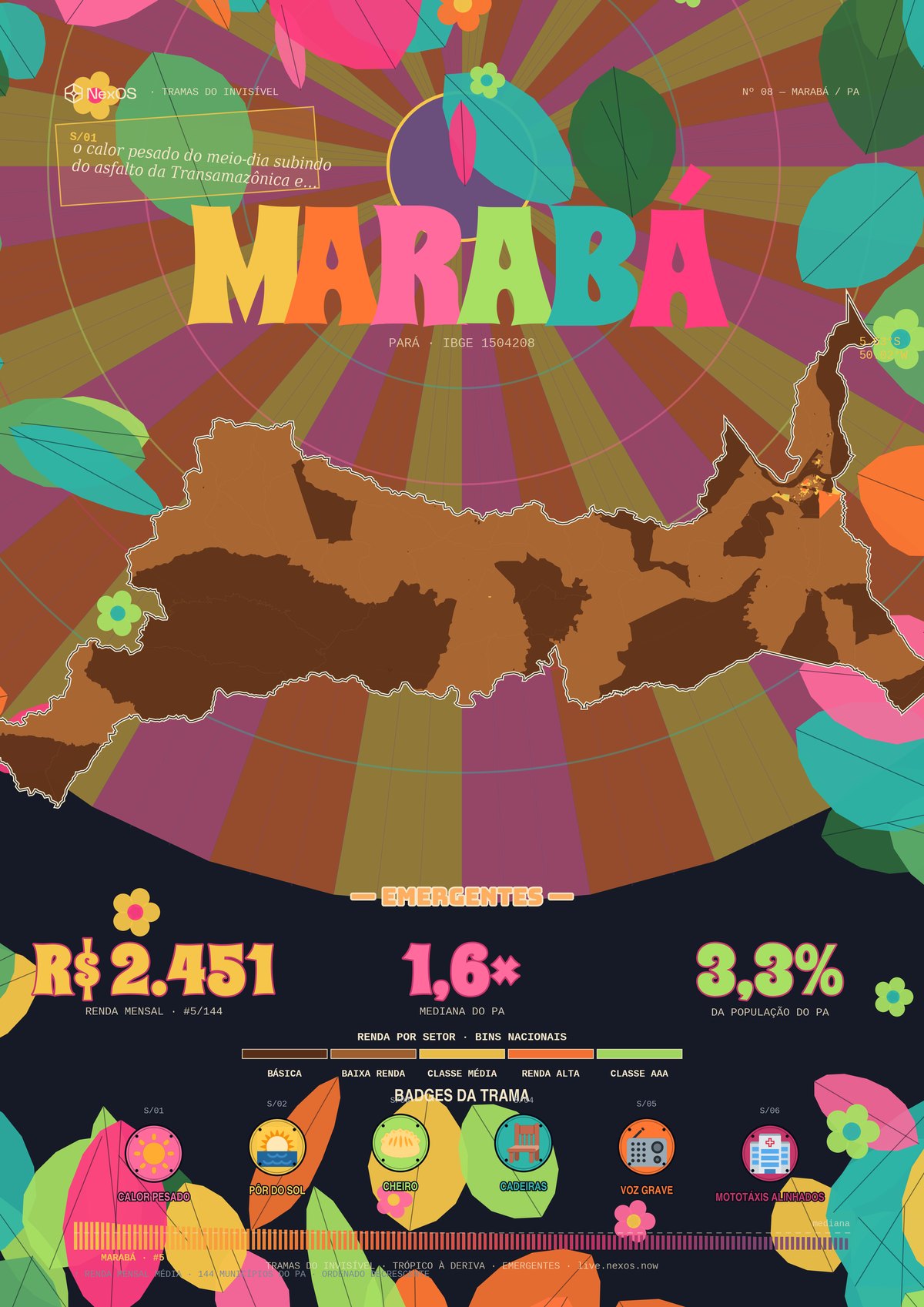
Create your city's poster, for free, at live.nexos.now/poster.


A full media hub, led by Rádio Correio
The media profile NexOS assigns Marabá is Full Media Hub (TV+Radio+Digital). Rádio Correio 92.1 FM leads, 12,769 monthly streaming listeners, ahead of Rádio FM 91 (10,410).
Online, correiodecarajas.com.br holds the largest local traffic, 318,325 monthly pageviews, but none of the 6 mapped local sites are plugged into programmatic media, all selling only through direct sales.
Classifieds and utilities lead the city’s digital consumption. Social and portals come next, with Pinterest and Glance ahead, and video and TV driven by the Kwai app.

How Marabá wants to be talked about
The city describes itself as a crossroads, a board of trade and services that lives off people passing through by river and road, with mining and agribusiness treated as a distant backdrop. But behind that crossroads self-image, it’s industry that sustains more than half the city’s value added, and it’s industry, not street commerce, that pulls in formal financing. Cattle ranching, despite being physically immense, barely shows up in that credit. The city is, at the same time, crossroads and factory, and the second one dominates the ledger far more than the city itself tends to admit.
Explore Marabá’s X-ray on NexOS · City hall: maraba.pa.gov.br · IBGE profile: cidades.ibge.gov.br/brasil/pa/maraba. See also the family archetypes piece and the 4-layer method.
This piece is part of the Tramas series, territorial intelligence as a method. Data cross-referenced by NexOS: IBGE (GDP, Census, agricultural and livestock production), BNDES (indirect operations by subsector), Banco Central (Pix, ESTBAN: credit and real estate financing), CadÚnico/Bolsa Família, DETRAN (vehicle fleet), ANATEL and curated local media inventory. Symbolic profile, invisible networks and classification: Tramas do Invisível methodology.

Americana, Brazil: nostalgic for the old street, but with fewer multigenerational households than the national average
Americana's Trama profile talks about surnames that repeat across neighborhoods and neighbors who know each other by sight, but NexOS's family archetype data shows only 12.09% of households are multigenerational.

São Carlos, Brazil: behind the tech-hub label, industry pulls 46.7% of BNDES financing, well ahead of trade and services
R$273.7 million in BNDES financing (910 operations) makes industry, led by machinery, the biggest borrower of development credit in a city that sells itself as a university hub.