

Maricá, Brazil: the country's 2nd-highest GDP per capita doesn't reach the pockets of people who live there
Oil extracted off the coast puts Maricá in 2nd place nationally in GDP per capita, trailing only neighboring Saquarema. In the pockets of residents, though, the picture is much smaller: credit per resident sits at a third of the national average, and more money leaves the city via Pix than comes in, month after month.


Maricá has the 2nd-highest GDP per capita in Brazil among larger cities: R$680,000 per resident in 2023, trailing only neighboring Saquarema (R$723,000). The number is real, but it’s born almost entirely from oil extracted off the coast: extractive industry accounts for 77.1% of the city’s value added, and public administration is just 2.13%, which already rules out the idea that royalties turn into a bloated city hall. The problem is that money doesn’t seem to turn into full pockets either: credit per resident is R$5,045, less than a third of the national average.
The most direct signal of that is in Pix: Maricá pays out more than it receives every single month, without a single exception across the 30 months of data NexOS tracks. The monthly deficit more than doubled, from R$55.4 million in January 2024 to R$114.6 million in June 2026.
Wealth
Where the economy actually breathes
Maricá’s GDP shows an extreme composition: extractive industry pulls 77.1% of value added, services sit at 20.7%, public administration at just 2.13%, and agriculture doesn’t pass 0.02%. There’s no support here for a “city hall grown rich on royalties” thesis: the public sector itself barely shows up in the accounts.
Even development lending confirms the oil money doesn’t flow through conventional channels: BNDES loans name commerce and services as the top destination (R$20.1 million), 64 times more than what went to the extractive sector (R$315 thousand). Oil wealth arrives as direct royalty revenue, not as productive credit spread across the city.
Money leaving faster than it comes in
In the vehicle fleet, Maricá has 59,549 cars against 22,717 motorcycles, 2.6 cars for every motorcycle, a clear dominance of cars over motorcycles. Total bank credit went from R$742.4 million to R$831.9 million in two years, up just 12%. Real-estate financing grew much faster, from R$243.3 million to R$331.6 million, up 36%, already accounting for 40% of all credit in the city. Savings deposits grew even faster, up 40.5% over the same period: a sign of money being parked, not necessarily invested.
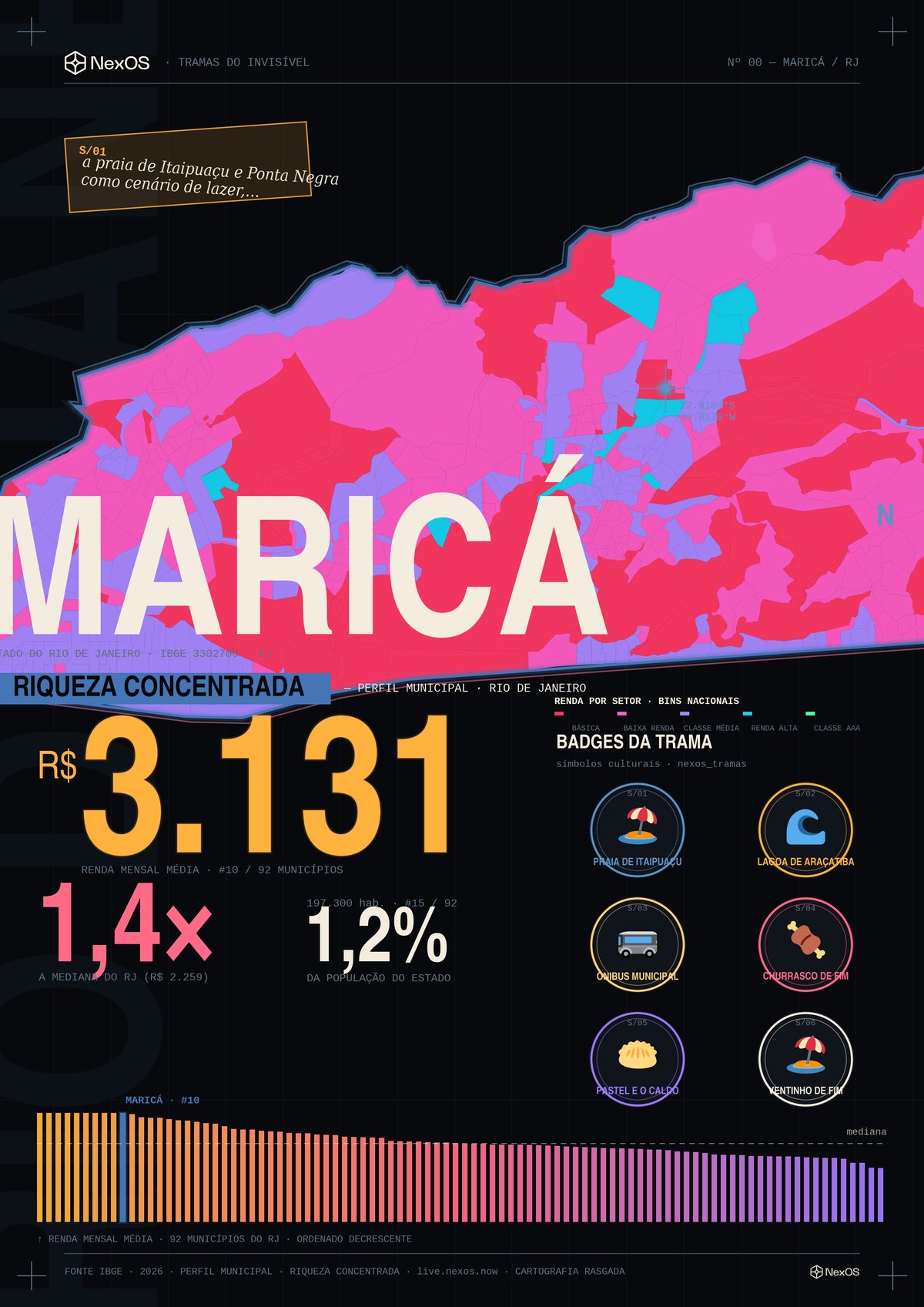
Create your city's poster, free, at live.nexos.now/poster.

Who lives in the city that's richest on paper
Maricá’s family archetypes pull the opposite direction from what GDP suggests. Married couples with young children are 17.5% of households, 11% below the national average; adult couples without children are 11.06%, 14% above average; and elderly couples and elderly people living alone combined add up to 7.59% of households, 11% above the national average.
The profile NexOS assigns the city is Concentrated Wealth, with average household-head income of R$3,131 (the 10th-highest among Rio de Janeiro state’s 92 municipalities) and, even so, 21.9% of families receiving Bolsa Família welfare, above the national average. Concentrated wealth and social vulnerability sit side by side.
Where land became a fight
The Trama profile records rising land values in areas like Itaipuaçu, Inoã and Ponta Negra drawing door-to-door real-estate agents and “for sale” signs on every post. Longtime residents sell lots to settle debts, and those lots turn into gated developments or vacation homes, pushing lower-income families toward more distant areas with less infrastructure. That sits alongside a lot of housing that stays shuttered outside the summer season: the sense of a city that feels half-empty at times, yet expensive for people who are actually from there. At night, bars with live music and car-stereo walls compete for space with people who need to wake up early, especially in mixed zones where the bar is downstairs and the bedroom is upstairs.

Radio nearly silent, digital a giant
Maricá has only one real commercial radio station, Rádio Ultra 88.1 FM, with 661 monthly listens. Digital flips the picture: maricainfo.com has 1.76 million monthly pageviews. Of the 10 local sites mapped, only it is plugged into programmatic buying; the other 9, including leisecamarica.com.br (164.2k pageviews), sell only through direct deals.

Connected territory, creative capacity still limited
Maricá’s connectivity infrastructure is nearly complete: 99.6% urban and 93.5% rural, classified by ANATEL as a “100% connected territory (countryside + city).” Even so, creative capacity remains at “low capacity” (audio, text and light images), not heavy video.
Coolita (free TV) has the highest consumption intensity, closely followed by Pinterest. In classifieds, Bom Negócio and OLX appear side by side, a sign of a direct-selling economy between neighbors. NetVasco, a Vasco da Gama fan site, also shows real strength, echoing the home team of people crossing the RJ-106 highway toward Rio. Domain by domain, by access intensity per user:
How Maricá wants to be spoken to
Whoever speaks to Maricá speaks to someone measuring time on two scales: the road’s rigid schedule, for people who work in Niterói or Rio and come home tired; and the tide’s looser rhythm, for those who stay and build life between the beach, the lagoon and neighborhood shops. It’s a city where a patron saint’s feast, an evangelical service and an offering to Iemanjá share the same shoreline, where a real-estate agent knocks door to door and a WhatsApp group stands in for the police patrol.
In the end, Maricá proves that a record GDP per capita can mean almost nothing for the people living inside it: the platform on the horizon sustains an impressive national account, but credit, radio and the paychecks of the people who stay onshore tell a much more modest story.
Explore the X-ray of Maricá on NexOS · City hall: marica.rj.gov.br · IBGE profile: cidades.ibge.gov.br/brasil/rj/marica. See also Linhares and the 4-layer method.
This piece is part of the Tramas series, territorial intelligence as method. Data cross-referenced by NexOS: IBGE (GDP, 2022 Census), BNDES (indirect operations by subsector), Central Bank (Pix, ESTBAN: credit, real-estate financing and savings), CadÚnico/Bolsa Família, DETRAN (vehicle fleet), ANATEL and curated local media inventory. Symbolic profile, invisible networks and classification: Tramas do Invisível methodology.

Americana, Brazil: nostalgic for the old street, but with fewer multigenerational households than the national average
Americana's Trama profile talks about surnames that repeat across neighborhoods and neighbors who know each other by sight, but NexOS's family archetype data shows only 12.09% of households are multigenerational.

São Carlos, Brazil: behind the tech-hub label, industry pulls 46.7% of BNDES financing, well ahead of trade and services
R$273.7 million in BNDES financing (910 operations) makes industry, led by machinery, the biggest borrower of development credit in a city that sells itself as a university hub.