

Salgueiro, Brazil: the vaquejada city raises 2.3 goats for every head of cattle
Goat and sheep herds (94,000 head) have outnumbered cattle for at least three years, while BNDES financing for the farming sector never exceeds 0.3% of the city's total.


Salgueiro identifies with cattle: the city’s own Trama profile calls it “Crossroads of the Sertão,” where vaquejada (cattle-roping culture) and an economy “tied to cattle and goats” define the local identity. But the real herd tells a different story: 2.3 goats for every head of cattle, 48,973 goats against 21,148 cattle in 2024.
The herd the vaquejada doesn't advertise
The herd composition isn’t a one-year fluke: goats have outnumbered cattle since at least 2022. In 2022, 53,919 goats against 16,913 cattle; in 2023, 54,542 against 19,735; in 2024, 48,973 against 21,148. The ratio shifts, but the goat has never lost the lead.
In GDP, this entire livestock sector, cattle, goats and sheep combined, accounts for just 1.83% of value added (R$15.85 million of R$865.7 million), behind services (56.85%) and public administration (33.0%), and even behind industry (8.33%). Formal credit follows the same path: of the R$75.1 million BNDES disbursed in Salgueiro, farming got just 0.3%, R$228,200 across 2 operations. Trade and services lead financing (R$33.9 million, 45.2%), followed by industry (R$31.0 million, 41.3%, driven by a single R$29.9 million loan for transport equipment).
In the local fleet, motorcycles total 18,773 units, nearly double the 10,328 cars, with the Honda CG 125 (3,614 units) as the city’s most common model.
Who lives at the sertão crossroads
In NexOS’s family archetype data, Salgueiro has fewer 25-39 year-olds than the national average, 5.84% of households against 7.14%, and more multigenerational households, 17.7% against 15.04%. The average monthly household head income is R$1,783, classified as “medium purchasing power.”
Bank credit grew 30.0% between January 2024 and December 2025, from R$428.0 million to R$556.5 million, and real estate financing grew even faster, 61.6% over the same period, from R$110.2 million to R$178.0 million, now 32.0% of all the city’s credit.
Pix received by the city (individuals + businesses) grew 68.4% between January 2024 and June 2026, from R$240.3 million to R$404.6 million a month, peaking at R$425.8 million in December 2025.
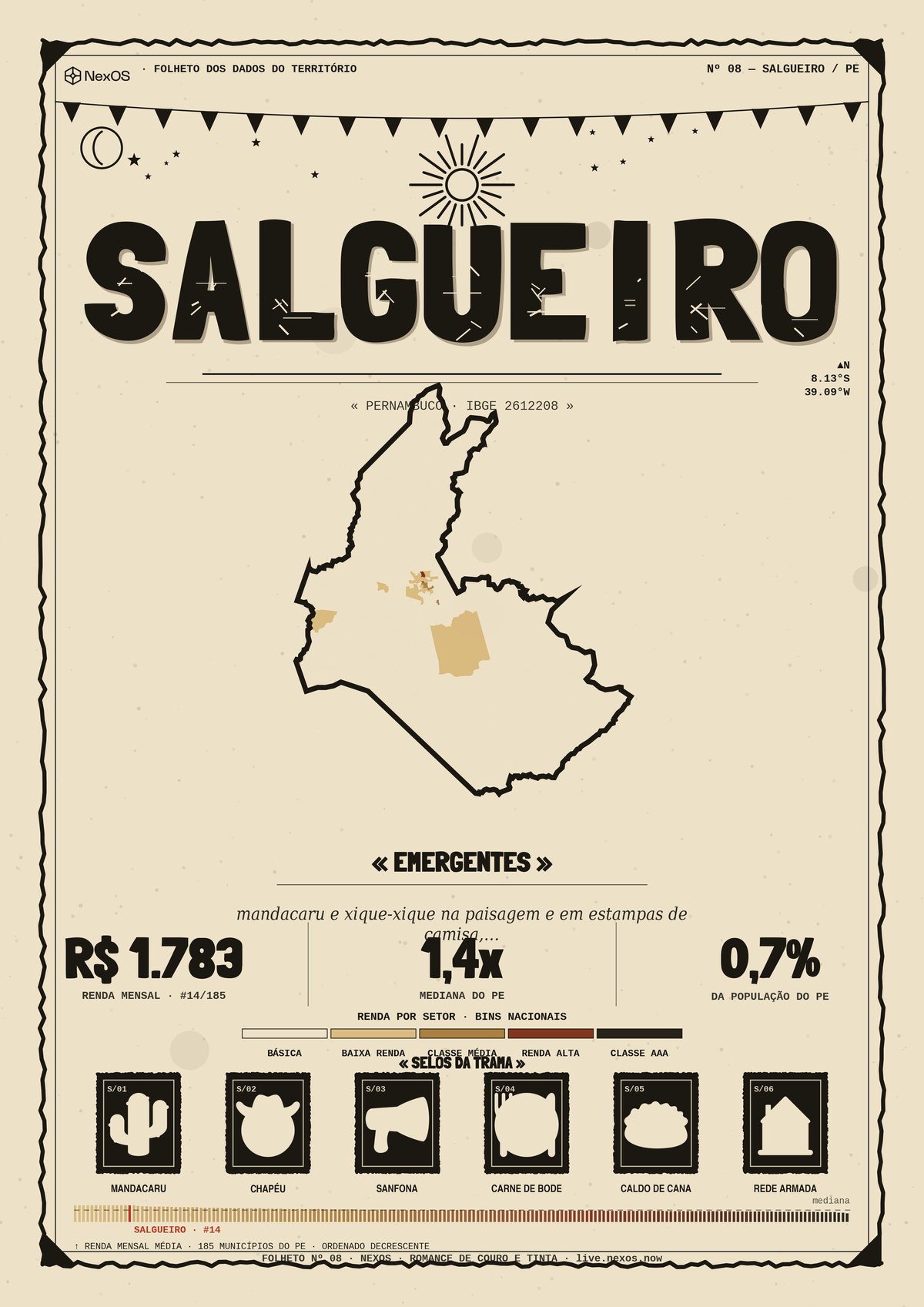
Create your city's poster, for free, at live.nexos.now/poster.


A local media oasis, led by Rádio Salgueiro
The media profile NexOS assigns Salgueiro is Local Oasis (Radio+Sites), different from the “full hub” profile of larger cities. Rádio Salgueiro 102.9 FM leads, 8,301 monthly streaming listeners, ahead of Rádio Executiva 97.1 FM (6,329) and Rádio Asa Branca 91.5 FM (6,281).
Online, only 2 local sites were mapped, blogdosilvalima.com.br (72,379 monthly pageviews) and alvinhopatriota.com.br (9,955), and neither is plugged into programmatic media: both sell only through direct sales.
Classifieds and utilities lead the city’s digital consumption. Video and TV come next, driven by the Kwai app, ahead of Pinterest, which leads social and portals.

How Salgueiro wants to be talked about
Vaquejada remains the symbolic heart of the city: the bull at the center of the arena, the cowboy on horseback, the “cattle land” reputation spread across the sertão. But the herd that actually grazes in Salgueiro is goat and sheep, more numerous and better suited to drought, and formal credit doesn’t look at that herd at all: 99.7% of BNDES financing goes to other sectors. The city keeps the bull as a symbol and raises the goat for a living.
Explore Salgueiro’s X-ray on NexOS · City hall: salgueiro.pe.gov.br · IBGE profile: cidades.ibge.gov.br/brasil/pe/salgueiro. See also the family archetypes piece and the 4-layer method.
This piece is part of the Tramas series, territorial intelligence as a method. Data cross-referenced by NexOS: IBGE (GDP, Census, agricultural and livestock production), BNDES (indirect operations by subsector), Banco Central (Pix, ESTBAN: credit and real estate financing), CadÚnico/Bolsa Família, DETRAN (vehicle fleet), ANATEL and curated local media inventory. Symbolic profile, invisible networks and classification: Tramas do Invisível methodology.

Americana, Brazil: nostalgic for the old street, but with fewer multigenerational households than the national average
Americana's Trama profile talks about surnames that repeat across neighborhoods and neighbors who know each other by sight, but NexOS's family archetype data shows only 12.09% of households are multigenerational.

São Carlos, Brazil: behind the tech-hub label, industry pulls 46.7% of BNDES financing, well ahead of trade and services
R$273.7 million in BNDES financing (910 operations) makes industry, led by machinery, the biggest borrower of development credit in a city that sells itself as a university hub.