

Santa Maria, Brazil: barracks and university move more of GDP (17.6%) than all of the city's industry (13%)
With income among the 20 highest in Rio Grande do Sul (497 municipalities) and fewer married-couples-with-young-children households than the national average, Santa Maria functions less like an industrial hub and more like a regional capital of public service.


Santa Maria describes itself through its university, its military barracks, and the wind that crosses its rail junction: the city’s own Trama profile calls it “Crossroads of the Rails and the Winds.” In GDP, though, what leads isn’t a factory: public administration, defense, public health and public education add up to 17.6% of value added, ahead of all of the city’s industry, 13%.
Wealth
The payroll that leads the factory
Santa Maria’s value added comes to R$8.47 billion, within a GDP of R$10.93 billion. Services lead (64.84%), but public administration, defense, public health and public education come in second (17.58%), ahead of industry (12.96%) and well above farming (4.62%).
BNDES disbursements to local companies total R$1.06 billion, and infrastructure leads by a wide margin (48.3%, R$509.8 million), driven mostly by road transport (R$424 million across 1,556 operations). Trade and services (24.0%, R$253.6 million) and industry (22.0%, R$231.6 million) follow, and farming holds the smallest share (5.7%, R$60.4 million).
In the local fleet, cars lead with 115,946 units, and the single most common model in the whole city is the Volkswagen Gol (7,879 units). The military presence even shows up on the radio dial: Rádio Verde Oliva 90.5 FM is run by Brazil’s own Ministry of Defense, with 3,404 monthly streaming listeners.
Who lives at the crossroads
The average monthly household head income, R$4,189, ranks among the 20 highest in Rio Grande do Sul, out of 497 municipalities. In NexOS’s family archetype data, though, Santa Maria sits slightly below the national pattern: married couples with young children make up 17.38% of households (national average, 19.74%), and multigenerational households add up to 14.55% (national average, 15.04%). The Bolsa Família welfare rate is 15.74% of families, and 51.58% of households are female-headed.
Bank credit grew faster than real estate financing, a different pattern than usually seen: the total credit balance rose 23.3% between January 2024 and December 2025, from R$6,792.5 million to R$8,376.1 million, while real estate financing grew 17.7% over the same period, from R$1,699.0 million to R$2,000.3 million. As a result, real estate’s share of total credit fell from 25.0% to 23.9%.
Pix received by the city (individuals + businesses) grew 69.1% between January 2024 and June 2026, from R$1,647.0 million to R$2,785.0 million a month, peaking at R$2,884.8 million in December 2025.
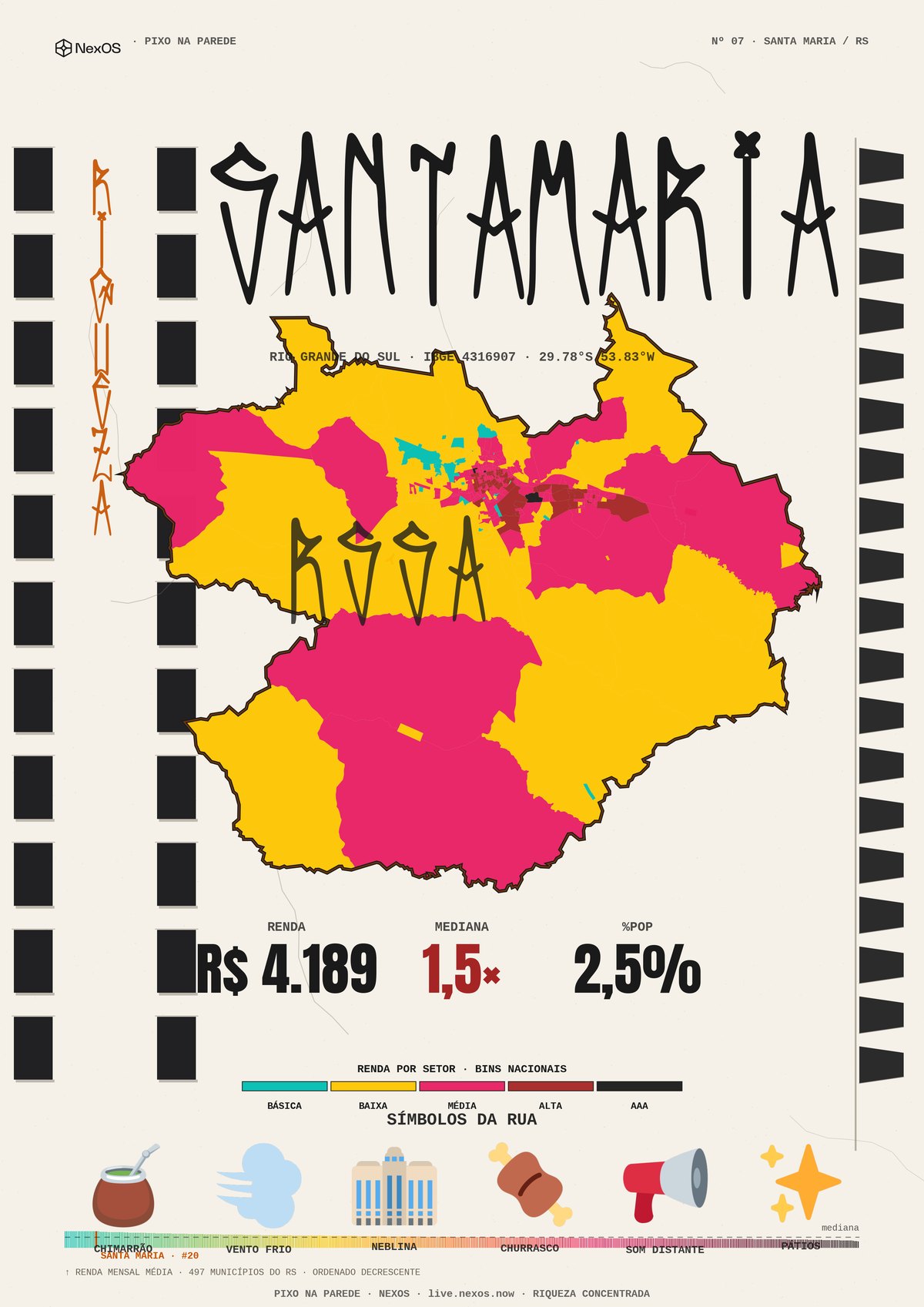
Create your city's poster, for free, at live.nexos.now/poster.


A full media hub, led by Nativa
The media profile NexOS assigns Santa Maria is Full Media Hub (TV+Radio+Digital). Rádio Nativa 99.5 FM leads by a wide margin, 77,236 monthly streaming listeners, nearly triple the runner-up, Rádio Imembuí 101.9 FM (28,585).
Online, diariosm.com.br holds the largest local traffic, 726,571 monthly pageviews, and is already plugged into programmatic media (3,703,648 monthly impressions, 5.1 ads per pageview). That’s an unusual pattern: two other local sites, bei.net.br and santamaria24horas.com.br, are also plugged in, for a total of 3 of the 7 mapped sites connected to programmatic media.
Classifieds and utilities lead the city’s digital consumption. News and media come next, driven by Globo, ahead of Pinterest, which leads social and portals.

How Santa Maria wants to be talked about
The city presents itself through its university, its barracks and the wind that crosses its rail junction, an identity of passage and public service. That’s a real image: the paycheck from a barracks, a university hospital and a classroom moves more money in GDP than all its factories combined. Industry exists, but it isn’t what sustains the city’s economy; it’s the state, in its various forms, that keeps leading any production line.
Explore Santa Maria’s X-ray on NexOS · City hall: santamaria.rs.gov.br · IBGE profile: cidades.ibge.gov.br/brasil/rs/santa-maria. See also the family archetypes piece and the 4-layer method.
This piece is part of the Tramas series, territorial intelligence as a method. Data cross-referenced by NexOS: IBGE (GDP, Census, agricultural and livestock production), BNDES (indirect operations by subsector), Banco Central (Pix, ESTBAN: credit and real estate financing), CadÚnico/Bolsa Família, DETRAN (vehicle fleet), ANATEL and curated local media inventory. Symbolic profile, invisible networks and classification: Tramas do Invisível methodology.

Americana, Brazil: nostalgic for the old street, but with fewer multigenerational households than the national average
Americana's Trama profile talks about surnames that repeat across neighborhoods and neighbors who know each other by sight, but NexOS's family archetype data shows only 12.09% of households are multigenerational.

São Carlos, Brazil: behind the tech-hub label, industry pulls 46.7% of BNDES financing, well ahead of trade and services
R$273.7 million in BNDES financing (910 operations) makes industry, led by machinery, the biggest borrower of development credit in a city that sells itself as a university hub.