

Santana, Brazil: average income of R$2,149 a month, in an economy 53% dependent on government
Public administration accounts for 53% of the city's value added, but that doesn't translate into prosperity: 64.25% of families receive Bolsa Família welfare, and multigenerational households (23.02%) are far more common than the national average, a sign of people sharing a roof to make the math work.


Public administration accounts for 53% of Santana’s value added, more than half the city’s entire economy. Even so, the average household head income doesn’t exceed R$2,149 a month, and 64.25% of families, nearly 2 in 3, receive Bolsa Família welfare.
The city’s Trama profile calls it “Door of the River-Sea”: an entry and exit point between the islands, inland Amapá and the rest of the country, resting against a river so wide it looks like the sea. It’s a door that moves cargo, people and public money, but it doesn’t always open into the pocket of whoever lives on the inside.
A government economy
The city’s total value added comes to R$2.31 billion, within a GDP of R$3.73 billion. Public administration leads by a wide margin (53.0%), ahead of services (36.7%), industry (9.4%) and farming, a minimal share (0.8%).
The city’s own Trama profile describes the local economy’s tripod: the port and cargo activity, popular retail commerce, and health and education services, with clinics in the Hospitalidade neighborhood and colleges like Estácio and Madre Tereza drawing people from outside. But BNDES disbursements to local companies show a discreet port in the credit data: road transport leads with R$44.2 million (117 operations), followed by auxiliary transport activities, R$30.6 million, the category closest to actual port operations. Trade and services comes third, R$29.5 million. Added together, the three stay under R$105 million: small next to the size of the payroll that sustains more than half the city’s economy.
Who holds the math together
In NexOS’s family archetype data, Santana strays from the national pattern in a way that helps explain how the city holds together despite low income. Multigenerational households are 23.02% of the total, well above the national average of 15.04%. Older-adult households, couples and people living alone, add up to just 1.75%, far below the 6.82% average.
The city’s own Trama profile describes this arrangement in detail: grandmothers taking in grandchildren while parents work, neighbors lending medicine or helping with transport to a doctor’s appointment, motorcycle-taxi drivers and corner-shop owners who know who’s out of work or sick. It’s a care network doing the job that income alone wouldn’t, which helps explain why nearly 2 in 3 families still depend on Bolsa Família even with a R$3.73 billion economy running around them.
Pix received by the city (individuals + businesses) grew 82.0% between January 2024 and June 2026, from R$490 million to R$892 million a month, peaking at R$979.7 million in December 2025.
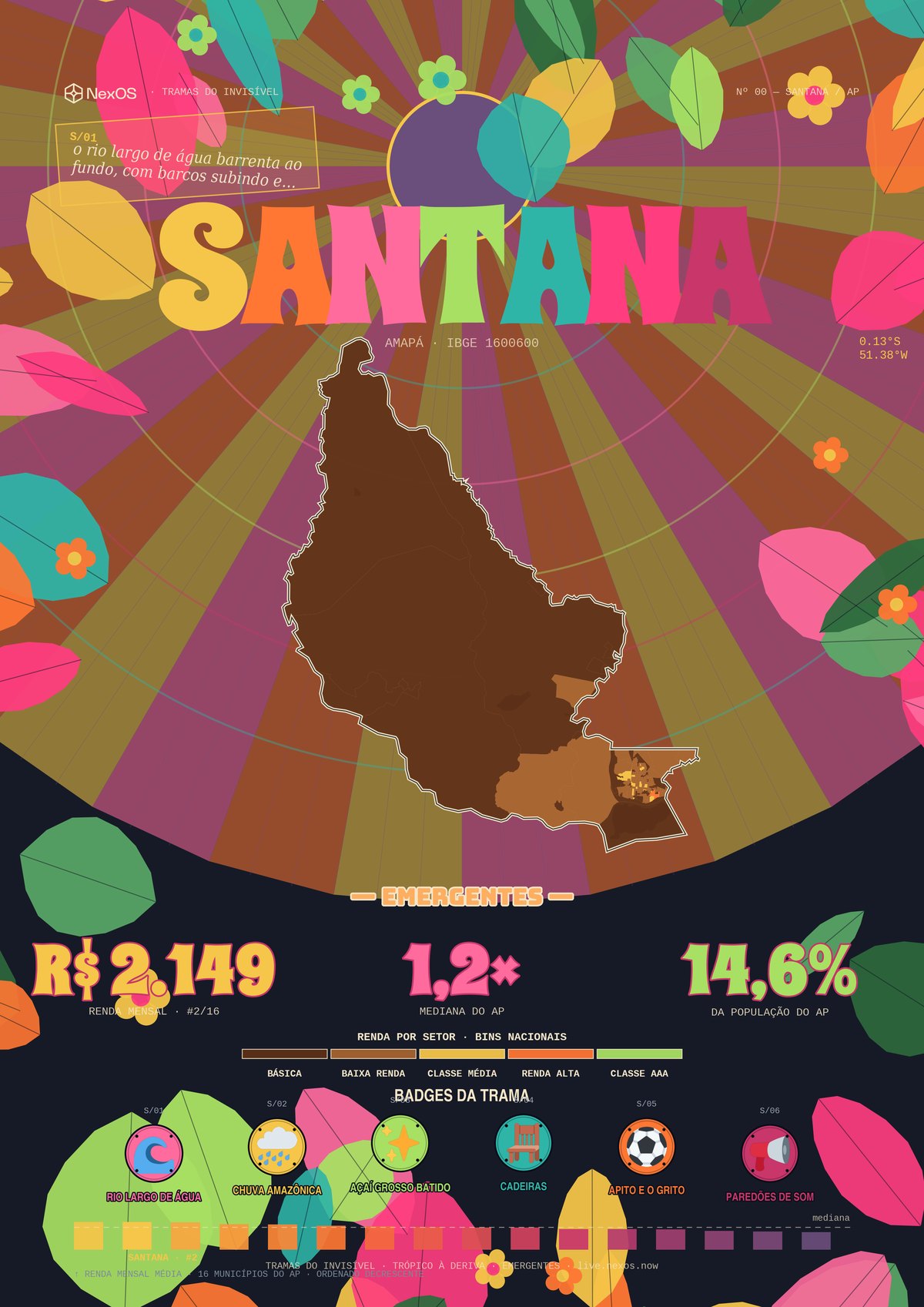
Create your city's poster, for free, at live.nexos.now/poster.


Five radio stations, two sites with no visits at all
The media profile NexOS assigns Santana is Local Oasis (Radio+Sites). Rádio Onda Livre 105.9 FM leads with 1,187 monthly streaming listeners, followed by Rádio Tarumã 104.3 FM (1,142) and Rádio Ação 92.3 FM (983).
Online, the two local sites mapped, santanadoamapa.blogspot.com and correiodesantana.com.br, register zero monthly pageviews in NexOS’s inventory: both unplugged, with no programmatic sales. The city’s own Trama profile describes both as neighborhood references, checked on the phone whenever news travels by word of mouth first, but the measured audience data doesn’t back that up.
Pinterest dominates social and portals, and Kwai leads short video. An offline Bible app ranks among the strongest in faith and leisure, echoing what the city’s own Trama profile records about midweek services packing narrow streets with cars and motorcycles.

How Santana wants to be talked about
The door that gives this city’s Trama its name opens onto two unequal sides: on one, cargo, public funds and transport credit crossing the river; on the other, grandmothers holding grandchildren, neighbors lending medicine, motorcycle-taxi drivers passing along news before the radio does. The city has more than half of its own economy propped up by the state, and nearly 2 in 3 families still turn to Bolsa Família to make the month work. Neither fact resolves the other; they just coexist, however they can.
Explore Santana’s X-ray on NexOS · City hall: santana.ap.gov.br · IBGE profile: cidades.ibge.gov.br/brasil/ap/santana. See also the family archetypes piece and the 4-layer method.
This piece is part of the Tramas series, territorial intelligence as a method. Data cross-referenced by NexOS: IBGE (GDP, Census, agricultural production), BNDES (indirect operations by subsector), Banco Central (Pix, ESTBAN: credit and real estate financing), CadÚnico/Bolsa Família, DETRAN (vehicle fleet), ANATEL and curated local media inventory. Symbolic profile, invisible networks and classification: Tramas do Invisível methodology.

Americana, Brazil: nostalgic for the old street, but with fewer multigenerational households than the national average
Americana's Trama profile talks about surnames that repeat across neighborhoods and neighbors who know each other by sight, but NexOS's family archetype data shows only 12.09% of households are multigenerational.

São Carlos, Brazil: behind the tech-hub label, industry pulls 46.7% of BNDES financing, well ahead of trade and services
R$273.7 million in BNDES financing (910 operations) makes industry, led by machinery, the biggest borrower of development credit in a city that sells itself as a university hub.