

Palmeira dos Índios, Brazil: the city that cares for the region's health, but 6 in 10 families live on welfare
Of the 14,000 families that receive the benefit, 82% are in extreme poverty, not moderate poverty. The average household head income doesn't exceed R$1,606 a month.


What doesn’t show in Palmeira dos Índios is bigger than what does. The city genuinely functions as a regional health and education hub for Alagoas’s Agreste region: clinics, labs, in-person colleges and distance-learning programs draw people from neighboring towns every day. But behind that hub-city facade, 60.8% of families here receive Bolsa Família welfare, and 82% of those families live in extreme poverty, not moderate poverty.
The city’s own Trama profile calls it “Porch of the Agreste”: a place where people are always leaning against the doorway, watching the street go by. It’s a fitting image, but what that porch hides is more than scenery.
The Trama profile itself describes community life in two very different layers. Downtown, the rhythm is that of a hub city: people constantly coming and going, the same faces repeating in bank lines, clinic waiting rooms and shops, many of them from out of town. In the neighborhoods, the sense of community is different: everyone knows whose kid is whose, who just arrived, who landed a city-hall job or got into college. Two different Palmeiras share the same address.
Stability
Services and the state, not farming
The farming the Trama profile describes in the countryside (cassava, sweet potato, beans, corn) is real, but small: the city’s entire crop production added up to R$16 million in 2024, a tiny fraction of GDP. It’s subsistence farming, not an economic engine. What sustains the city is the pairing of services (44.3%) and public administration (31.2%): together, three-quarters of value added, and it’s precisely there, in the “health and education services” line, that the regional hub lives.
Who's invisible in that hub
NexOS’s family archetype data shows a city under strain. Single-parent households make up 8.76% of homes, above the national average of 6.75%; multigenerational households, an arrangement that tends to grow when sharing a home is necessity rather than choice, add up to 17.68%, also above the 15.04% average.
And of the 13,926 families that receive Bolsa Família today, 11,475 are in extreme poverty: it’s not the majority of recipients in an intermediate situation, it’s the majority in a more severe one. NexOS classifies the city’s average purchasing power as medium, but that average hides a deeply unequal split between those who live off the health hub and those who live off the benefit.
The Trama profile itself describes how that income actually gets pieced together for much of the city: it isn’t a fixed salary, it’s income broken into fragments. A public-sector paycheck here, a day of bricklaying there, a motorcycle-taxi fare, a tab run up at the corner store. It’s an economy that exists, it just never shows up whole on any payroll.

The data of absence: little investment, little credit
The city’s total bank credit stayed essentially flat over two years: R$499 million in January 2024, R$505 million in December 2025, a change of little more than 1%.
BNDES disbursements to local companies are equally small: R$6.8 million for trade and services, R$3.8 million for road transport: figures that, compared to the hundreds of millions agribusiness cities receive, point to a poorly financed economy. In the local fleet, the motorcycle is the vehicle most people are left with: 17,792 motorcycles against 11,129 cars. The five most common models on the street are all Honda motorcycles (CG 150, CG 125, Pop, CG 160, Biz); the Volkswagen Gol, Brazil’s most popular car, only ranks 6th.

The visible wealth in contrast: the hub that serves outsiders
The city’s own Trama profile describes the other side of town: clinics and labs like Análise Saúde and Ceproal keep steady lines of people clutching referral slips; dental and specialty practices serve both Palmeira and neighboring municipalities; in-person colleges and distance-learning programs (Cruzeiro do Sul Virtual, UniCesumar, Cesmac do Sertão) bring in a steady stream of outside students who keep snack bars, stationery shops and small boarding houses busy. It’s a real hub. It just isn’t a hub that redistributes the wealth it attracts.
Pix receipts in the city grew 25.6% in 2025 over 2024, from R$2.90 billion to R$3.64 billion: the money moves, even with bank credit standing still.
Seven radio stations, a small digital footprint
The media profile NexOS assigns Palmeira dos Índios is Full Media Hub (TV+Radio+Digital), with a surprisingly crowded dial: seven radio stations compete for audience. Rádio Sampaio 94.5 FM leads by a wide margin (17,729 listeners/month), followed by Rádio Palmeira FM 104.1 (7,207).
In digital, though, the market is small: only five domains clear the intensity floor NexOS curates, led by Pinterest.

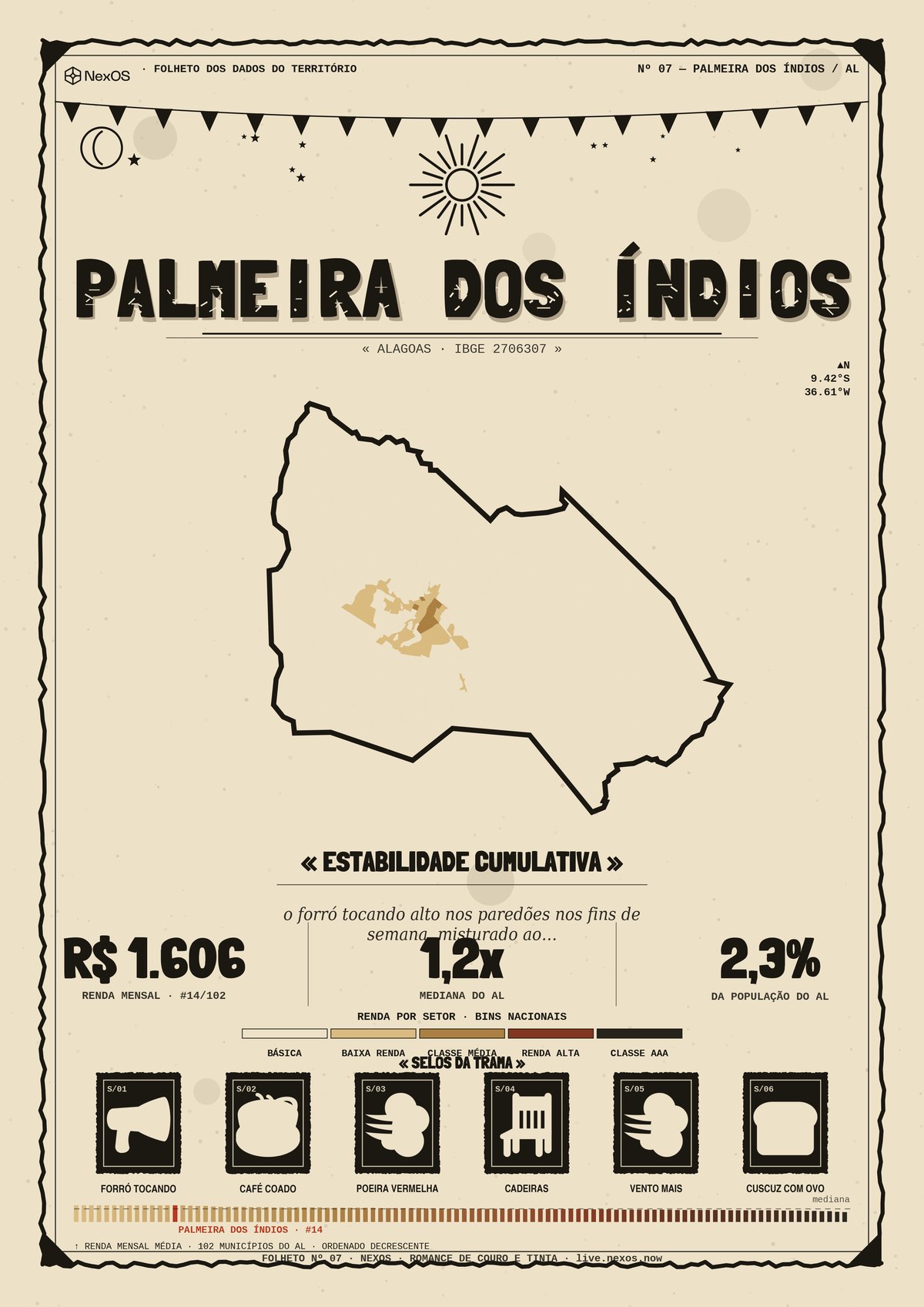
Create your city's poster, for free, at live.nexos.now/poster.
How Palmeira dos Índios wants to be talked about
The porch that gives this city’s Trama its name is a good place to watch the world go by: people arriving from elsewhere for a checkup, for college, to get life sorted out. But whoever lives on that porch, more often than not, isn’t the one being served, they’re the one watching. The health hub is real. The extreme poverty is too. Neither cancels the other out, and no single number in this city resolves that tension on its own.
Explore Palmeira dos Índios’s X-ray on NexOS · City hall: palmeiradosindios.al.gov.br · IBGE profile: cidades.ibge.gov.br/brasil/al/palmeira-dos-indios. See also Sorriso and the 4-layer method.
This piece is part of the Tramas series, territorial intelligence as a method. Data cross-referenced by NexOS: IBGE (GDP, Census, agricultural production), BNDES (indirect operations by subsector), Banco Central (Pix, ESTBAN: credit and real estate financing), CadÚnico/Bolsa Família, DETRAN (vehicle fleet), ANATEL and curated local media inventory. Symbolic profile, invisible networks and classification: Tramas do Invisível methodology.

Americana, Brazil: nostalgic for the old street, but with fewer multigenerational households than the national average
Americana's Trama profile talks about surnames that repeat across neighborhoods and neighbors who know each other by sight, but NexOS's family archetype data shows only 12.09% of households are multigenerational.

São Carlos, Brazil: behind the tech-hub label, industry pulls 46.7% of BNDES financing, well ahead of trade and services
R$273.7 million in BNDES financing (910 operations) makes industry, led by machinery, the biggest borrower of development credit in a city that sells itself as a university hub.