

Sorriso, Brazil: the same harvest every year, but wealth rises and falls with a price set elsewhere
In two years of billions in soybeans produced, the city's bank credit grew only 6%. The biggest BNDES investments went to road transport, not agriculture: the money finances the truck that hauls the grain out, not the people who stay.


Sorriso harvested nearly the same amount of soybeans in 2022, 2023 and 2024: 2.12, 2.24 and 2.08 million tonnes, a variation of under 10%. The value of that harvest, though, collapsed: R$5.81 billion, R$5.01 billion, R$3.33 billion, a 43% drop in two years. The city didn’t get poorer by producing less. It got poorer because the price of the grain fell abroad.
The city’s own Trama profile calls it the “Crossroads of the Harvests”: a point of passage between the asphalt and the red dirt of the plantations, where trucks cross, people arrive from every corner of the country, and a commodity price nobody in Sorriso controls gets decided.
The economy soybeans actually move
Soybeans are real, not a facade: agriculture accounts for 38% of the city’s value added, almost as much as services (40.9%). But the frontier of that money is volatile. The price Sorriso received per tonne of soybeans fell from R$2,742 (2022) to R$1,598 (2024), a 42% drop, closely tracking the fall in the national average soybean price over the same period (from R$2,863 to R$1,801 per tonne): not a problem isolated to this city, it’s the whole market.
That same price volatility cost the city its spot as Brazil’s top soybean economy: national champion by value in 2022 and 2023, Sorriso fell to 3rd place in 2024, overtaken by São Desidério and Formosa do Rio Preto, both in Bahia. The drop wasn’t about volume: Sorriso harvested 2.08 million tonnes in 2024, more than Formosa do Rio Preto (1.96 million) and virtually tied with São Desidério (2.09 million, just 0.4% more). What decided the ranking was price per tonne: Sorriso received R$1,598, against R$1,858 for Formosa (16% more) and R$1,776 for São Desidério (11% more) — a price gap that, on its own, explains nearly the entire value gap between the three cities that year.
What passes through the city, and what doesn't stay
In the local fleet, motorcycles are the majority: 39,307 motorcycles against 33,033 cars, more bikes than cars on the street. Pickup trucks, agribusiness’s work vehicle, are the third-largest category, with 16,236 units — Fiat Strada, Toyota Hilux and Chevrolet S10 lead that group. Among cars, the Volkswagen Gol is the most common model, but the Toyota Corolla, a higher-end sedan, ranks 2nd.
While the soybean price was deciding whether 2024 would be a good year or a bad one, the city’s bank credit barely moved: it grew from R$6.80 billion (January 2024) to R$7.21 billion (December 2025), a rise of only 6% across two years of billions in grain harvested. Real estate financing adds up to only 5.6% to 5.8% of total credit, a small share, a sign that the credit that does exist isn’t going into construction or fixed assets.
BNDES disbursements to local companies point to where the development-bank money actually goes: R$244.7 million to road transport, against R$56.6 million to agriculture. The financing follows the truck that hauls the grain out of the city, not the field that produces it.
Pix receipts in the city grew 125% since January 2024, from R$1.58 billion to R$3.55 billion per month, peaking at R$3.90 billion in March 2026.

Identities in transit
Sorriso’s residents are, for the most part, people who arrived recently. Young singles aged 25 to 39 make up 11.25% of households, well above the national average of 7.14%; married couples with young children add up to 25.95%, also far above Brazil’s 19.74%. On the other side, elderly residents (married or living alone) make up only 2.70% of households, less than half the national average of 6.82%.
It’s the demographic photograph of a frontier city: people arrive to work and raise children, few stay long enough to grow old there. Despite an average household head income of R$4,271 (the 3rd highest among Mato Grosso’s 141 municipalities) and a GDP per capita 3.1 times the national average, 13.84% of Sorriso’s families still receive Bolsa Família welfare. The profile NexOS assigns the city, Emerging, captures that middle ground: real wealth, but still concentrated, not a prosperity that has reached everyone who arrived to try their luck.

A radio station from far away, a small digital footprint
The media profile NexOS assigns Sorriso is Full Media Hub (TV+Radio+Digital), with 1 TV station and 3 radio stations based in the city. Rádio Sorriso 99.1 FM leads streaming audience (12,876 listeners/month), nearly triple Rádio Centro América 89.3 FM (4,821).
In digital, though, the scale is small: the 10 local sites mapped add up to only 107,000 pageviews per month, and none is plugged into programmatic media buying — all sell only through direct deals, starting with the local leader, jknoticias.com.

Connectivity still expanding, not complete
Sorriso’s connectivity is classified by ANATEL as “mixed, expanding”: only 21.3% of the rural area has coverage, exactly where the grain economy actually happens. Creative capacity remains “low capacity” (audio, text and light image).
Pinterest shows the highest consumption intensity, ahead of Outlook and Glance, a lock-screen content app. In news, UOL outperforms Globo.com, a sign that part of the city’s news consumption points to national portals rather than a hyperlocal outlet. Domain by domain, by intensity of access per user:
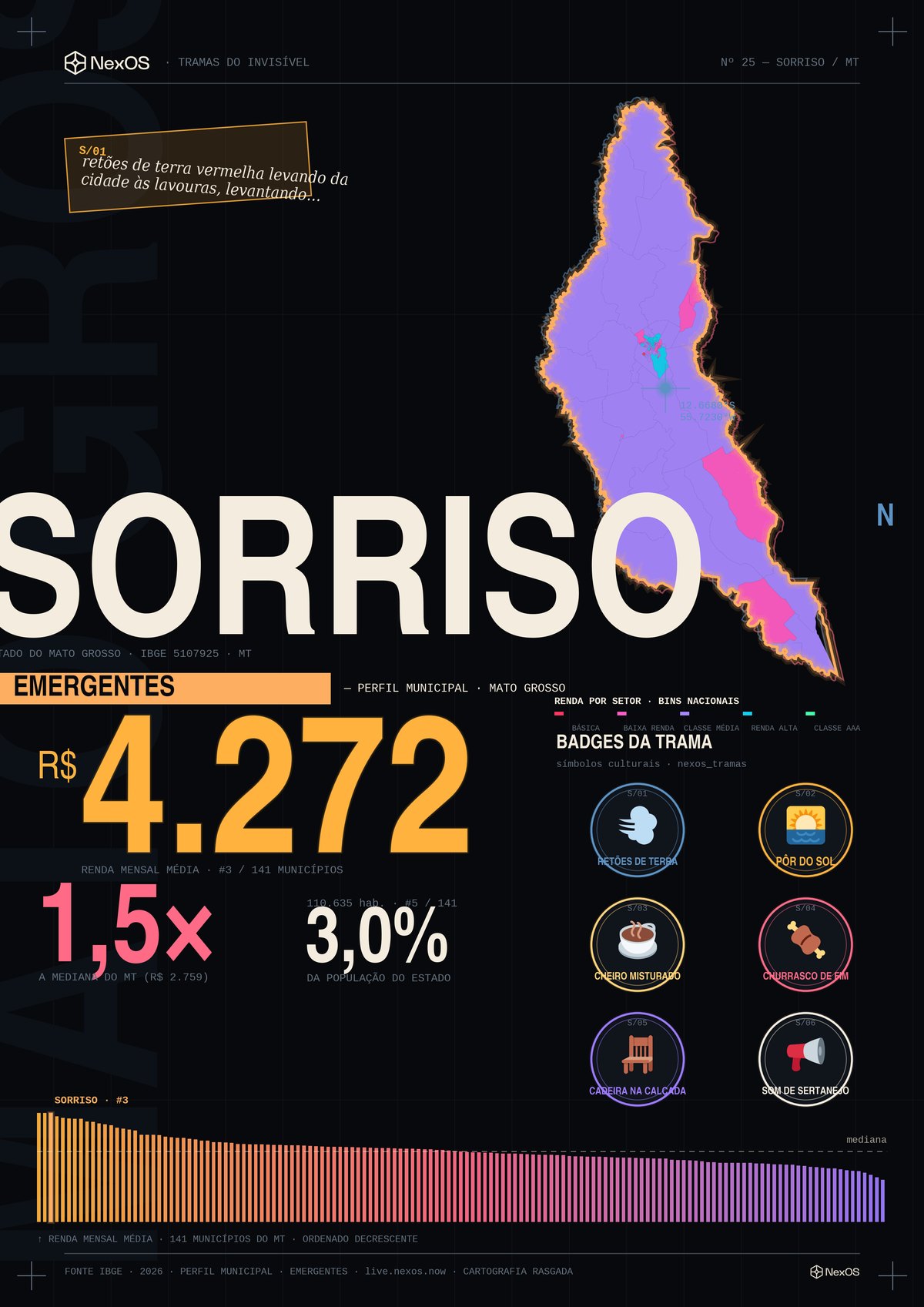
Create your city's poster, for free, at live.nexos.now/poster.
How Sorriso wants to be talked about
“Crossroads of the Harvests” is what the city’s own Trama profile calls it: a place of passage, where roads cross, trucks cross, people arrive from every corner of the country, and the price of a grain gets decided somewhere else. The soybean crop doesn’t change much from year to year, but the city’s wealth changes year to year, rising and falling with a number nobody in Sorriso writes. The loaded truck leaves down the highway, the freight becomes a disbursement recorded at BNDES, and local bank credit stays close to the same size it was two years ago. A lot passes through Sorriso. Less stays than it looks like.
Explore Sorriso’s X-ray on NexOS · City hall: sorriso.mt.gov.br · IBGE profile: cidades.ibge.gov.br/brasil/mt/sorriso. See also São Leopoldo and the 4-layer method.
This piece is part of the Tramas series, territorial intelligence as a method. Data cross-referenced by NexOS: IBGE (GDP, Census, agricultural production), BNDES (indirect operations by subsector), Banco Central (Pix, ESTBAN: credit and real estate financing), CadÚnico/Bolsa Família, DETRAN (vehicle fleet), ANATEL and curated local media inventory. Symbolic profile, invisible networks and classification: Tramas do Invisível methodology.

Americana, Brazil: nostalgic for the old street, but with fewer multigenerational households than the national average
Americana's Trama profile talks about surnames that repeat across neighborhoods and neighbors who know each other by sight, but NexOS's family archetype data shows only 12.09% of households are multigenerational.

São Carlos, Brazil: behind the tech-hub label, industry pulls 46.7% of BNDES financing, well ahead of trade and services
R$273.7 million in BNDES financing (910 operations) makes industry, led by machinery, the biggest borrower of development credit in a city that sells itself as a university hub.