

São Leopoldo, Brazil: industry runs 2x the national average, but the city behaves like a bedroom community
The bank credit shows that 58% of everything banks lend in the city finances real estate, more than triple Porto Alegre's share and on par with Cachoeirinha and Gravataí, classic bedroom communities of Greater Porto Alegre.


São Leopoldo’s GDP carries an industry that still accounts for 30.1% of the city’s value added, 2.1 times the national average: the kind of number that would back up the classic image of a factory town in the Sinos Valley, all metalworking shops, leather and the legacy of German colonization. But open up the local bank credit, and the story changes character: 57.9% of everything banks lend in the city finances real estate, a pattern much closer to Cachoeirinha and Gravataí, two classic bedroom communities of Greater Porto Alegre, than to any self-sufficient industrial hub.
The city’s own Trama profile calls it the “City of the Rails and the Sinos”: the Trensurb commuter rail organizes the time, work and encounters of the people who live there. It’s also the line that splits the two versions of São Leopoldo this X-ray walks through: the one that shows up in the GDP breakdown, and the one that shows up in the bank statement.
Wealth
A bedroom-community credit profile
Compared to its neighbors in Greater Porto Alegre, São Leopoldo’s credit doesn’t read like an industrial hub’s: it reads like the credit of a city where people sleep, while their economic life stays tied to somewhere else.
Upstairs: the industry the Sinos Valley left behind
São Leopoldo’s industry isn’t an empty facade. The city’s Trama profile describes whole families with some tie to Sinos Valley factories, workshops and metalworking shops, a direct legacy of an industrialization that, over the course of the century, layered onto the agricultural and colonial base of German immigration that gives the city its symbolic name.
The city recognizes itself as one of the gateways of German immigration into Rio Grande do Sul, with a memory of colonies, small landholdings and trades that shaped its neighborhoods. The Sinos River and the old railway logic helped organize the territory, connecting the city to the capital and to the Serra region long before Trensurb existed; industrialization in the Sinos Valley, over the decades, layered a factory-worker identity on top of that agricultural and colonial base.
In BNDES disbursements to local companies, metalworking received R$88.4 million and transport equipment another R$46.9 million, the largest blocks after road transport (R$264.8 million) and trade and services (R$158.7 million): development-bank money that still bets on the factory floor, not just the storefront.
The car dominates over the motorcycle in the local fleet (97,013 cars versus 25,520 motorcycles, nearly 4 cars per bike), and the most common models on the street are veterans long out of production: Volkswagen Gol leads by a wide margin, followed by Fiat Uno, Fiat Palio, Chevrolet Corsa and Ford Fiesta. Among motorcycles, the Honda CG dominates the top spots on its own.
The city’s own historical memory carries that same double mark. Alongside pride in its colonial origin, the Trama profile records the closing and shrinking of factories tied to the leather-and-footwear chain as a scar of unemployment still weighing on working-class families, alongside Sinos River floods as another recurring trauma.

Downstairs: where the credit actually goes
Anyone looking only at GDP misses the city’s second floor. Real estate financing accounts for 57.9% of everything banks lend in São Leopoldo as of December 2025, holding between 58% and 64% throughout 2024 and 2025 without ever dropping below that band: more than triple Porto Alegre’s share and ahead even of Novo Hamburgo, landing in the same territory as Cachoeirinha and Gravataí.
The Trama profile describes exactly that movement on the ground: areas near the Trensurb stations and around Unisinos university have been under pressure to build up, with small rental apartments, gated condos and commercial buildings replacing old houses and empty lots, while former industrial warehouses get converted into storage or new developments. Credit follows that same design: it doesn’t finance the next factory, it finances the next building.
What ties the two cities together: the train
The element that binds São Leopoldo’s two readings together is literally a line. The city’s Trama profile calls it the “City of the Rails and the Sinos” because it’s the train, more than the factory or the apartment building, that organizes the time of the people who live there: a packed platform in the morning, a factory shift change, a class at Unisinos, all running on the same clock.
NexOS’s family archetype data confirms that corridor-city profile. Young singles aged 25 to 39 make up 8.36% of households, above the national average of 7.14%; single-parent families add up to 7.74%, also above the 6.75% average; and multigenerational households, the arrangement most tied to one place, sit below the national average (13.21% versus 15.04%). It’s the demographic photograph of a city in transit: people who study there and work somewhere else, or the other way around.
Pix receipts in the city grew 43.9% in 2025 over 2024, jumping from R$20 billion to R$28.8 billion: the rhythm of people coming and going every day to study or work elsewhere also shows up in the money moving through the city.
And 18.9% of families still receive Bolsa Família, a sign that strong real estate credit coexists with real vulnerability, rather than replacing it.
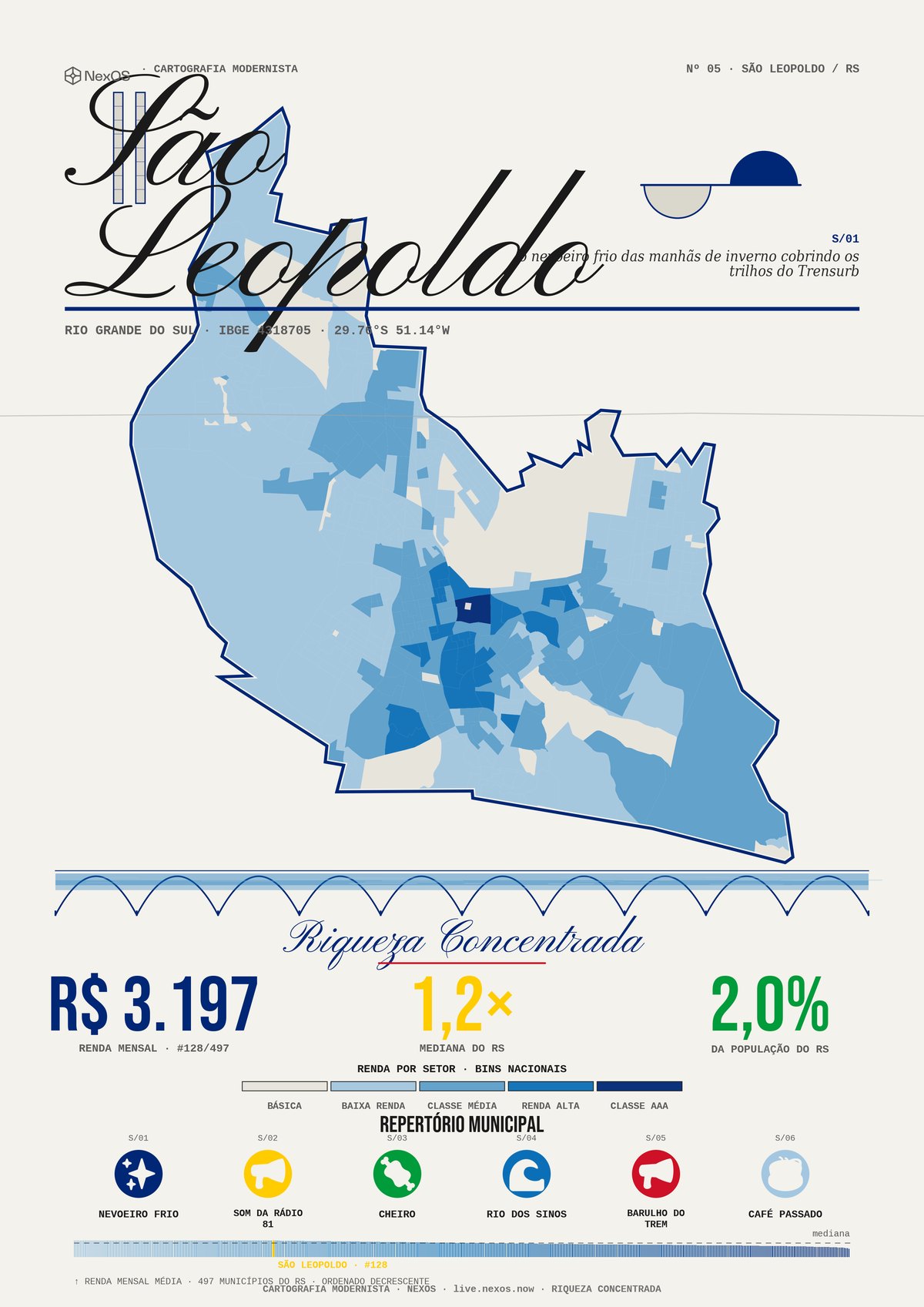
The “very high” purchasing power that NexOS assigns the city sits in tension with the average monthly income of the household head, at R$3,197 (#128 out of 497 municipalities in Rio Grande do Sul): part of the explanation lies precisely in abundant credit, especially real estate credit, propping up a level of consumption that declared income alone wouldn’t cover.

Radio in the ear, one site plugged into digital
The media profile NexOS assigns São Leopoldo is Local Oasis (Radio+Sites). Rádio 81 FM leads streaming audience (951 listeners/month), followed by Rádio Feitoria 87.9 FM (571), with Alegria Comunicação 92.9 FM and Rádio Progresso 81.9 FM rounding out the local dial with no streaming audience of their own measured.
In digital, only one of the 5 local sites mapped is plugged into programmatic media buying: metsul.com, with 4.85 million monthly pageviews focused on weather and storm alerts, carrying almost the entire mapped local traffic on its own. The others (berlinda.com.br, startcomunicacaosl.com.br, jornalvs.com.br, jornalsaoleo.com.br) sell only through direct deals.

Connected, but still in a light format
São Leopoldo’s connectivity infrastructure is nearly complete: 99.99% of the urban population and 100% of the rural area covered, classified by ANATEL as “100% connected territory (countryside + city).” Even so, creative capacity remains “low capacity” (audio, text and light image), not heavy video.
Coolita, a casual-games platform, shows the highest consumption intensity by a wide margin, ahead of Poki and Pinterest. In classifieds, OLX shows up with its own strength, and Correio do Povo, a traditional Porto Alegre newspaper, shows that part of the city’s news consumption still points toward the state capital rather than a hyperlocal outlet of its own. Domain by domain, by intensity of access per user:
Create your city's poster, for free, at live.nexos.now/poster.
How São Leopoldo wants to be talked about
Anyone stepping off the Trensurb in São Leopoldo on a cold, foggy winter morning crosses both cities in a few minutes on foot: the factory that still employs people and still draws BNDES disbursements, and the new building rising where a warehouse or a row house used to stand, propped up by credit that no longer bets on the former. Neither version cancels the other out: both live at the same address, and the train runs past both of them, every single day, at the same time.
Explore São Leopoldo’s X-ray on NexOS · City hall: saoleopoldo.rs.gov.br · IBGE profile: cidades.ibge.gov.br/brasil/rs/sao-leopoldo. See also Linhares and the 4-layer method.
This piece is part of the Tramas series, territorial intelligence as a method. Data cross-referenced by NexOS: IBGE (GDP, Census), BNDES (indirect operations by subsector), Banco Central (Pix, ESTBAN: credit and real estate financing), CadÚnico/Bolsa Família, DETRAN (vehicle fleet), ANATEL and curated local media inventory. Symbolic profile, invisible networks and classification: Tramas do Invisível methodology.

Americana, Brazil: nostalgic for the old street, but with fewer multigenerational households than the national average
Americana's Trama profile talks about surnames that repeat across neighborhoods and neighbors who know each other by sight, but NexOS's family archetype data shows only 12.09% of households are multigenerational.

São Carlos, Brazil: behind the tech-hub label, industry pulls 46.7% of BNDES financing, well ahead of trade and services
R$273.7 million in BNDES financing (910 operations) makes industry, led by machinery, the biggest borrower of development credit in a city that sells itself as a university hub.